

Top Ten Programming Languages- Comparison Guide to Choose the Best
Overview
Choosing the right programming language for your project can be a difficult task. You need to choose the language that fits your product or software, the platform you want to target, and the long-term project requirements. This practical guide on the top programming languages can help you find the right option.
Whether you run a business or a startup company, the decision of a programming language is crucial. It is because the language you select can affect development speed, hiring, maintenance, and security of your business software. In this detailed guide, we compare ten popular languages.
Before comparing languages, including Python and Rust, let’s go through their global popularity and points to consider for selecting the most suitable language. We will dig deeper into the comparison of languages from the perspective of a software development company.
Most Popular Programming Languages and Points for Selection
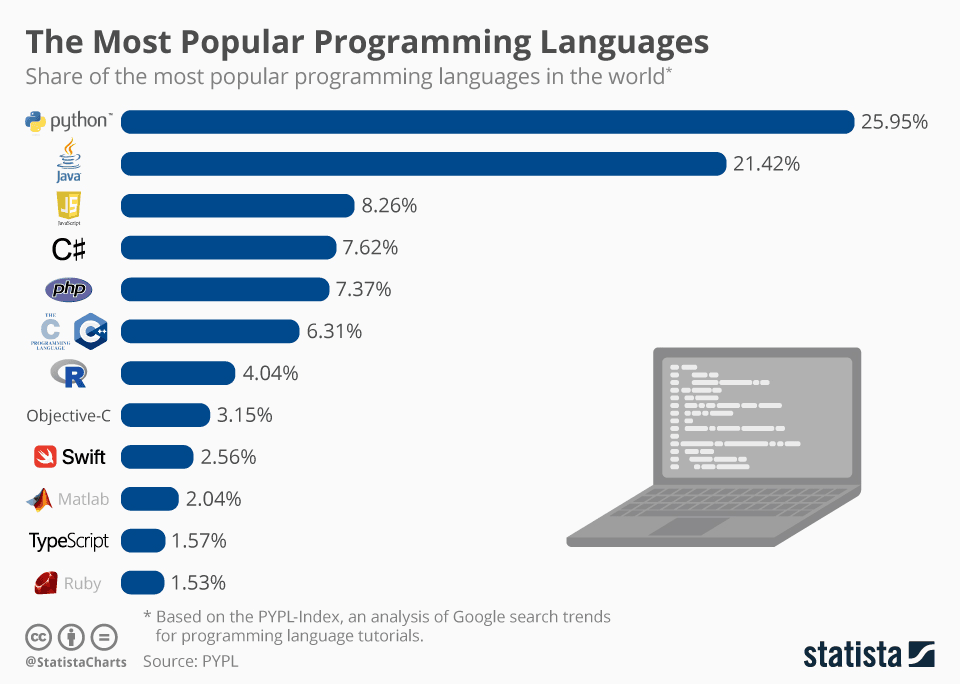
Popularity of programming languages can be a noteworthy factor; however, it is not the only deciding factor. As per a Statista survey, Python rules the chart with over a 25 percent share among popular programming languages. About a fifth of Google searches for the best programming language to learn are for Java. The following graph shows the percentages.
As per this graph, Python and Java are close competitors with over 25 percent and 21 percent market shares, respectively.
Source
When it comes to deciding the best programming language for developing enterprise applications, it is better to consider the following factors-
- Project requirement
- Platform
- Application performance
- Scalability
- Development Speed
- Availability of talent
- Ecosystem
- Maintenance
A comprehensive programming language comparison can help you decide the right option as it covers all these aspects. Alternatively, it is better to consult a reputable mobile app development company that offers end-to-end software development solutions.
Comparison of Programming Languages
Python is the most widely used programming language for developing advanced software. Here is the list of the top ten programming languages from which you can choose the right option.
Python
It is a highly flexible and scalable programming language because of its simple syntax and vast ecosystem. An easily readable syntax makes Python one of the most accessible programming languages for beginners.
Whether you need to develop an AI/ML-enabled or a data science-related solution, you should consider Python. It is an ideal choice for developing backend systems, web applications, scripting, etc.
Python is usually not the first choice when raw execution performance is the main requirement. In such cases, C++, Rust, or Go are more suitable languages.
JavaScript
This is a preferred choice for web development projects. JavaScript was introduced as a browser-based scripting language primarily. It has evolved into a broad development technology in recent years. Developers use it for server-side development with environments like Node.js.
JavaScript is highly useful for developing interactive websites, web applications, backend services, real-time applications, and cross-platform applications. Frameworks and libraries such as React, Angular, and Vue have expanded their roles these days.
It is better to choose JavaScript for a web-based project. It is particularly beneficial for organizations that want interactive UI and availability of developers. It is, however, necessary for development teams to implement architecture management to avoid complexity.
Java
This has been a major enterprise programming language for decades. Java is a portable and capable language with a mature ecosystem for developing large-scale applications. It follows object-oriented programming (OOP) principles.
Developers widely use Java for developing enterprise software, backend systems, financial applications, large-scale web applications, and cloud-based solutions. Spring and Spring Boot are some of the mature frameworks of Java’s ecosystem.
Java can require more code and structure than some newer candidates in programming. It is, however, beneficial for developing a large application that needs long-term maintainability and extensive enterprise integration.
C++
This language focuses on performance by giving extensive control over memory and system resources. Software developers use C++ to create applications that require high performance, efficiency, and close-to-the-hardware control.
Some of the common uses of the C++ programming language include operating systems, embedded systems, real-time systems, performance -critical applications, and game engines. This language is essential for the creation of applications that run close to the hardware.
C++ is not among the easiest programming languages for beginners. To be able to use this language, software developers should have knowledge of memory management, pointers, and resource management.
C#
This is a versatile language from Microsoft. Developers use C# to build applications that are part of the Windows operating system environment or any other environment. It is very suitable for use with the .NET framework.
C# is useful for developing enterprise-level software, web applications, Windows applications, and games. The Unity game engine makes C# relevant for developers to build engaging gaming applications.
If an organization has already invested in the Microsoft ecosystem or if it wants a modern language with a mature framework, C# is useful. Another emerging usage of this language is in game development.
Go
Go, also known as Golang, is a Google-backed language. It is simple, efficient, and highly concurrent. Golang is useful for building high-performance applications. It is also useful in cloud services, backend APIs, DevOps tools, and distributed systems.
The concurrency model of Go provides language-level features to make programming more approachable than some lower-level languages. Go is a strong candidate for developing backend services where performance and simplicity matter.
Go does not offer many libraries for every specialized domain like older ecosystems such as Java or Python.
PHP
It has been around for a long time and is still relevant because of its connection to web development. PHP was designed for server-side web development and continues to power much of web infrastructure.
Modern PHP is considerably more capable than its previous versions. PHP is a great choice for web-based projects, particularly when you already have PHP skills or must maintain an existing application.
You should consider contacting a software development company for using PHP in an upcoming project.
Rust
This programming language has become popular for offering a combination of low-level performance along with memory safety. Performance is excellent in system programming; however, problems arise because of memory-related bugs.
Rust can resolve these issues with its ownership and borrowing model. This model prevents many classes of memory errors at compile time. Rust is useful for systems programming, security-sensitive applications, embedded systems, etc.
Rust has a difficult learning curve because of the ownership model. It is, however, worth considering when your company needs high-performance applications with stronger safeguards against memory-related issues.
TypeScript
It extends JavaScript by adding static typing and other features that make large codebases easier to manage. TypeScript is particularly useful for teams working on complex frontend or full-stack applications where maintaining consistency is difficult.
TypeScript offers advantages in code maintainability, refactoring, IDE support, and developer tooling. As this language compiles to JavaScript, developers can continue using the vast JS ecosystem.
TypeScript is a strong choice for medium and large web applications, especially when multiple developers work on the same codebase.
Swift
Apple has created this language to develop applications within its ecosystem. It is a modern, developer-friendly programming language and mainly useful for developing applications for iOS, iPadOS, macOS, and tvOS.
This programming language has a clear and concise syntax along with type safety and high performance. It interacts with the native frameworks of Apple, namely SwiftUI, UIKit, and Core Data. Swift provides a good balance between performance, security, and ease of development. Swift offers a perfect solution for iOS application development.
A mobile application development company can help you select the appropriate programming language. It is fair to say that the developers should take into consideration a number of factors rather than choose a programming language according to its popularity.
For instance, one business may be interested in developing a custom native application. This business should prioritize platform-specific technologies. Another may want to develop an application for a range of platforms. This business should opt for cross-platform development.
Comparing Top Programming Languages
A simple ranking of the most popular programming languages list is not sufficient for choosing the appropriate option. Here is a quick table that compares all ten languages with their strengths, use cases, and learning curves.
| Language | Core Strengths | Common Use Cases | Learning Curve |
| Python | Simplicity, versatility | AI, data, backend, automation | Low |
| JavaScript | Web ecosystem | Frontend, backend, web apps | Moderate |
| Java | Enterprise-level maturity | Backend, enterprise systems | Moderate |
| C++ | Performance, control | Games, systems, embedded | High |
| C# | .NET ecosystem | Enterprise, web, games | Moderate |
| PHP | Web development | Website, CMS, eCommerce | Low-Moderate |
| Go | Simplicity, concurrency | Cloud, APIs, microservices | Moderate |
| Rust | Performance, memory safety | Systems, infrastructure | High |
| TypeScript | Maintainable JavaScript | Large web applications | Moderate |
| Swift | Modern, safe, fast | iOS, iPadOS, watchOS apps | Moderate |
This table is just a starting point. A reputable software development company can help you select the right language.
Team expertise, project architecture, business objectives, and existing infrastructure are some of the decision drivers.
Right Language Should Change as Your Product Evolves
Modern business systems use multiple languages where each offers a practical advantage. For example, a company can use TypeScript for a web interface, Python for AI services, and Go for backend infrastructure. This approach can work well when the architecture justifies it.
Here, the objective should not be to use as many languages as possible. Instead, the smallest practical technology stack is useful to meet your project requirements.
Want to build customized software to drive growth for your business?
LET’S CONNECTConcluding Remarks
There is no single winner among the top programming languages. The best programming language to learn for beginners is the one that aligns with the software type. For businesses, the best programming language is the one that offers high availability, scalability, and long-term support.
A good programming language should solve a problem rather than creating one. It is better to start with product requirements and work backward instead of selecting the most popular language for your project. Programming language comparison can certainly help you make the right decision.


 Have an Idea?Let’s Build It Together!