

18 Golang Frameworks for Developers to Build High-Performance Apps

Introduction
A Go project needs the right decision about the framework from all available options. Software development teams should consider the framework that helps them deliver a scalable application. Here, the programming language is only one part of the equation. The framework makes up the second part, ensuring how quickly you can launch, scale, and maintain a customized, scalable application.
A reputed Golang web development company can balance performance, maintainability, and deployment requirements for any application. Development teams, however, spend weeks deciding the right framework for maintaining this subtle balance. It is necessary to choose a framework in line with the project needs and business objectives. When it comes to evaluating Golang frameworks for developers, the right choice depends on the type of application.
This guide shows the top Golang frameworks available across different categories. It will help you choose the most suitable framework to build modern, high-performance, and scalable applications.
Top Golang Frameworks for Developers
The Stack Overflow Developer Survey 2024 has revealed that Go is one of the most preferred languages. Though it is not in the top five programming, scripting, and markup languages, the survey shows that about one in every seven developers uses Go.
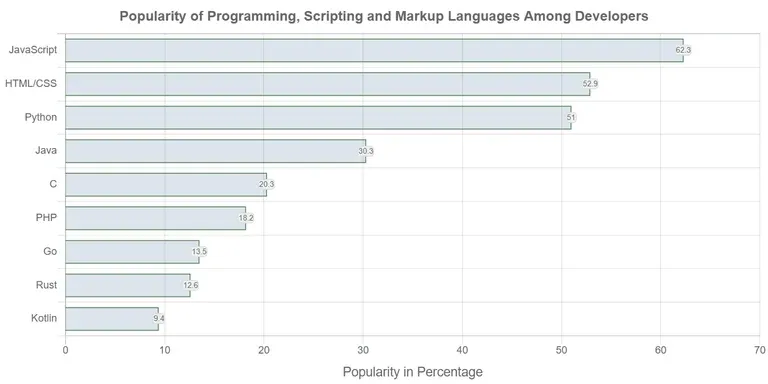
Source
High concurrency requirements, distributed architectures, AI service integration, and real-time data processing are some of the challenges of modern applications. Go frameworks for scalable applications have some noteworthy features like quick request handling, middleware support, and long-term maintainability with active community support. Here are 18 top Golang frameworks for AI-powered applications with high performance.
Web and API Frameworks
Gin
It remains one of the most widely used Go frameworks for developing REST APIs and microservices. It offers exceptional speed and a straightforward API design to make high-performance web applications. A reputable Golang web development company chooses Gin to maintain a balance between simplicity and performance.
Fiber
This framework is built on Fasthttp. Developers migrating from JS ecosystems find Fiber intuitive because of its familiar syntax. Fiber is useful for building startup MVPs and high-concurrency applications. It is one of the most discussed Go frameworks for scalable applications, as it offers impressive performance benchmarks.
Echo
It combines speed with a wide set of features. It's built-in middleware ecosystem reduces development effort and assists developers in maintaining performance. It is a better framework for enterprise API development and cloud-native services. Echo is a go-to choice for a team of developers that needs speed and extensive middleware support.
Iris
This framework focuses on speed with extensive built-in functionality. It is a preferred choice for developing real-time applications, enterprise systems, and large-scale APIs. It extends support for MVC structures and WebSockets as well. Iris is useful when teams need flexibility and performance together.
Fasthttp
This platform prioritizes maximum performance. It serves as a base for high-speed applications. It, however, cannot work as a complete framework. Fasthttp is suitable for custom frameworks, heavy-traffic systems, and services that require ultra-high performance. Fasthttp is ideal for building applications that require very low latency.
Microservice & Cloud-Native Frameworks
GoFrame
It incorporates a wide range of tools to support APIs, microservices, command lines, and distributed architectures. This can be an excellent option for creating and implementing cloud applications. GoFrame has gained popularity for having a sophisticated backend architecture.
Micro
As a cloud-based microservices platform, Micro makes the development, implementation, and management of applications easier. It supports service discovery, API gateways, message queues, and authentication mechanisms. Micro is ideal for cloud-native applications and distributed enterprise environments.
Heartz
It concentrates on scalability and performance in highly distributed settings. The framework offers strong support for service communication patterns. If the Golang web development company intends to work with distributed systems and large-scale APIs, Hertz will be a great choice.
Kratos
This platform is specifically designed for microservices. It includes service governance features and supports clean architecture in cloud platforms. This framework will prove effective when creating service-oriented systems and enterprise-level architectures. It ensures consistency in developing large service ecosystems.
Web & Full Stack Development Frameworks
Beego
The framework employs a full-stack MVC approach. Being one of the top Golang frameworks for developers, it features ORM, sessions, caching, and logging functionalities. Beego is perfect for developing enterprise-level systems, business-level applications, and highly sophisticated backend systems. Organizations that need multiple features use Beego due to its detailed architecture.
Revel
The framework is among the earliest full-stack frameworks in Go. It comprises routing, testing, validation, and templates in an organized environment. The framework can be employed in developing conventional web applications and projects requiring fast development. Programmers prefer Revel for convention-driven development.
Buffalo
It offers Golang developers an integrated package of features. Instead of assembling several libraries to develop applications, developers enjoy a fully integrated system in Buffalo. It is useful for full-stack web development. Developers use this framework to build startup platforms and customized SaaS products. It reduces setup time significantly.
Flamingo
It is a full-service Go framework useful for developing large-scale and complex web apps. It follows a modular architecture and offers features including dependency injection, routing, configuration management, etc. It is best for developing large-scale eCommerce platforms and modular business systems.
Martini
It introduced middleware handling to the Go web development process. It is ideal for smaller projects and learning middleware patterns. Many modern frameworks show a visible influence from Martini. Though it is an older framework compared to other ones, it remains relevant and important.
Minimalist Routers and Toolkits
Chi
This router offers lightweight routing and composability. It gives flexibility to developers. The core advantage of Chi is that it does not enforce strict architectural decisions. It is good for building lightweight APIs, custom architectures, and microservices. Development teams that like assembling their stacks prefer Chi.
Mux
It provides powerful URL routing. Mux becomes critical when you need flexible routing rather than full-stack functionality. Mux becomes the most suitable framework for API and module development. In addition, it is helpful for routing challenges. Many developers use this framework due to its reliability and simplicity.
GoFr
It is one of the top Golang frameworks when it comes to developing RESTful APIs, MVPs, and lightweight applications. This framework allows developers to develop routing, middleware, and observability without facing many complexities. Developers who prefer clean and efficient architecture use this framework due to its quick development.
Gorilla Toolkit
The Gorilla Toolkit is a highly influential toolkit within the Go ecosystem. It has built-in routing and WebSocket capabilities that support many production systems. This framework is ideal for making WebSocket applications and custom web servers. Many existing Go applications rely on Gorilla components to date.
Best Frameworks for AI-Powered Applications
The corporate sector has witnessed revolutionary changes due to the rise of generative AI. Even developers have started leveraging this technology to build the backend. It is, however, essential to select the most effective Golang frameworks for AI-powered applications according to several characteristics. Some of these capabilities include model serving, real-time processing, and API communication.
Here is a quick table of AI-friendly frameworks for Go.
| Go Framework | AI App Strength |
| Gin | Fast AI API endpoints |
| Fiber | High-throughput inference services |
| Echo | Secure AI integrations |
| GoFrame | Distributed AI platforms |
| Kratos | AI microservices architecture |
| Go Kit | Enterprise AI service orchestration |
It is fair to say that AI shortcomings do not occur inside the framework. In most cases, latency originates from model inference, external API calls, or network communication. It is, therefore, essential to choose a framework with strong concurrency support. Such a framework is better than any other framework marketed for AI workloads. Companies can consult a reputable Golang web development company.
When a Custom Approach Makes More Sense
The reality is that not every project requires a full framework. When it comes to developing highly specialized systems, it is necessary to combine Go’s standard library with targeted packages. It can give more flexibility and reduce overload. This approach works well in several circumstances. For example, when developers have extreme performance requirements and a narrowly defined app scope.
When development teams need full architectural control and dependency management has become a priority, the custom approach is more useful. The exception is developing an enterprise project that has multiple contributors. Established frameworks are necessary in such scenarios.
Looking to Hire Dedicated Golang Developers for Building Enterprise Applications?
LET’S CONNECT!Conclusion
There is tremendous flexibility in using the GO programming language for building an application with the latest trends and techniques. You need a Go framework for creating APIs, enterprise platforms, SaaS, or AI-powered solutions. You can consider several aspects, such as architecture, capabilities, and overall business objectives, to choose the best-suited Go framework. A leading Golang web development company can assist in selecting the right framework.


 Have an Idea?Let’s Build It Together!