

11 Best Mobile App Development Platforms for Modern Apps
Introduction
Mobile applications have become a significant part of everyday life. They may be used for different reasons like buying, banking, communication, entertainment, learning, etc. In business, the use of mobile apps can help companies reach out to consumers and generate more revenue. In addition to having a good idea, developers need the right tools to develop the app.
Mobile app development platforms provide developers with access to the tools that are necessary to develop, test, deploy, and maintain the application. There are some platforms that only allow the development of one particular operating system, such as Android or iOS. Some others help developers build cross-platform apps.
There are many mobile app development platforms available to build an enterprise-grade solution. It is not easy for developers to find the best platform to meet their project requirements. Here are the 11 most popular platforms and frameworks that developers should consider.
Mobile App Development Frameworks - Market Trends and Adoption
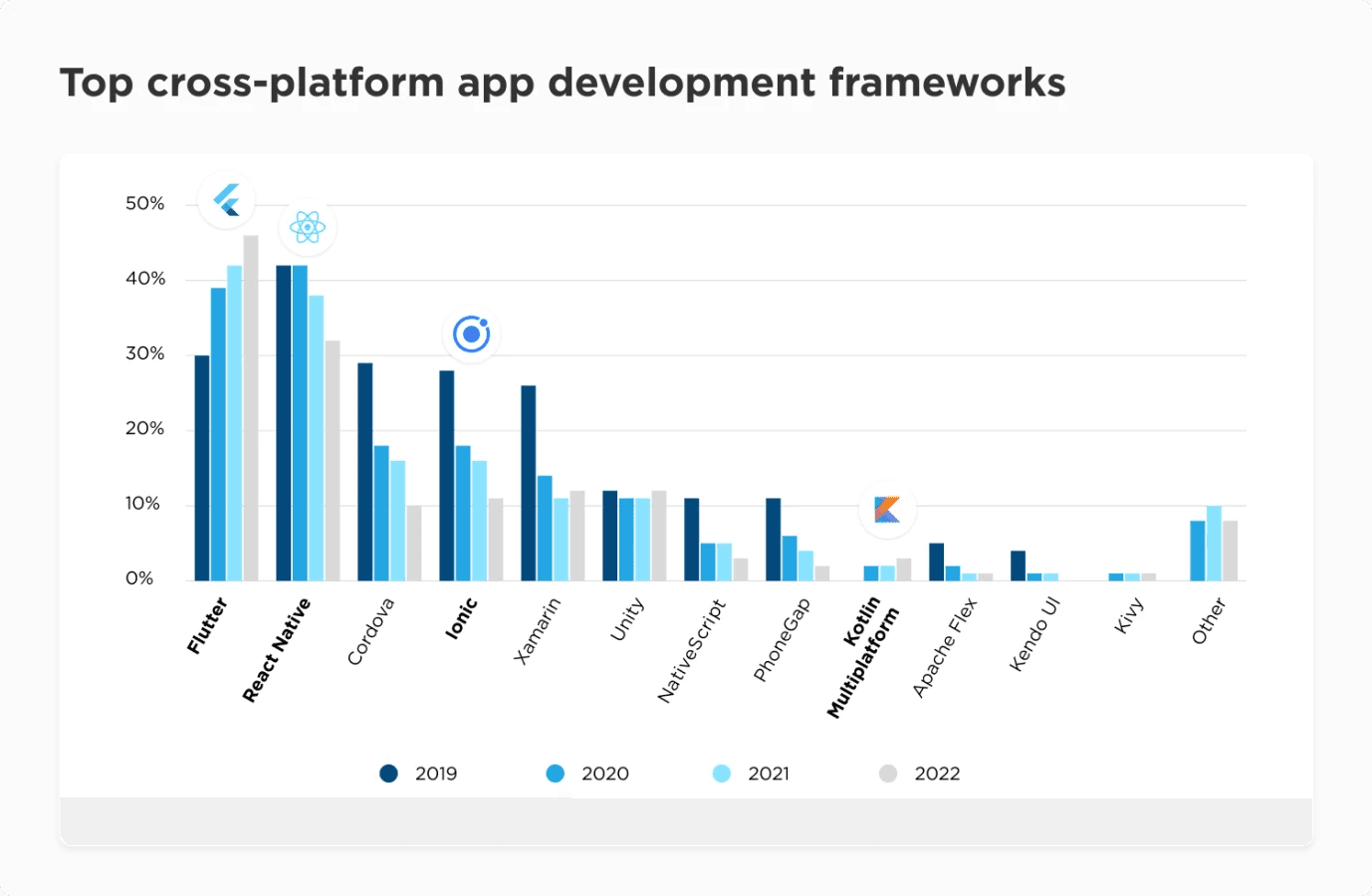
The rise in the demand for mobile apps has led to an increasing requirement for effective frameworks for mobile application development. Business organizations and developers prefer to use technologies that can help them save time by developing applications for multiple platforms simultaneously.
Flutter and React Native are the most popular cross-platform frameworks. Developers are able to develop an application for multiple platforms through a single codebase using these frameworks. There are other frameworks and technologies like Ionic, Xamarin, Unity, NativeScript, PhoneGap, Apache Flex, Kendo UI, etc., but the usage of these varies according to the purpose.
Unity differs greatly from other frameworks such as Flutter and React Native. Unity is a popular framework for mobile game development and 2D and 3D apps. These apps involve simulation, and they have complex graphics. Flutter and React Native are utilized in business and consumer app development.
A cross-platform framework is a good choice for companies that target Android and iOS users. This framework assists companies in making an app for both operating systems without separate code bases. Native development tools are a good choice for applications that demand deep platform integration.
Popularity statistics can give some useful information. Businesses can make a decision on frameworks according to the needs of their applications.
Flutter
Flutter is an open-source software development kit (SDK). It is a Google-backed, robust, cross-platform toolkit for developing applications for Android, iOS, web, and desktops.
With Flutter, developers can write once and deploy across different platforms without writing the same code twice.
The framework uses the Dart programming language. The built-in widgets allow designers to build the user interface easily.
React Native
Created and supported by Meta, React Native is one of the most commonly used frameworks for app development.
It allows programmers to develop applications for Android and iOS platforms via JavaScript and React. A large amount of code can be shared across various platforms. It reduces the development time significantly.
This framework is especially useful for organizations that use JavaScript and React technologies.
As a cross-platform development framework, it is useful for startups and organizations that employ a JavaScript development team.
Xamarin
It is a Microsoft-backed cross-platform mobile application development framework. Developers can create apps for both Android and iOS using Xamarin. They can build mobile apps using the C# and .NET programming languages. They can also share their code across different platforms and still access the native device capabilities.
Xamarin is ideal for companies that are operating within the Microsoft environment and have developers who are familiar with C# and .NET. Developers are able to cut down the coding work by sharing code across various platforms.
Xamarin is ideal for cross-platform mobile apps and companies familiar with C# and .NET.
.NET MAUI
.NET MAUI (Multi-platform App UI) is a cross-platform tool. This tool allows developers to create applications for Android, iOS, Windows, and macOS platforms using C# and .NET programming languages.
It is ideal for enterprises that utilize Microsoft technologies because their developers may already have the relevant knowledge to work on such applications.
Developers can reuse a considerable portion of the application code.
It is best suited for enterprise applications and enterprises using Microsoft technologies.
Kotlin Multiplatform
With Kotlin Multiplatform, programmers can share the application code across multiple platforms.
In other words, developers can share business logic and data-related code while simultaneously developing the platform-specific part of the application.
Thus, developers get the advantages of code-sharing but do not lose the native functionality.
It is best suited for applications for Android and iOS with code-sharing and native functionality requirements.
Ionic
The Ionic framework is used to create mobile applications using web technologies such as HTML, CSS, and JavaScript.
The Ionic framework can operate with other web frameworks such as React, Angular, and Vue.
With the ability to develop the framework using web technologies, developers can easily adopt this tool in mobile application development.
It is best suited for business applications and simple applications.
NativeScript
NativeScript is an open-source framework that allows developers to create mobile applications using JavaScript and TypeScript.
The framework provides features to use the native capabilities of the devices. Developers can build cross-platform applications using native capabilities.
It is best suited for cross-platform applications and organizations with experience in JavaScript and TypeScript.
Unity
It is mainly beneficial for creating gaming applications. It is also useful for building apps that require advanced graphics or interactions.
It allows building both 2D and 3D applications. Developers can build applications for Android and iOS devices.
Unity is not required for creating a business application.
A mobile application development company with skilled developers can help businesses choose the right approach according to their project requirements.
Apache Cordova
Using Apache Cordova, developers can build mobile apps using technologies such as HTML, CSS, and JavaScript.
Apache Cordova will package the app using web technologies and run it on a mobile platform using different functionalities of the device through plugins.
It is best for developing simple mobile and web apps.
SwiftUI
Apple has created SwiftUI, which helps developers create interfaces.
This technology works using the Swift language and uses an innovative approach to interface creation. With its help, it is possible to create applications for iPhone, iPad, Mac, Apple Watch, and other Apple devices.
It simplifies the process of interface development. It is well-integrated into the Apple development environment.
It is best for contemporary iOS apps and companies operating in Apple environments.
Kivy
Kivy is an open-source framework that is used in cross-platform application development using the Python programming language. Kivy allows building applications for various platforms like Android and iOS using a shared codebase.
The framework enables multi-touch capabilities and can be used to develop applications with custom user interfaces.
The Kivy framework may prove useful for developers and organizations with knowledge of Python.
How to Choose the Right Platform for Mobile App Development
Selecting the right mobile application development platform should not be based on just the popularity of the platform.
Considerations for choosing the right platform are
Target OS
In the first place, determine which operating systems you are designing the application for.
If you are making a native Android app, you can use Android Studio. In case of a native iOS app, you can opt for Xcode and SwiftUI.
To create apps that run on both Android and iOS, cross-platform frameworks such as Flutter and React Native are useful.
App Features
Think about what problems your app is designed to solve.
A simple business application does not have the same requirements as a mobile game or an app that uses advanced device features.
Make a list of the key features before choosing your technology.
Performance
Performance is important for the best user experience.
When you require high performance and certain functionalities, native app development is a good choice.
However, in some cases, cross-platform solutions can be very efficient and swift.
Development Team
Think about your development team’s skill set.
For instance, JavaScript developers will not have difficulties with building an application in React Native or Ionic, while C# developers will feel more confident with .NET MAUI.
Cost and Development Time
It is better to consider the cost and the mobile application development time.
Cross-platform app development can reduce effort by allowing teams to reuse code across platforms. The actual cost of app development depends on several factors, including development complexity, functionality, integration, testing, and maintenance.
The company that provides mobile app development services can help you estimate all this before the development starts.
Long-Term Maintenance
The app requires regular updates after its launch.
Operating systems change, requirements shift, and user expectations change with time.
Choose a platform that provides documentation and community support for developers.
Selecting the right mobile app development framework can simplify the development process and maintenance.
Want to make a customized business app for your enterprise?
LET’S CONNECTFinal Thoughts
Choosing a mobile app development platform is a critical factor in simplifying the development process. Some of the trending mobile app development platforms are Flutter, React Native, Xamarin, .NET MAUI, Kotlin Multiplatform, Ionic, NativeScript, Unity, Apache Cordova, SwiftUI, and Kivy.
It is better to consider the target audience, functionalities, performance criteria, budget, developers, and future expectations than to opt for the popular platform. An experienced mobile app development services provider can assist you in selecting the suitable platform for your specific requirements.
Silicon IT Hub is a renowned mobile application development company that provides comprehensive solutions tailored to meet specific business needs. Our team of development experts can assist your company in building an advanced and future-ready application.


 Have an Idea?Let’s Build It Together!