

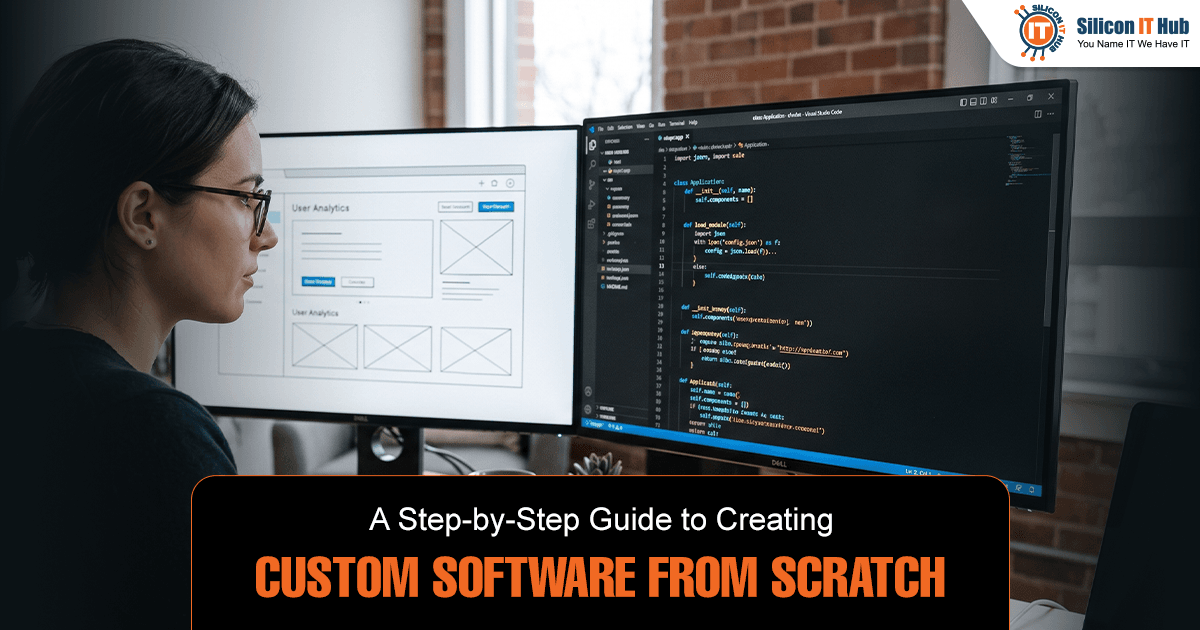
Transforming Ideas: Guide to Creating Custom Software from Scratch
Introduction
Many businesses struggle because of investing in irrelevant software. No off-the-shelf platform can give a big return on investment. It comes from scalable software solutions that fit your internal processes and evolve alongside your business. This is a major reason why global organizations rely on customized software instead of generic applications for driving digital transformation.
An effective custom software development guide enables companies to get a successful solution. It starts with understanding business requirements, identifying workflow issues, and planning a solution that delivers value for a long time. It is fair to say that businesses should treat software as their strategic asset to achieve better operational efficiency and higher returns on investment. The software development process, however, may seem complex.
Whether you want to build a SaaS platform or to modernize existing systems, each decision you make involves cost, scalability, maintenance, and future innovation. This detailed guide to creating custom software covers every aspect of the process from idea validation to deployment. We can start it with a glimpse of business problems and the features of scalable, enterprise software.
Overview of Business Problems
Identifying business problems is the first step for developing custom software from scratch. This can help companies get measurable outcomes from the customized solution. For example, one company builds a customer portal to address competition, and the other develops it to reduce customer onboarding time. Here, the second company can get a measurable objective for the tailored solution and improve its decision-making process.
You can find the business issues before hiring a custom software development company in the USA. Here are some of the points that can help you find the issues-
- Identifying the processes that need improvement
- Finding target audience and users that interact with the application
- Defining measurable outcomes for determining success
- Reviewing existing systems that need integration
- Listing operational problems that cost your business the most
These aspects can assist you in preventing unnecessary development and increasing the chances of seamless adoption.
Another important factor is to make a list of software capabilities that assist you in achieving business goals. A reputable custom software development service provider can guide you throughout this process. Here we give a quick table containing different business objectives and respective software capabilities.
| Business Objectives | Software Capability or Functionality |
| Reduce customer response time | Automated ticket routing |
| Increase sales conversions | Personalized recommendation engine |
| Improve operational efficiency | Workflow automation |
| Reduce manual reporting | Real-time analytics in dashboard |
| Improve compliance | Automated audit logs |
This approach enables companies to leverage the features of customized software.
Step-by-Step Guide to Creating Custom Software
Creating custom software involves several steps, ranging from idea validation to design and development to deployment. Here is a step-by-step guide to custom software development.
Step 1. Idea Validation
This is a major step to reduce risks associated with the custom software development process. Many software projects fail because teams begin development before proper validation. The validation of the idea requires including factors like
- Stakeholder workshops
- Customer interviews
- Competitor analysis
- Technical feasibility test
- Regulatory evaluation
This stage assists companies in getting rid of assumptions that would otherwise become expensive mistakes in the development process. It is better to document every user’s role in the software. Companies can map their daily tasks to get the crucial information on missing requirements before development begins.
Step 2. Identify Requirements
Ambiguity in documentation leads to complex and complicated software for users. Identification and detailing of functional requirements are necessary to understand what the application must accomplish. Here are a few examples of key requirements-
- User authentication
- Role-based permissions
- Workflow approvals
- Payment processing
- Notification systems
- Third-party integrations
It is also necessary to define exceptions. For example, what happens if a payment gateway becomes unavailable for some reason? How should the application respond when inventory reaches zero? When the development team addresses these scenarios early, companies can reduce redesign costs significantly.
Step 3. Design Architecture
Many businesses underestimate architectural decisions for their software. It is because they consider such decisions irrelevant for users. Architecture, however, can determine scalability, security, maintainability, and future expansion of tailored software. A modern software architecture includes cloud infrastructure, API strategy, database design, authentication systems, security frameworks, and disaster recovery planning.
The software development company includes performance optimization and microservices versus monolithic architecture. Developers build scalable software solutions from the beginning for companies that expect rapid growth. It is fair to say that ignoring future expansion can be disastrous for growth-oriented companies. For example, software that supports 5000 users today may need to support 500k within three to five years.
Step 4. Build User Experience
This is one of the most important steps to consider. No company can afford poor usability of their software, even if the solution offers excellent functionality. Prototypes and wireframes are useful in validating the navigational process, workflow, and user journey.
When it comes to user experience, there are several criteria that designers need to evaluate. Some of them include simplicity of navigation, accessibility, mobile friendliness, visual consistency, and patterns of user interactions. Designers choose prototype testing because it helps identify usability problems in advance. Workflow visualization will help stakeholders determine necessary functionality.
Step 5. Choose Methodology
The next essential step is execution. A disciplined and structured development process is required for developing successful software. In contemporary software development processes, developers don’t wait till the completion of the whole application to release it. Rather, they release their modules in the development cycles, receive feedback, and make improvements to their final product.
Agile development offers greater flexibility than the conventional waterfall development model. It is because the agile development process can deal with the changing requirements of the stakeholders better than the waterfall model. Here is a brief description of the waterfall and agile software development approaches.
| Waterfall Development | Agile Development |
| Fixed requirements at the beginning | Requirements evolve through iterations |
| Long release cycles | Frequent incremental releases |
| Client’s feedback arrives late | Continuous collaboration with stackholder |
| Higher redesign costs | Faster adaptation to changing needs |
| Limited flexibility | Improved responsiveness and innovation |
This does not mean Agile suits every project. It is better to consult a reputable custom software development company to get assistance in selecting the right methodology.
Step 6. Select Technology
Choosing the most suitable technology as per the project requirement is crucial to get the desired outcome. Every decision related to the technology stack affects future maintenance, scalability, security, and operational costs of the company. An experienced custom software development company in the USA considers the factors, including
- Expected user volume
- Integration requirements
- Development timelines
- Security standards
- Long-term maintenance
- Performance expectations
- Developer availability
For example, a customer-facing SaaS platform works well on React, Node.js, Kubernetes, PostgreSQL, and AWS. An enterprise manufacturing platform, however, could require .NET, Azure, SQL Server, and advanced ERP integrations.
Step 7. Develop Features
A phased approach enables companies to validate assumptions while delivering value. Usually, developers organize releases into three phases-
- Minimum Viable Product (MVP)
It focuses only on essential business functions, including user registration, authentication, core workflows, reporting, and basic integration.
- Operational Enhancements
Developers include additional functionality like advanced analytics, AI-powered recommendations, and workflow automation on the basis of user feedback.
- Business Expansion
Once software adoption grows, companies introduce niche features such as enterprise security, advanced reporting, multilingual support, and multi-region deployment.
This structured development roadmap prevents software from becoming unnecessarily complex before users can validate it.
Step 8. Build Security
Many companies treat cybersecurity as the final phase of development. A modern software development approach, however, rejects this concept because it is difficult to remove vulnerabilities introduced during development. This is a reason why security should be integrated into every stage of development. Developers focus on
- Secure authentication
- Role-based access control
- API security
- Data encryption
- Secure coding standards
- Automated vulnerability scanning
Ignoring security in custom software does not save money. It usually increases operational risks and associated costs. Businesses may face difficulty in meeting compliance and maintaining their reputation when security is compromised.
Step 9. Test Performance
Testing is essential for quality assurance and consistent performance. A modern software testing process evaluates the complete user experience under real operating conditions. A comprehensive testing method includes functional testing, performance testing, load testing, regression testing, compatibility testing, and user acceptance testing (UAT).
As a leading custom software development service provider, we have observed that user acceptance testing identifies workflow improvements instead of software defects. Business users suggest refinements only after interacting with realistic scenarios frequently. This makes UAT one of the most useful phases of software development.
Step 10. Deploy Software
Successful software deployment requires operational planning, tool monitoring, user communication, and even rollback procedures. The software development company includes the following aspects in deployment planning-
- Infrastructure validation
- Database migration
- Performance monitoring
- Security validation
- User onboarding
- Staff training
- Support readiness
It is better to treat software deployment as an operational milestone rather than a technical release.
This guide to creating custom software can assist companies in getting an effective solution for handling their business processes. It is, however, important to ensure that this bespoke software has the necessary integration capabilities to create long-term value. Another noteworthy aspect is that companies should avoid common mistakes that disrupt software development projects.
Common Mistakes that Disrupt Software Development Projects
Many development projects exceed budgets or fail to deliver expected results because of planning gaps. It is, therefore, necessary to recognize these risks early to make better decisions throughout the project.
Some of the common mistakes organizations make are building too many features too soon, ignoring user adoption, choosing technology before defining requirements, and neglecting long-term maintenance. Several companies underestimate the integration complexity and ignore data security. All these mistakes may result in high maintenance costs and even reputational damage.
Looking for Enterprise-Level Custom Software Development Services?
LET’S CONNECT!When to Partner with a Custom Software Development Company in USA
The right development partner can assist companies at every stage of building software. Many organizations wrongfully believe that they need developers initially. The reality is that they often need business analysts, UI/UX specialists, DevOps engineers, and quality assurance experts along with developers. You can get the advantage of a dedicated team of experienced professionals simply by partnering with a custom software development company.
Here are some circumstances when you need a reliable software development partner-
- Unique business processes
- Industry-specific compliance requirements
- Scalable digital product
- Limited internal development capacity
- Faster product delivery is necessary
Companies can start their effective partnerships with the validation of ideas. Teams can spend adequate time understanding workflows, users, and growth plans to deliver valuable solutions.
Concluding Remarks
Custom software has evolved from a competitive advantage to a strategic necessity for modern organizations. The most successful solutions begin by understanding business needs and challenges. It is necessary to prioritize measurable business outcomes and integration capabilities. Scalable software solutions need the combination of the right technology stack and development methodology.
As a renowned custom software development company in the USA and India, we build advanced and future-ready solutions. If your company is looking for software modernization or to create a new solution, you can hire dedicated developers in India from our in-house teams. We assist you in getting access to experienced engineering talent and a cost-effective delivery process without compromising the quality of tailored solutions.


 Have an Idea?Let’s Build It Together!