

How to Build Better Microservices in Design, Security, and Scalability
Overview
Modern applications face one crucial challenge. They need to evolve quickly without disrupting or changing the entire system. As enterprise applications become larger, their deployment, scaling, and troubleshooting become increasingly difficult because of complex architectures. A reputable mobile application development company uses microservices to address this challenge. This concept divides an application into deployable services.
Following microservices best practices is about more than splitting a monolithic application into smaller pieces. Each service requires a clear responsibility, proper data ownership, controlled dependencies, and effective observability. A collection of small services can become harder to manage without these foundations. A custom mobile application development services provider follows these practices.
A well-designed microservices architecture enables developers to include capabilities, including users, payments, orders, notifications, and analytics. This guide explains microservices architecture best practices, design patterns, and development principles. Teams should follow these practices when building modern applications. Let’s start with the scope of microservices in application development.
Importance of Microservices in Modern App Development
It is necessary to understand microservices architecture before moving ahead. This approach segregates an application into multiple small, autonomous services. Each service focuses on a specific business capability and communicates with other services. Microservices architecture enables developers to develop, test, deploy, and scale each service independently. It can provide several advantages while meeting diverse requirements of the application.
Microservices assist the developer team to update one service without redeploying the entire application. It is also possible to scale the payment service independently if this service experiences more traffic than the reporting service. Microservices architecture promotes team autonomy, and different teams can work on various services without modifying a shared codebase. It brings flexibility and isolation for resolving issues in any one service.
Microservices- Scope in Applications You Should Know
An IBM survey has revealed that as many as 45 percent of data analytics or business intelligence applications rely on microservices. The following graph shows that 41 percent of database applications and 38 percent of CRM solutions opt for microservices. It is fair to say that the scope gets wider for microservices in the custom application development domain over the period.
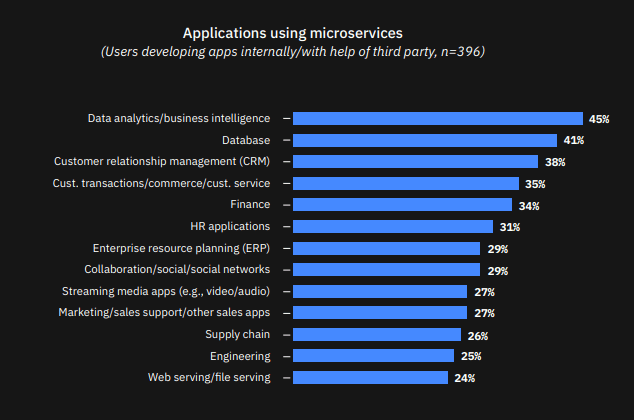
Source
We will witness the dominance of microservices in the custom application development domain.
15 Microservices Architecture Best Practices for Modern Applications
Here we mention some best practices related to microservices for developing modern applications.
Services Related to Business Capabilities
It is the first and one of the most important principles. It is essential to identify meaningful business capabilities before creating microservices. For example, rather than having separate services for customer database access and controllers, an application might have a ‘customer management’ capability. This is one of the crucial microservices development best practices because poorly defined boundaries can create excessive inter-service communication.
Services Should be Loosely Coupled
A microservice should be capable of evolving without making simultaneous changes across multiple services. Tight coupling can emerge through shared databases, business logic, and schemas. This can reduce the flexibility of the respective service. It is, therefore, necessary to ensure that each service exposes only the capabilities other services require. Architecture guidance from Microsoft specifically recommends avoiding shared database schemas.
Each Service Should Have Clear Ownership
Data ownership is at the core of effective microservices. A service should generally control the data required for your business capability rather than enabling other services. For example, the order service should access order data and the inventory service should get access to inventory data. The order service should not modify tables belonging to the inventory service and vice versa. This can improve autonomy but introduce distributed data management challenges.
Design APIs Carefully
Poor API design could generate some hidden dependencies that would ruin the whole microservice architecture. Custom mobile application development services aim at making good APIs that have proper naming, error handling, versioning strategy, and domain semantics. The developers must avoid making an API that is chatty and requires many calls to perform a single action. Good APIs enable services to evolve independently.
Use API Gateway Properly
The API gateway acts as a controlled access point between clients and backend services. Unlike a situation where there is a need to call different internal services individually, the client can interact with the gateway. This will direct the call to the appropriate backend. The API gateway is useful for different purposes, including authentication, request routing, TLS termination, monitoring, policy enforcement, and rate limiting. It also contributes to reducing complexity for clients. monitoring, policy enforcement, and rate limiting. It also reduces client complexity.
Plan Service Discovery Appropriately
As the number of services increases, it becomes more difficult to maintain service locations manually. Service discovery enables services to locate available instances dynamically. Effective service discovery best practices in microservices include the following:
- Use a reliable service registry
- Avoid hardcoding service addresses
- Monitor service health
- Handle unavailable instances gracefully
- Establish secure service-to-service communication
Service discovery has a direct connection with reliable inter-service communication.
Choose the Right Communication Pattern
The intercommunication between microservices could be synchronous or asynchronous. Synchronous communication means a service would send a message and wait for an answer. Common methods of this type are REST APIs and gRPC. Asynchronous communication implies that one service will publish a message or an event, which another service processes independently. Teams should select a proper communication pattern based on the business requirements. ight inter-service communication pattern according to business requirements.
Use Containerization in a Strategic Way
Containerization is an efficient method of encapsulation and deployment of services together with their dependencies. Docker microservices allow teams to think about each service as a container and deploy them consistently at all stages. This is beneficial to create consistent environments and quick deployment. Containerization makes an architecture scalable; nevertheless, teams still need proper resource management and orchestration.
Build for Independent Scaling
One of the strongest arguments for microservices is independent scaling. A service may need to scale to address increasing traffic volume, CPU consumption, database load, queue depth, and scheduled workloads. Microservices enable teams to scale the specific service instead of scaling the entire application. This targeted approach is one of the most useful benefits of microservices, especially when application-level scalability is not necessary.
Integrate Security into the Architecture
It is not proper to add security after deploying microservices. Companies should ensure that microservices security covers external and internal communication. Here, important considerations include strong authentication, API security, encryption in transit, network segmentation, input validation, and role-based authorization. Service-to-service communication may also require mutual TLS or other controls according to the environment.
Make a Design for Failure
When distributed systems fail, it is possible that a service may become unavailable and a network request may time out. The architecture should assume that failures will occur, and therefore, it is necessary to implement some resilience techniques, including
- Timeouts
- Retries
- Circuit breakers
- Bulkheads
- Idempotency
- Graceful degradation
It is essential to use retries carefully. This is because repeating an unsafe operation can create duplicate transactions or additional system load. This is a reason why idempotency and failure-aware API design should be considered together.
Implement Effective Monitoring
Traditional application monitoring is insufficient for distributed architectures. Microservices monitoring should provide visibility across service boundaries. Developers should monitor response time, error rates, queue depth, dependency failures, security events, and deployment health. Distributed tracing is therefore useful to track a single user request through multiple services.
For example:
Mobile App → API Gateway → Order Service → Payment Service → Notification Service
If the request takes five seconds, tracing can help companies identify where the delay occurred.
Use the Right Design Patterns
There is no universal architectural pattern that fits every application. Several microservices design patterns, such as API gateway, saga, circuit breaker, and bulkhead, can address recurring challenges. It is, therefore, important to choose the best microservices design pattern.
Avoid Creating Too Many Microservices
Creating dozens of tiny services without meaningful boundaries can create some issues over time. More microservices mean an increase in deployments, network calls, monitoring requirements, and greater debugging complexity. This is an architecture that technically consists of multiple services but remains tightly coupled, known as a distributed monolith. It is, therefore, necessary to keep meaningful service boundaries.
Standardize Where It Helps
Microservices give teams autonomy; however, unrestricted technology choices can create operational hurdles. If every team uses a different programming language, logging approach, monitoring platform, deployment process, and security mechanism, the organization has to maintain too many tools. Standardization can help the company get rid of this situation without creating unnecessary complexity.
Let’s go through some common mistakes related to microservices.
Common Microservices Mistakes to Avoid
Even a technically strong team of professionals can encounter problems when they commit any of the following mistakes-
- Splitting Monolith Too Quickly
When you move from one large application to dozens of smaller services without domain analysis, you may face unnecessary complexity.
- Sharing Database
A shared database can create hidden discrepancies between different microservices and create several issues in implementation.
- Ignoring Distributed Transactions
Business workflows spanning multiple services need to design consistency strategies carefully without ignoring distributed transactions.
Other mistakes include treating the API gateway as a monolith and ignoring observability, which can cost organizations in the form of several issues. Microservice development best practices can assist companies in avoiding these mistakes effectively.
Want to Develop an Advanced, Custom Application for Your Business?
LET’S CONNECTRole of Silicon IT Hub in Microservice Development
Silicon IT Hub brings over two decades of experience in software development. The company has become a trusted web and mobile app development partner by focusing on UI/UX, business consulting, product engineering, and quality assurance. It assists modern businesses in adopting microservices as an architectural and product-development decision rather than a technology implementation. In-house teams at Silicon IT Hub can build secure and scalable apps.
The company offers end-to-end software development services, including API-driven communication, cloud hosting, testing, and ongoing support. Specialized development and operations teams enable global companies to drive digital transformation through technological advancements.
Concluding Remarks
Microservices offer a strong foundation for modern applications, but disciplined architecture and engineering practices are also essential. The most important microservices architecture best practices is to follow business-focused boundaries. Teams need clear data ownership, well-designed APIs, proper service discovery, secure gateways, and strategic containerization.
Scalability acts as a bridge between business objectives and workload requirements. Security and resilience are also important factors. Working with an experienced mobile application development company can help teams get the necessary flexibility and scalability. Effective microservices development is not just about creating many independent services. It is also about creating the right services with the necessary security.


 Have an Idea?Let’s Build It Together!