

Building Scalable Multi-Tenant SaaS Platforms using .NET and Angular
Overview
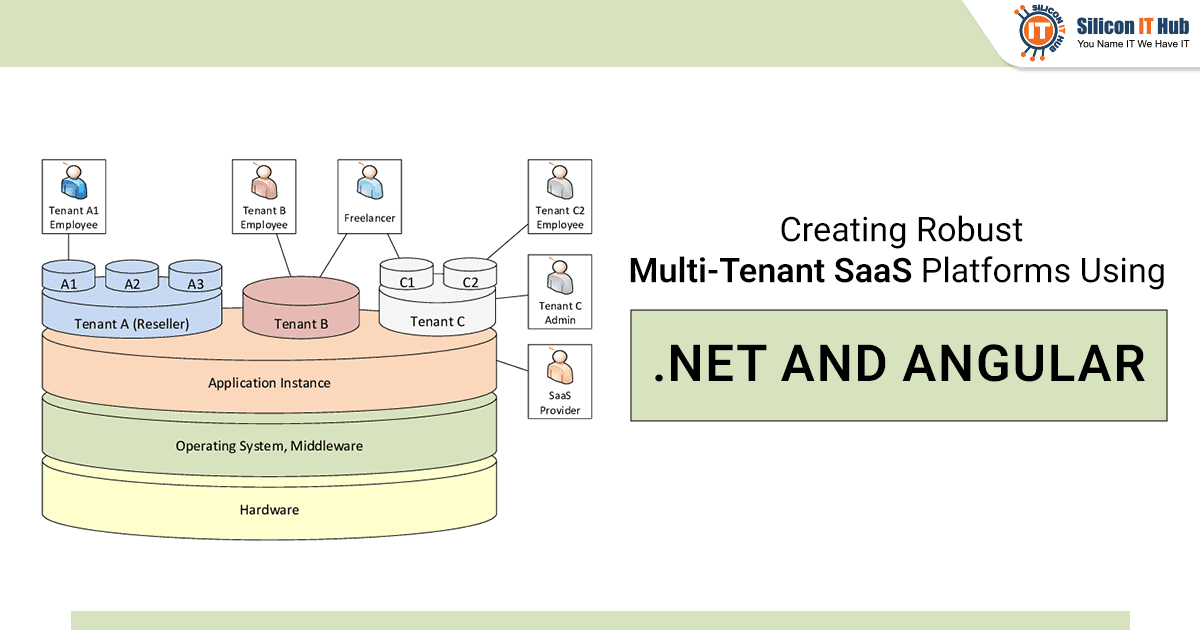
A SaaS product that serves multiple customers without compromising security can be highly complex. Custom software development service providers build a multi-tenant architecture to serve this objective. This SaaS architecture enables multiple organizations to use a shared application.
Angular and .NET combine to offer a robust technology stack to build multi-tenant SaaS architecture. ASP.NET Core gives the backend foundation for APIs, authentication, business logic, and tenant management. Angular, on the other hand, is useful for developing responsive interfaces for a custom app.
Building such a platform needs a carefully designed architecture, reliable tenant data isolation, and scalable infrastructure, combining the two technologies. When you want to invest in scalable SaaS architecture, it is better to understand these architectural aspects.
This blog discusses the role of .NET and Angular in developing multi-tenant SaaS platforms. Let’s dig deeper into the concept of multi-tenant SaaS architecture.
Role of .NET and Angular in Multi-Tenant Platforms
A multi-tenant Software-as-a-Service (SaaS) platform can serve multiple customers using the same environment simultaneously. Each tenant can be a business, organization, department, or customer account. Some components of a multi-tenant SaaS platform include
- Shared application layer
- Tenant-aware APIs
- Authentication and authorization
- Centralized administration
- Tenant-level reporting and analytics
- Monitoring and logging
- Tenant-specific configuration
ASP.NET Core handles the following aspects-
- RESTful APIs
- Authentication and authorization
- Tenant identification
- Database access
- Background processing
- Integration services
- Logging and monitoring
Angular, on the other hand, can manage the following-
- User interfaces
- Routing
- Forms
- Role-based navigation
- Tenant-specific setting
- Dashboards
- API communication
- Client-side state management
Frontend and backend development teams work on developing Angular SaaS applications independently, following predefined API contracts. Mobile application development service provider companies may reuse the ASP.NET Core API layer. This layer is helpful for web applications and native or cross-platform mobile clients.
How to Design Multi-Tenant Architecture in ASP.NET Core
A well-built multi-tenant architecture in ASP.NET Core can separate tenant resolution, authorization, business logic, and data access to give an accurate response.
Here is a simplified request flow from client to response-
Client → Authentication → Tenant Resolution → Authorization → Business Logic → Data Access → Response
Let’s go through each stage in brief.
Authentication
It is the first step where an application verifies the identity of the user or service making the request.
Tenant Resolution
In the next stage, the system determines which tenant the request belongs to for giving a response.
Authorization
This is a crucial step where the system determines whether that user has permission to perform the requested action.
Business Logic
Here, the application processes the operation as per tenant-specific, global business rules.
Data Access
The data layer retrieves or modifies records while determining tenant boundaries.
This separation makes the application easier to maintain and test. It also reduces the risk of placing tenant-specific logic throughout the codebase.
It is, however, necessary to select the right database strategy to leverage the multi-tenant system.
Choosing the Right Database Strategy
Database design is one of the most important decisions companies should make in a multi-tenant system. Here are three common approaches to selecting the right database strategy-
Shared Database and Schema
As per this approach, all tenants use the same database and tables. A unique Tenant ID column identifies which tenant holds which records. This relatively cost-efficient model can simplify infrastructure management. The real challenge in this strategy is to enforce consistent tenant filtering.
A single missing tenant condition in a database query can lead to a serious data exposure problem.
Shared Database and Separate Schemas
As per this strategy, each tenant has its own database schema. It provides more separation than a shared schema while retaining some infrastructure efficiencies. This approach can be useful when tenants require greater logical isolation without increasing operational overhead.
Database Per Tenant
This model enables every customer to get an independent database. It offers stronger isolation and is capable of simplifying requirements related to tenant-specific backups, compliance, or database customization.
The issue, however, is operational complexity. For example, for 2000 tenants, there are potentially 2000 databases to provision, monitor, migrate, and maintain.
It is fair to say that there is no universally accepted database strategy. You can make a decision depending on tenant size, regulatory requirements, expected scale, and available resources. It is also important to consider tenant data isolation as part of the architecture from the initial stage.
Building an Angular Multi-Tenant Application
An Angular multi-tenant application can load tenant-specific information, including
- Branding
- Logos
- Themes
- Navigation
- Feature availability
- User roles
- Dashboard configuration
- Workflow options
For example, two customers could use the same Angular application while seeing different dashboards and features. Angular development services can retrieve tenant configuration from the backend after authentication.
Route guards can control access to specific sections of the application. HTTP interceptors can also help attach authentication information and other necessary request metadata to API calls.
It is better to remember that frontend controls can improve the user experience, whereas backend authorization is useful for ensuring security. If we consider this fact for Angular and ASP.NET, it would be the following-
Hiding a menu item in Angular does not prevent calling the API, and therefore, the ASP.NET Core backend should validate every operation.
Tenant-Specific Customization without Creating Technical Debt
Customization is the ultimate requirement for different tenants. For example, one organization may need a specific approval workflow, while another may require different reports. When a SaaS platform with poor design is not sufficient to meet tenant-specific customization requirements.
Configuration-based customization is, therefore, a better strategy. Companies can define configurable rules for every approval process, instead of creating separate code. Some of these rules include-
- Department hierarchy
- User roles
- Workflow stages
- Required fields
- Feature permissions
- Notification preferences
The Angular application can render the proper experience on the basis of backend-related configuration. It enables a SaaS product to support different business requirements while managing the underlying codebase.
Top SaaS Architecture Patterns to Consider
Different SaaS products have specific architectural approaches. Modular monolith, microservices, and hybrid architecture are some useful SaaS architecture patterns. It is fair to say that the best architecture doesn't need to be the most complex.
A modular monolith may be more appropriate than microservices in the early stages of a SaaS product. Architecture should follow real scalability and operational needs rather than technology trends.
How to Scale .NET and Angular SaaS Platform
A .NET and Angular platform has multiple levels. When it comes to scaling this platform, these levels need consideration. ASP.NET Core applications can be deployed across multiple instances behind a load balancer and remain practical for handling requests across different instances.
Database performance also becomes a bottleneck before application servers. Proper indexing, query optimization, partitioning, read replicas, and caching are some of the strategies to address this limitation. Finally, it is essential to ensure that applications do not block API requests.
Background workers in the application or platform can handle tasks like email processing, data imports, notifications, scheduled synchronization, and document processing.
These are some essential steps when scaling a .NET and Angular platform.
Security Considerations for Multi-Tenant SaaS
Security becomes highly complicated when multiple tenant organizations share their infrastructure. Some key security considerations for the SaaS product include authentication, authorization, encryption, tenant isolation, and secrets management. Audit logging and monitoring are also essential.
When it comes to securing a multi-tenant SaaS product, automated integration and authorization tests can give substantial value. A SaaS provider should consider some useful metrics, including request volume, error rates, active users, storage consumption, and database query performance.
Integrating Mobile Applications with the Same Backend
Modern SaaS products require mobile access. Mobile application development services are useful for combining a .NET and Angular architecture to ensure seamless access. Here, both web and mobile applications consume the same ASP.NET Core APIs.
The architecture can look like-
Angular Web Application
↓
ASP.NET Core API Layer
↓
Business & Tenant Services
↓
Database / External Services
and
Mobile Application
↓
ASP.NET Core API Layer
This approach centralizes business rules for both web and mobile applications. Mobile users can authenticate, retrieve tenant-specific information, and interact with the same backend services used by the Angular application. It also simplifies long-term maintenance of business applications.
Looking to leverage a custom multi-tenant SaaS platform for your application?
LET’S CONNECTCommon Challenges and Role of Experienced Software Development Company
Multi-tenancy brings some challenges, including data leakage risks, complex migrations, and customization pressure. It also increases testing complexity and operational overhead. It is better to evaluate data leakage risks, complex migrations, customization pressure, and operational overhead.
A reputable software development company can take a practical development approach and follow standard practices to address these common challenges. Businesses should evaluate custom software development services to remove these bottlenecks.
A trusted software development partner should have a development team that has experience in
- SaaS architecture
- Multi-tenant application development
- Cloud deployment
- API development
- Security engineering
- DevOps
- Mobile application integration
- Database architecture
Your development partner should be capable of explaining why a particular architecture is more appropriate than the latest trend. Your partner’s goal should be to build a secure, maintainable, scalable, and economically practical architecture.
Concluding Remarks
Building a robust SaaS platform with .NET and Angular requires proper architectural planning. Though evolving technologies provide the foundation, the SaaS product’s quality depends on various aspects, including tenant resolution, authorization, etc.
ASP.NET Core is useful for developing a strong backend for tenant-centric APIs and business services, while Angular can deliver flexible interfaces for an Angular SaaS application.
Finally, businesses planning a new SaaS product or modernizing an existing one, they should consider mobile experiences. Mobile application development services can make it possible by using reusable APIs and centralized business logic.
Both .NET and Angular can make a secure and scalable SaaS architecture for addressing various challenges and business requirements.


 Have an Idea?Let’s Build It Together!