

Top Features and Benefits of AI Agents for Legal Research
Overview
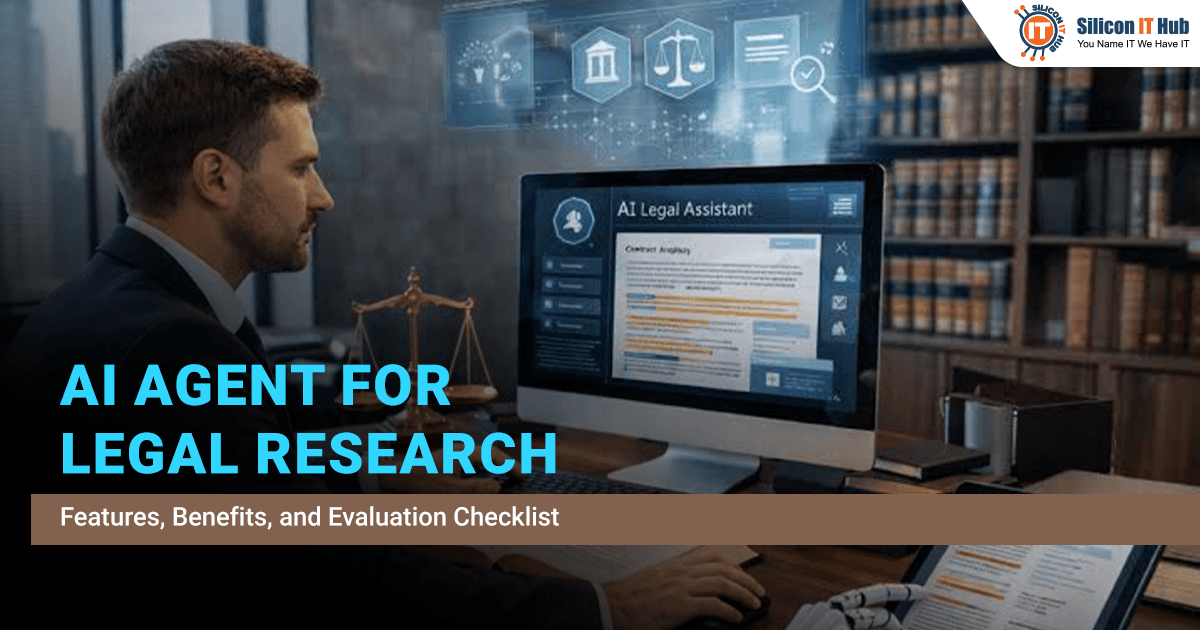
Traditionally, legal research required some researchers to spend substantial time searching case law, comparing precedents, and validating sources. It was challenging for the law firm to find the right information and understand its legal context. Legal AI software can make it possible by processing large volumes of documents and identifying relevant passages.
Whether the firm wants a summary of lengthy materials or a structured set of findings, AI for legal research is highly relevant and beneficial. Yet not every solution is capable of performing legal work functions like an AI agent.
Unlike a conventional search interface that retrieves documents, an AI agent can interpret a task and analyze results before producing an output. It is, therefore, necessary for law firms and corporate legal departments to understand the difference between any intelligent solution and legal AI software.
AI for Legal Research- Scope and Importance
Let’s start with the growing importance of AI agents globally. As per the official survey, the AI agents market is expected to grow at nearly 50 percent CAGR this decade. North America is projected to remain at the top with a USD 19.47 billion market share in the year 2030. The following graph shows the global predictions for AI agents market size for the year 2030.

Source
Another research report revealed that customer support, sales, and cybersecurity will remain the top business functions. Legal and compliance functions are also increasingly using AI agents. We can see this in the following graph, with 18 percent usage. Let’s understand the importance of AI agents in legal processes.
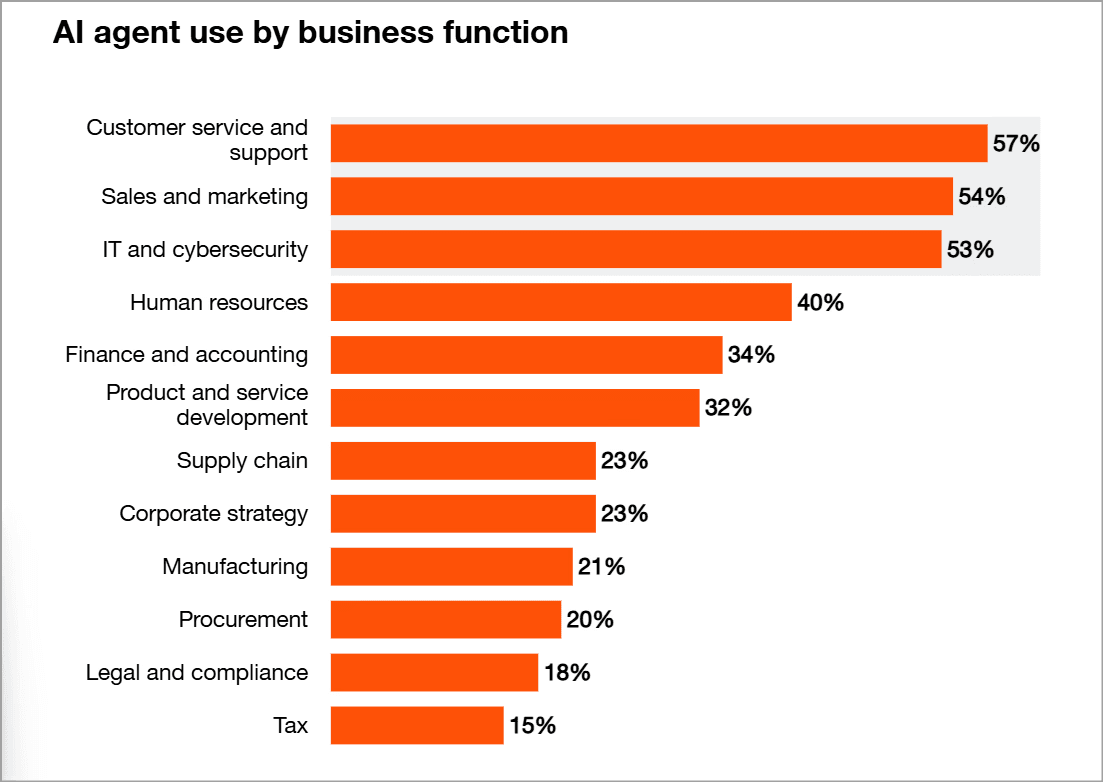
Source
AI tools for legal research can assist with multiple stages of the legal research process. A traditional legal database might require a user to enter a query, review results, and manually compare relevant authorities. An AI agent, on the other hand, can support a more conversational and task-oriented approach.
Advanced AI agents for lawyers can break the lawyer’s request into multiple research activities. These activities include interpreting the legal question, extracting relevant passages, organizing findings by jurisdiction, and searching for connected legal sources. This, however, does not eliminate or reduce the lawyer’s responsibility.
A reputable AI chatbot development services provider can build agents with domain-specific capabilities. For example, legal research requires several characteristics, such as working with large collections of text, case opinions, regulations, pleadings, etc. Contextual questions and repetitive tasks are some other major aspects of legal research.
AI legal research tools can assist firms in handling these tasks with information retrieval and analysis capabilities. It is, however, necessary to consider that an inaccurate summary or unsupported citation can create serious consequences. Therefore, AI tools for legal research should have features that offer accuracy, traceability, and source validation.
Key Features of an AI Agent for Legal Research
An AI research agent should have the following features to benefit the legal sector:
Natural Language Queries for Legal Firms
AI tools should enable lawyers to pose a research question in ordinary language instead of constructing complex searches. The AI system should interpret the intent behind the query and identify relevant concepts, entities, jurisdictions, and legal issues. Finally, AI tools for legal research should have conversational interfaces.
Search and Retrieval of Legal Documents
An AI agent should search relevant sources and retrieve documents based on context and legal concepts. Semantic search can help law firms identify documents on similar legal concepts even when they use different terminology.
For example, if a lawyer is researching ‘employer restrictions on post-employment competition’, non-compete agreements should also appear.
Source Grounding and Citation
This is one of the most important capabilities in AI-driven legal research software. An AI-generated answer should be connected to the underlying legal authorities whenever possible. A strong AI legal system should provide the following details-
- Case names
- Court and jurisdiction
- Statutory references
- Relevant passages
- Document links or identifiers
The Source grounding feature makes it easier for lawyers to verify an AI-generated response.
Case Law Analysis
An AI agent should be able to extract relevant information from judicial opinions. Some such information includes facts, arguments, holdings, reasoning, precedents cited, and outcomes. It is useful for researchers because they can read AI-generated summaries instead of reading every retrieved decision before determining its relevance.
Statutory and Regulatory Research
An effective AI-powered legal system should support relevant statutes, regulations, amendments, and other authoritative materials where applicable. The agent should also account for dates. A legal research platform should include mechanisms for identifying the applicable version of a legal authority and communicating the source’s date.
Multi-Step Workflows for Research
A standard research workflow should look like-
Question → Search → Retrieve → Filter → Analyze → Compare → Cite → Summarize
An AI agent can coordinate parts of the research process instead of requiring the lawyer to perform each step. This is specifically beneficial for research assignments involving multiple jurisdictions or large document collections.
Document Upload and Analysis
Legal teams need to research issues frequently. An AI agent may give users an opportunity to upload contracts, pleadings, policies, and other documents, as well as ask questions about them. The system will find relevant clauses and correlate them with relevant legal sources. This is useful for maintaining necessary integrations and permissions.
Comparative Analysis of Information
Legal research often requires comparison instead of separate analysis. The AI agent with strong functions will help lawyers to compare several cases, statutory sections, contract clauses, judicial interpretations, and regulatory requirements. They can quickly understand where authorities agree or differ by looking at a comparison table.
Research History & Collaboration
It is necessary to consider that legal research is not an entirely individual process. Research history, saved queries, citations, and collaboration tools are essential during hearings. These features will help avoid repeating the same research and will help another lawyer understand the exact conclusion.
Security and Access Controls
An AI research platform should address authentication, role-based access, encryption, audit logs, tenant isolation, and permission management. It is essential because legal information is highly sensitive and confidential. Law and compliance organizations handle confidential information; therefore, security should remain the top priority.
All these features are highly beneficial for legal entities.
Top Benefits of AI Agents for Lawyers
Legal research software can reduce repetitive effort in finding and analyzing various aspects. It enables attorneys to become more efficient in handling data, providing advantages such as
Faster Preliminary Search
They start their process using natural language questions and get a well-structured research starting point. Such a tool can help avoid the necessity of conducting multiple searches and opening documents separately.
Improved Document Management
An AI-driven system can support law firms in document classification, extraction, summarization, and relevance analysis. Furthermore, it can aid researchers in identifying documents worthy of further investigation.
More Structured Research
AI agents for lawyers can organize findings into predefined structures. This can be in the following order-
- Issue
- Authority
- Jurisdiction
- Holding
- Reasoning
- Relevance
- Citation
This predefined structure can make the research process easier and save time.
Reduced Administrative Work
Legal professionals spend time analyzing law and organizing research. AI, here, can assist by handling tasks like extracting citations, categorizing documents, and generating preliminary comparisons. This can save a lot of time and effort.
Consistent Research Workflows
Organizations can create standardized research workflows for recurring legal questions. For example, a corporate legal department could develop a process for reviewing regulatory changes across specific jurisdictions.
Trusted AI chatbot development services can assist your firm to leverage these benefits. It is, however, necessary to choose the right AI software.
How to Choose the Right Legal AI Software
Selecting legal AI software requires proper testing to determine whether the chatbot produces convincing answers. A practical evaluation can examine the entire research workflow. You can start with testing the system using representative legal questions and compare its responses against authoritative sources.
You should also ensure wide coverage and proper citation reliability. It is necessary to determine which legal sources the system can access and how frequently it gets updated for underlying sources. The AI system you choose should have useful safeguards, including source grounding, citation verification, confidence indicators, etc.
Integration capabilities, human-in-the-loop controls, privacy, and traceability are other major factors to consider while choosing the right AI software for your legal firm. You can also evaluate the system for query experience, search refinement, export options, collaboration, response clarity, and document navigation. Finally, the AI software should be easy to use.
Let’s go through an evaluation checklist that will help you get the best AI agent or tools.
Want to make a dedicated AI agent for your law firm?
LET’S CONNECTYour Evaluation Checklist for AI for Legal Research
Legal teams or organizations can use the following quick table before selecting an AI research solution:
| Evaluation Factor | What to Ask |
| Accuracy | Does the system produce reliable research results? |
| Citations | Can every important claim be traced to a source? |
| Coverage | Does it cover the required jurisdictions and authorities? |
| Freshness of Information | How frequently does it update legal information? |
| Document Analysis | Can it analyze relevant legal documents? |
| Workflow | Can it handle multi-step legal research tasks? |
| Security | How are confidential documents protected? |
| Integration Capabilities | Can it connect with existing legal systems? |
| Human in Loop | Can lawyers review and validate results? |
| Usability | Can legal professionals adopt it without excessive training? |
Apart from these aspects, teams can ask about scalability, customization, cost, and a proof-of-concept in the real world.
Concluding Remarks
AI agents can change the way we perform research in the legal sector. These agents bring search, document analysis, summarization, comparison, and workflow automation into the process. Organizations that evaluate legal research software should give priority to the combination of accuracy, integration, usability, traceability, and human oversight.


 Have an Idea?Let’s Build It Together!