

AI for Production- A Journey from LLM-Centric to Agentic Systems
Overview
A couple of years ago, enterprise-grade generative AI applications revolved around a simple pattern. Users sent a prompt to a large language model and received a response. Custom AI development services made these applications for content generation and question answering.
Modern businesses, however, always demand more. A customer-support system may need to identify a customer’s account, interpret a policy, and decide what action is appropriate. A software engineering assistant, on the other hand, may need to inspect a repository and run tests.
Such workflows require AI to move from generating an answer to taking action. This is agentic AI in a controlled environment. This paradigm shift drives interest in more sophisticated AI agent architecture.
It is, however, fair to say that developing production agentic systems requires deliberate engineering, permissions, tool execution, evaluation, security, and even failure handling. AI agent development services help organizations get a reliable, secure, and robust system ready for production.
This blog discusses all the aspects related to production-ready systems and how they switch from LLM-centric to agentic AI.
Shift from LLM-Centric AI to Agentic AI
An LLM-centric application typically follows a simple and predictable pattern:
User-Prompt-LLM-Response
This model may retrieve information from a knowledge base, but the application code controls its overall workflow.
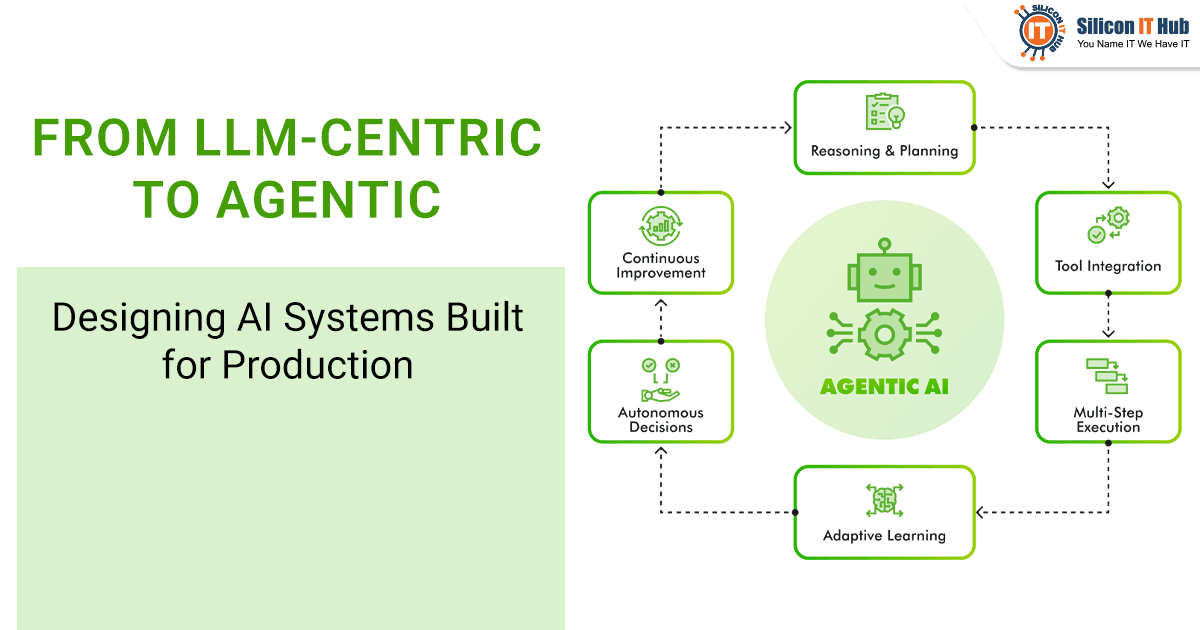
An agentic AI system introduces several layers, including:
Goal-Agent-Reasoning-Tools-Environment-Observation-Next Action
This distinction matters because an LLM itself does not provide identity management, permission boundaries, tool validation, operational monitoring, and transaction management automatically. An AI agent development strategy, therefore, begins with the business process rather than the model itself.
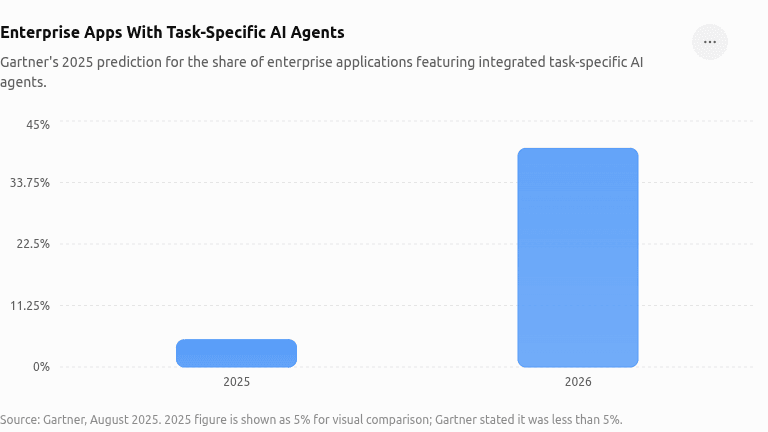
Gartner has projected that almost 40 percent of enterprise applications will have task-specific AI agents by the end of 2026 for this reason. The following graph shows this massive increase from just 5 percent in 2025 to 40 percent in 2026.
Custom AI development companies can build advanced agentic AI systems to serve different objectives in production. This production agent could:
- Authenticate the user
- Identify the relevant account
- Initiate the reset workflow
- Confirm completion
- Record the action
- Escalate to a human whenever necessary
Agentic systems introduce a feedback loop rather than a single model invocation. They are highly capable because the surrounding system gives the model controlled access to the right information.
How to Design Strong AI Agent Architecture
An AI agent architecture for production should separate reasoning from execution. Here are some layers of a useful conceptual architecture-
| Layer | Primary Responsibility |
| User/Business Interface | Captures goals and presents outcomes |
| Agent Runtime | Manages agent state and execution |
| Reasoning Layer | Interprets context and selects actions |
| Orchestration Layer | Controls workflows and agent interactions |
| Tool Layer | Provides controlled access to external systems |
| Data/Knowledge | Supplies trusted information |
| Security | Controls identity, permissions, and policies |
| Observability | Tracks behavior, performance, and failures |
| Evaluation | Measures quality and reliability |
This separation helps companies prevent the LLM from becoming the app’s control plane. It is fair to say that the system should control whether the action proposed by the model happens.
One of the biggest mistakes in agentic development is to put every decision within the language model. It creates unnecessary uncertainty. A production system should distinguish between probabilistic and deterministic tasks.
Tool-Calling AI Agents and Guardrails
APIs, databases, enterprise applications, search systems, and other services can interact with tool-calling AI agents. These agents are useful, but they should not simply expose unrestricted app functionality to a model.
Each of these tool-calling AI agents should define-
- What it does
- What inputs it accepts
- Which identities can use it
- What data it can access
- What validation is necessary
- What errors it can commit
Let’s understand this through a real-life example. Consider a banking-related AI agent. A tool known as get_account_balance is primarily read-oriented, and a tool called transfer_funds changes financial state. The second tool needs stronger controls than the first one.
The system may work on the following workflow-
Agent request → Policy check → User authorization → Transaction validation → Tool execution → Audit event
The AI model should not bypass that chain. As systems become more complex, AI orchestration becomes essential to determine various aspects.
AI vs LLM vs Traditional Orchestration
AI orchestration can address the complexities of your business system. It determines which agent that acts and which tool that should be called. It also determines when a workflow should continue and stop. This is different from asking an LLM to generate the next step.
A powerful AI orchestrator can impose explicit workflow boundaries
Request received
↓
Classify request
↓
Retrieve customer context
↓
Determine eligibility
↓
Request approval if required
↓
Execute action
↓
Verify result
↓
Update system of record
↓
Notify user
Each of these steps has a defined contract. The LLM may influence the route, but the orchestration layer controls all the permissible routes.
When the workflow contains ambiguity, LLM orchestration remains useful. On the other hand, traditional workflow engines are beneficial when the process is known in advance. For example, an employee expense report has a predictable sequence:
Validate employee - Validate expense category - Check amount - Apply approval policy - Record reimbursement
If an employee submits a natural-language explanation with ambiguous receipts, an LLM could help interpret the information. Otherwise, there is no role for an LLM in this traditional workflow.
LLM for ambiguity + deterministic orchestration for control.
This avoids treating language models as replacements for conventional software engineering.
When to Use Multi-Agent System
Multi-agent systems can divide complex responsibilities across specialized agents. For example, an enterprise procurement workflow consists of a sourcing agent, a supplier-analysis agent, a contract agent, a compliance agent, and a reporting agent. Each agent can have a narrower scope.
This can make large workflows more practical, but multi-agent architecture offers more agents. This results in
- More communication
- More state management
- More failure modes
- More security boundaries
- More evaluation complexity
Companies should add another agent only when specialization provides a measurable advantage.
Observability and Security for AI Agents
AI agent observability helps your company’s teams understand requested tasks, agent context, model, and selected tools. It is also beneficial to get information related to the failure of the workflow, task costing, and the necessity of human intervention. This tracing or monitoring is valuable.
Agent tracing can reveal the duration of the entire process so that the engineering team can have actionable insights. It is difficult to improve agent performance without this level of visibility. Another major factor is AI agent security. It goes beyond protecting the model endpoint.
Various security controls should address the following:
Identity
Every agent and user interaction should be based on a clear identity.
Least Privilege
Agents should receive only the necessary permissions for their tasks.
Tool Permissions
Each AI tool should have transparent access rules.
Input Validation
Tool arguments need to be validated before execution.
Output Validation
Results of sensitive or consequential tools may require validation before being passed onward.
Secrets Management
API keys and credentials should not be exposed through prompts or model context.
Auditability
Sensitive actions need to generate auditable events.
Human Approval
High-impact actions should be based on human approval, especially when performing irreversible operations.
Whether it is data deletion or payment approval, all the activities of AI agents need proper monitoring to ensure security.
Want to Build an Advanced Agentic System for Your Organization?
LET’S CONNECTAI Agent Deployment for Production
When it comes to the production release, a mature AI agent deployment process is essential. This process consists of development, evaluation, staging, controlled release, monitoring, and iteration steps. It is essential to select a model according to the task.
Why Cost and Performance Go Together
Agentic workflows can make several model calls, but a conventional application would make only one. This directly increases the cost. For example, a request from one user could trigger intent classification, planning, tool selection, reasoning, validation, and final response generation.
If each of these steps invokes a large model, the system may become highly expensive and perform slowly. Companies should, therefore, implement the following optimization strategies-
- Use smaller models for simple tasks
- Reducing extra context
- Caching stable results
- Limiting reasoning loops
- Using deterministic routing when possible
- Combining compatible operations
- Setting execution budgets
The main objective of these strategies is to achieve the desired business outcome at an acceptable cost and quality.
Scope of Custom AI Development Services
Custom AI development services can provide value for complex business requirements that involve legacy systems, unique data, and specialized security requirements.
A custom implementation enables enterprises to leverage the benefits of AI agents by integrating them with ERP systems, CRM platforms, databases, customer portals, workflow systems, business APIs, and document repositories.
A reputable AI software development company can identify a business process where controlled autonomy can give measurable value. For example, an organization might begin with an internal support agent that can retrieve approved documentation and create support tickets.
After evaluation, it could receive additional but related capabilities. This incremental approach can reduce risk and generate real operational value while keeping the agent’s authority within limits.
Custom AI development service providers can give a practical roadmap for moving beyond LLM-centric applications.
Concluding Remarks
LLM-centric AI to Agentic AI transition represents a shift from generative AI to advanced systems that participate in controlled workflows.
A well-defined AI agent architecture, deliberate AI orchestration, reliable data access, and robust AI agent security are essential when building a production-ready system. Companies can manage complex workflows by using multi-agent systems. But they should consider several aspects.
Finally, organizations that invest in custom AI development services should define the level of autonomy. This can help them achieve better architecture and more realistic production outcomes through improved governance.


 Have an Idea?Let’s Build It Together!