

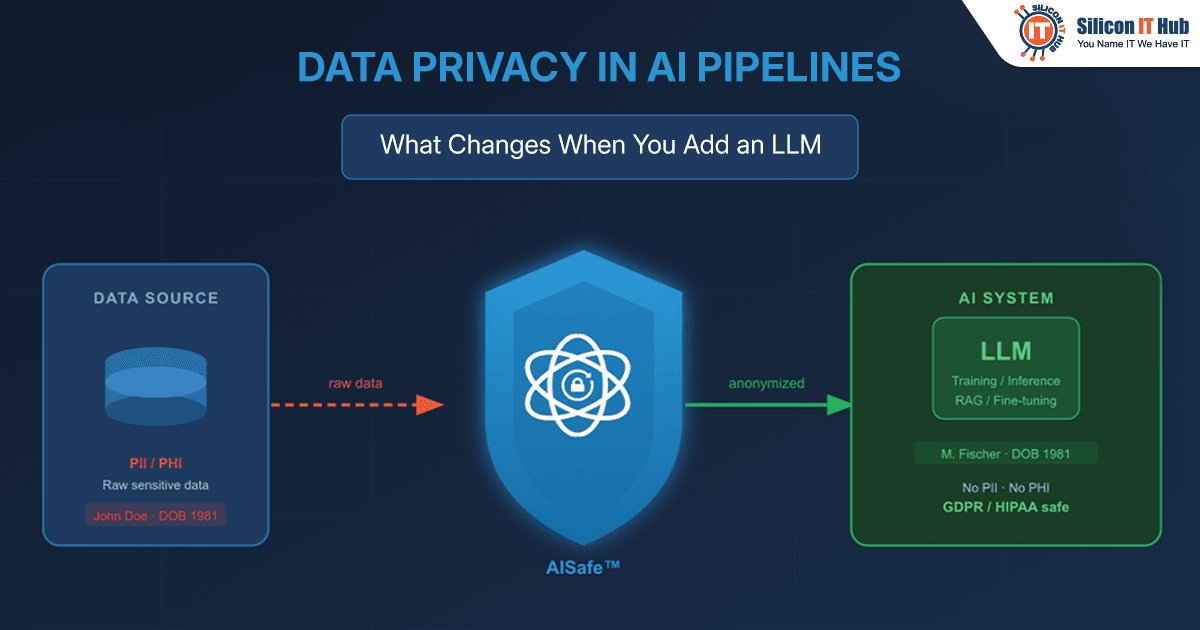
Data Privacy in AI Pipelines- Changes You Need to Know When Adding LLM
Introduction
A Large Language Model (LLM) can bring revolutionary changes in an AI-driven, enterprise-grade system. The addition of this model in an existing AI pipeline can add new data flows around prompts, model APIs, generated responses, and retrieval systems. This LLM addition can, however, create changes related to data privacy in AI pipelines. Companies need to understand the type of information that reaches the LLM and who can access it.
Whether your company is building an internal AI assistant, customer-facing chatbot, an AI agent, or an enterprise copilot, it is necessary to consider data privacy. You should identify if the language model or its supporting services expose information through an output. When you invest in AI development services, it is better to treat an LLM as another data-processing component that has security and privacy boundaries.
This post talks about the changes that occur when we add an LLM into an AI pipeline. It also digs deeper into designing secure LLM integration and privacy architecture for AI applications. Let’s start by discussing the increasing scope of large language models.
Scope of LLMs (Large Language Models)
AI development services largely depend on large language models. They are sophisticated AI systems that build on deep learning. LLMs aim at getting precise language prediction and contextual comprehension. The market size of large language models has increased steadily and significantly in recent years. An official research report has revealed that the global LLM market will reach 82.1 billion USD by 2033.
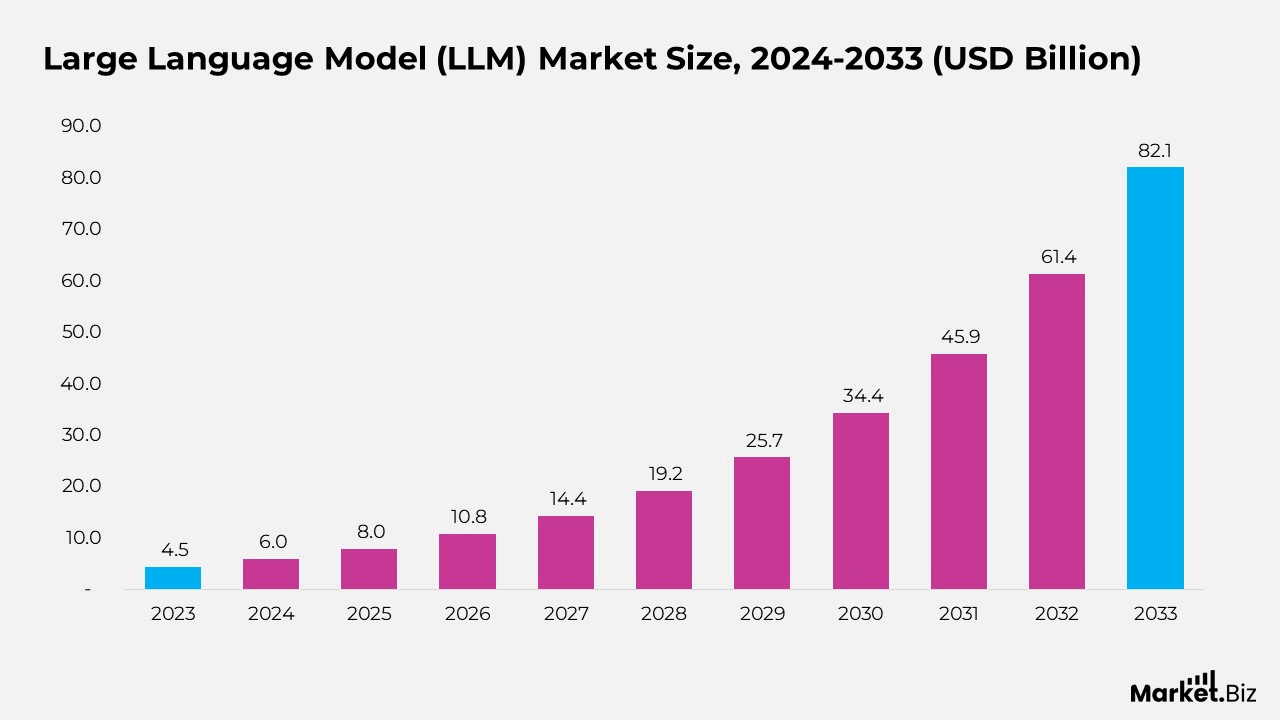
Source
A popular AI app development company integrates LLMs into AI pipelines. This can create challenges related to data privacy.
Data Privacy Changes on Adding an LLM
The biggest change is the number of places where information can travel when we add an LLM into an AI pipeline. A traditional AI pipeline has four places where information travels-
Data Source-Preprocessing-Model-Output-Application
An LLM-enabled AI pipeline, on the other hand, has the following places for data transfer-
User/Data Source-Preprocessing-Retrieval-Context Assembly-Prompt-LLM-Output Validation-Application-Logging/Monitoring
Addition of LLM can cover additional services including AI gateways, observability platforms, agent tools, conversation stores, and embedding models. Every additional component related to LLM in AI pipelines can create another place where data can be processed, cached, or exposed. This is why adding an LLM into an AI pipeline can expand the surface for privacy attacks even when the application remains the same.
Here we mention some significant data privacy changes due to the addition of an LLM into AI pipelines.
Prompts become New Data Boundary
A conventional application has predefined fields that transfer data to a backend service. With an LLM, however, application data can be assembled into a prompt. A prompt may have customer information, internal documents, financial information, employee information, contract details, database records, retrieved knowledge, product specifications, and user-generated content. The prompt may therefore contain more information than the user’s apparent question.
If an AI-driven application sends all this information to an external model, the privacy risk becomes larger than the user interaction.
LLM Context can Expose Hidden Data
One of the most important differences between the logic of common and LLM-based applications is in the way of assembling context. Retrieval-augmented generation (RAG) enables an LLM to retrieve information from internal sources before generating an answer. Though this is a powerful way to get an answer, it can create authorization problems. What if an enterprise knowledge base has HR documents, customer records, and legal agreements?
The LLM should not become an authority that decides whether the user can access a document. Here, the distinction is essential for ensuring secure LLM integration in AI pipelines.
Sensitive Data can Enter into Prompts
Developers focus on what users explicitly enter, but it is not sufficient. They should focus on the way sensitive information can enter an LLM prompt through email content, uploaded files, CRM records, web pages, and tool outputs. Previous conversation history, retrieved documents, and API responses also provide sensitive data. This leads to an important privacy consideration for RAG and agentic systems.
Even if a user does not type a customer’s personal information into the chatbot, the application could retrieve it automatically.
Output Is Another Privacy Boundary
Privacy controls are applicable to outputs as well. Incorrect retrieval, prompt injection, excessive context, poor access controls, and inadequate output filtering are some reasons users receive sensitive information through an LLM. Cross-user context leakage and incorrect application logic are other factors that make outputs more sensitive from the perspective of data privacy.
It is, therefore, necessary for applications to validate model output before displaying it or passing it to another business system. You should not treat an LLM response as trusted application data.
Prompt Injection Affects Data Privacy
Conventional AI pipelines and LLM-based systems have a key difference: prompt injection. An attacker may provide instructions designed to manipulate the model into ignoring application rules. This prompt injection can also be used to get key information from the context. The attack can be direct, such as a malicious user entering an adversarial prompt, or indirect when an AI assistant retrieves an external document.
This document may have hidden instructions to manipulate the model when it processes that document.
Logging May Lead to Privacy Risk
LLM applications need extensive monitoring because various teams may log user prompts, token counts, retrieved documents, errors, latency, model responses, etc. All such information is useful for debugging and quality improvement, but it can be a secondary repository of sensitive information. Suppose an application processes confidential customer records.
If the complete prompt and its response are saved, the organization may create a copy of that sensitive information unintentionally. Teams should, therefore, consider redacting sensitive fields, masking identifiers, logging metadata instead of full prompts, and restricting log access depending on the application.
Third-Party LLM Providers Change Model
An external LLM API may introduce another organization into your company’s data flow. Your company should understand the type of data to be transmitted, the place of data processing and prompt retention, available controls, etc. You should also consider contractual obligations, deletion mechanisms, and data residency options with security measures before sending business or personal information.
It is fair to say that external LLM APIs are not inherently unsafe, but they create another processing relationship that needs active monitoring.
AI development services include due diligence, training, and security measures to strengthen data privacy in LLM-based applications.
How to Design Secure LLM Integration in AI Pipelines
It starts with data classification. Companies should categorize the information they would like to process through pipelines before integrating an LLM. Here is a quick table showing data categories with examples and recommended approaches.
| Data Category | Example | Consideration |
| Public | Product documentation | Lower sensitivity |
| Internal | Business procedures | Access controlled |
| Confidential | Contracts, strategy documents | Strict access and monitoring |
| Personal | Customer or employee information | Minimize, protect, and govern |
| Highly Sensitive | Credentials, financial/health data | Avoid unnecessary exposure |
This classification can influence models, providers, storage mechanisms, and security controls. You can take assistance from a reputable AI application development company to categorize information properly. This can ensure secure LLM integration in AI pipelines.
Privacy Architecture for LLM Applications
A strong implementation of LLM into AI applications includes multiple control layers, including data minimization, input filtering, identity & authorization, secure context assembly, controlled model access, etc. This layered approach is according to the broader risk-management mindset for generative AI systems.
Privacy Checklist before Adding an LLM
Teams should find the answers to the questions related to data, model, and prompts before adding an LLM into AI pipelines.
Data
- What information will enter the model?
- Is any personal, confidential, or sensitive information involved?
Model
- Which model is being used?
- What are the provider’s data-handling terms?
Retrieval
- Can the model retrieve internal documents?
- Can one user’s context reach another user?
Prompts
- Are they logged?
- Are sensitive values masked?
Outputs
- Can model responses contain sensitive information?
- Can outputs trigger application actions?
Access
- What can the LLM access?
- Have permissions
Testing
- Has the system been tested for prompt injection?
- Has unauthorized data retrieval been tested?
The LLM integration is not ready for production, or addition is not advisable if any of these questions have no clear answers. A trusted AI development partner keeps data privacy at the core throughout the application lifecycle. You can discuss data classification, RAG security, API security, data retention, logging, output validation, and encryption with your experienced AI app development partner.
AI development services should be capable of integrating an LLM without weakening an application’s existing data privacy and security controls.
Looking to build an LLM-powered AI Application for Your Business?
LET’S CONNECTRole of Silicon IT Hub in AI Development
Over 25 years of extensive experience in various sectors and after delivering 2000+ projects successfully, Silicon IT Hub is a preferred partner for developing customized AI applications. Our in-house team of expert AI professionals can take care of the entire development lifecycle from requirement gathering to model development. Our AI development services include AI/ML consulting, enterprise AI development, AI agent development, and data engineering.
LLM training and customization are a key part of our AI expertise. We develop and train large language models and smaller custom models to address specific business needs. You can hire AI developers for building complex solutions for data processing, custom models, and AI pipelines. We assist you in leveraging the benefits of AI and LLMs across data, workflows, and business systems.
Concluding Remarks
The addition of an LLM to AI pipelines can change the way data moves through the system. Prompts can contain sensitive information, retrieval systems can expose internal documents, and third-party model providers introduce new relationships. That is why your company should consider data privacy in AI pipelines across the complete lifecycle.
Businesses that invest in AI development services should focus on data classification, access control, secure retrieval, monitoring, and responsible practices to maintain data privacy.


 Have an Idea?Let’s Build It Together!