

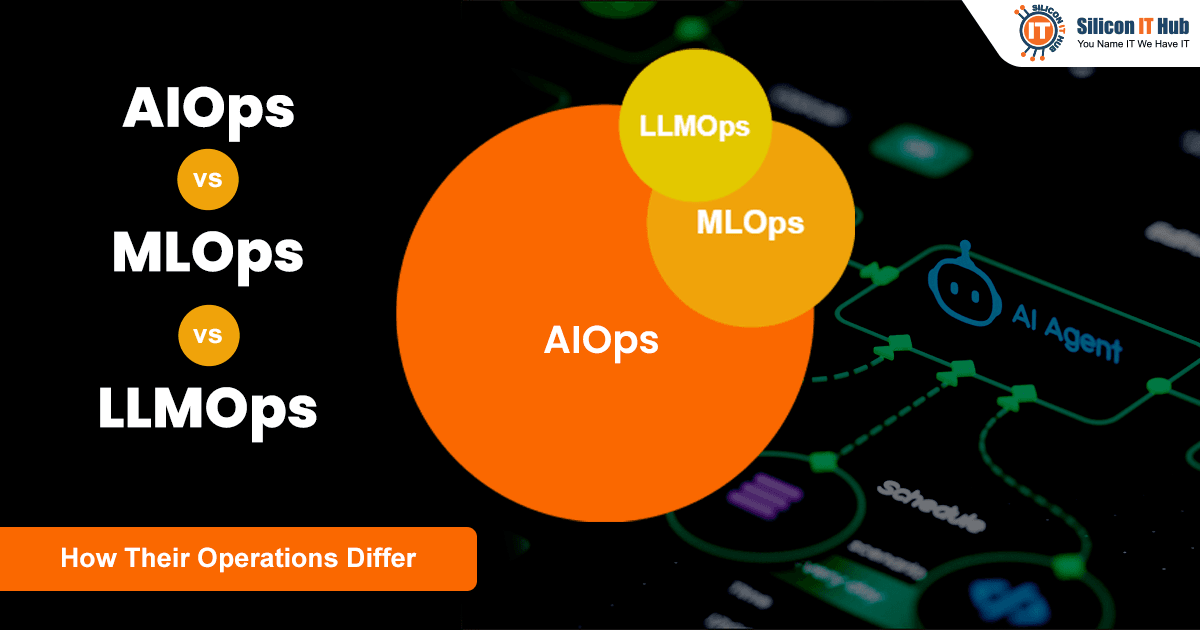
AIOps vs MLOps vs LLMOps: How Their Operations Differ
Overview
AI operations take modern businesses to the next level. It is, however, challenging for businesses to monitor thousands of IT events with different operational requirements using a single model. This leads AI development services to take help from predictive ML models and large language models.
This post discusses the roles of three models- AIOps, MLOps, and LLMOps- in custom AI development services and their differences. We will also dig deeper into MLOps vs LLMOps in this post, but before moving ahead, let’s understand these three models one after another.
Scope and Importance of AIOps
AIOps is about using artificial intelligence for IT operations. It uses AI techniques to improve the way of monitoring and managing IT environments. An AIOps platform gathers a lot of operations-related data from different sources. Some such sources are infrastructure, applications, networks, logs, and systems.
ML and analytics are capable of discovering patterns and identifying anomalies from this data. While AIOps means AI for operations, MLOps and LLMOps are useful for applying operations to AI systems. Some typical AIOps use cases include the following:
- Anomaly detection
- Event correlation
- Automated incident prioritization
- Root-cause analysis
- Capacity planning
- IT service management
- Automated remediation
AIOps can increase business value by reducing operational complexity and helping teams focus on meaningful incidents.
Scope and Importance of MLOps
MLOps meaning is to use practices, processes, and technologies to operationalize machine learning throughout its lifecycle. It connects data science, ML engineering, and operations. An ML system depends on application code, data, features, training process, and production behavior.
A mature MLOps workflow consists of data collection and preparation, experimentation, model training, evaluation & versioning, deployment, retraining, and governance. An ML model can perform well during development and degrade after deployment. This is why model monitoring and deployment are key elements of MLOps.
MLOps use cases include
- Fraud detection
- Recommendation systems
- Demand forecasting
- Predictive maintenance
- Credit risk modeling
- Computer vision
- Predictive analytics
- Dynamic pricing
For example, a fraud detection model may need frequent retraining because such behaviour changes over time. An MLOps pipeline can connect data preparation, training, evaluation, model registration, and monitoring into a repeatable process.
Scope and Importance of LLMOps
AIOps is about using artificial intelligence for IT operations. It uses AI techniques to improve the way of monitoring and managing IT environments. An AIOps platform gathers lot of operational data from infrastructure, applications, networks, logs, and other systems.
Machine learning and analytics techniques can recognize patterns, identify anomalies, and assist the operations team in investigating an incident based on collected data. While AIOps involves artificial intelligence in operations, MLOps and LLMOps involve operations for AI systems. Examples of typical AIOps applications include:
- Foundation models
- System prompts
- Retrieval systems
- Vector databases
- Embedding models
- Knowledge bases
- Guardrails
- External tools
- APIs
- Evaluation systems
- Application infrastructure
LLMOps must monitor the entire AI application rather than simply checking the availability of the model. For example, a customer support assistant might produce a technically valid response while still giving incorrect information. It is because the retrieval system supplied outdated documents.
Let’s go through the differences between AIOps, MLOps, and LLMOps in detail.
AIOps vs MLOps vs LLMOps- Key Differences You Should Know
It is essential to understand how these three approaches work by differentiating them.
| Factor | AIOps | MLOps | LLMOps |
| Primary Focus | IT operations | ML lifecycle | LLM applications and lifecycle |
| Core Objective | Improve IT reliability | Operationalize ML models | Operationalize LLM-powered systems |
| Data | Logs, metrics, traces | Training and inference data | Prompts, responses, tokens, documents, tool calls |
| Users | IT and operations teams | Data scientists, ML engineers, DevOps | AI and ML engineers, developers |
| Monitoring Focus | Infrastructure and application health | Model and data performance | Model quality, responses, cost, latency |
| Common Concern | Alert noise and incidents | Model drift | Hallucinations and response quality |
| Deployment Focus | IT workloads and remediation | ML models | LLMs, prompts, RAG, agents |
| Evaluation | Operational outcomes | Statistical/model metrics | Quality, safety, relevance |
| Retraining | Not the central concern | Core capability | Fine-tuning and prompt/model changes |
| Cost Focus | Infrastructure efficiency | Training and serving resources | Token and inference costs |
This quick table illustrates that it is not advisable to treat these three disciplines as interchangeable.
Why LLMOps vs MLOps Difference Matters
The LLMOps vs MLOps difference is specifically important because we can consider LLMOps as a specialized extension of broader MLOps practices. LLMOps requires many traditional MLOps capabilities, including
- Model versioning
- Data management
- Evaluation
- Monitoring
- Security
- Governance
- Reproductivity
- Deployment automation
The difference between LLMOps and MLOps emerges in what teams measure. Traditional ML evaluation often relies on relatively well-defined metrics such as accuracy, precision, or AUC. LLM evaluation, on the other hand, is more complicated because generated outputs can be acceptable in multiple ways. The response you get may be
- Grammatically correct but factually wrong
- Accurate but unnecessarily expensive to generate
- Respond correctly but violate a company’s policy
The output may also change significantly after adjusting a prompt, model, or retrieval.
AI Observability Changes Across Three Disciplines
This is a major point of difference between AIOps, MLOps, and LLMOps. AI observability goes beyond application monitoring with the use of artificial intelligence.
In AIOps, it is the input that AI analyzes to improve IT operations.
In MLOps, it helps determine whether an ML system remains reliable and whether the model has changed.
In LLMOps, it extends into the quality and behavior of generated inputs. When it comes to an LLM-powered application, teams may need to monitor
- Prompt and response behavior
- Token consumption
- Response latency
- Retrieval quality
- Hallucination indicators
- Tool execution
- User feedback
- Cost per request
- Model performance
- Agent trajectories
Modern AI agents add another layer of complexity. It is because these agents may call multiple models, APIs, tools, and knowledge sources.
Looking to develop an Advanced, AI-Driven Business App for Your Company?
LET’S CONNECTWhich Model Does Your Business Need?
The answer to this question depends on your organization’s requirements. Let’s dig deeper into the selection of three disciplines.
Choose AIOps for IT Complexity
AIOps makes sense when your organization manages large and complex IT environments. This discipline assists your company in incident detection, automated remediation, and operational analytics. A large enterprise with hybrid cloud infrastructure uses AIOps to consolidate operational signals.
Choose MLOps for Predictive Models
This discipline is essential when your organization develops and deploys traditional machine learning models at scale. Whether these models depend on changing datasets or directly influence business decisions, a formal MLOps process is useful for improving reliability and traceability.
Choose LLMOps for Generative AI
LLMOps becomes relevant when your business moves beyond an experimental chatbot and begins operating production-grade generative AI applications. When an app depends on RAG, prompt engineering, agents, or high-volume inference, LLMOps provides the operational structure.
In some scenarios, organizations can use AIOps, MLOps, and LLMOps together.
AIOps, MLOps, and LLMOps- Can We Use Them Together?
It is fair to say that larger organizations may eventually need all three disciplines. Let’s consider an enterprise customer-service platform as an example.
Its infrastructure team could use AIOps to monitor infrastructure and operational events.
The company might use MLOps to operate a churn-prediction model to identify customers at risk of leaving.
At the same time, its customer-support assistant could use LLMOps to manage prompts, retrieval, response quality, and AI safety.
Here, these disciplines coexist and operate at different levels. AIOps manages IT operations, MLOps manages ML operations, and LLMOps manages large language model applications.
Companies investing in AI development services should define their operational requirements before selecting the right strategy or approach.
Final Takeaway
The AIOps vs MLOps vs LLMOps comparison becomes clearer when we consider them as separate approaches for solving different operational problems. MLOps and LLMOps share significant similarities, but LLM applications introduce some operational characteristics that traditional ML workflows cannot address fully.
For technology leaders, the goal should not be to choose the newest ‘Ops’ discipline. Their goal should be to determine requirements, chances of failures, and control necessary to keep the AI system reliable. A custom AI development services provider can help organizations select the right approach.


 Have an Idea?Let’s Build It Together!