

Global App Launch Checklist- What Engineering Teams Should Consider
Introduction
What is a global app launch as a process? It is a system test for the architecture, infrastructure, localization strategy, compliance readiness, and operational discipline of your application. Engineering teams discover this at the end of the development process. This is a major reason why the app works in staging, passes QA, and survives internal demos. This app, however, fails under real-world conditions, including CDN latency, payment failures, and localization issues.
We can consider the global app deployment as an operational program. Here is a useful checklist for engineers, DevOps teams, and QA specialists from a custom mobile app development company’s perspective. It focuses on the technical and operational aspects to prevent any launch-week surprises or setbacks. It is important to go through the reasons why global app launches fail before moving ahead.
Why Global App Deployment Fails
As per a Statista survey, the global market for mobile apps is expected to reach USD 756 billion by 2027. The following graph shows this estimated growth with a steady CAGR of over 8 percent from 2022 to 2027.
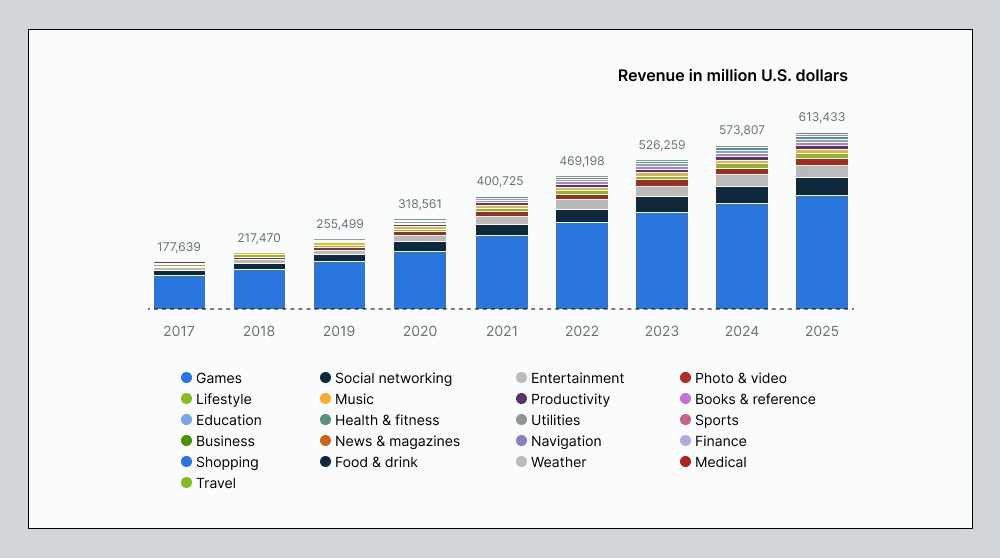
Source
It is, however, essential to consider that despite the average number of apps installed crossing 80 apps in a smartphone, nearly 62 percent of them remain unused on a month-over-month basis. Companies should consider global app launching as a crucial task for this reason.
Most failures of application launches are because of small assumptions that break apps. Common examples include hardcoded locale or currency values, backend services capable of handling beta traffic only, and incomplete app store metadata. Other common reasons behind the failure of global app deployment are
- Failure of push notifications across time zones
- Inconsistency in API behavior under load
- Missed privacy disclosures for particular regions
- Absence of safe rollback of release pipelines
A comprehensive launch checklist can reduce the risk of failures by forcing teams to validate assumptions in advance.
Global App Launch Checklist
The detailed checklist for a global app launch will help you ensure its success. Mobile app development service providers follow these factors in a step-by-step manner.
1. Finalize Architecture of App Release
It is better to finalize the production architecture before releasing the app. Last-minute infrastructure changes create unpredictable behavior in the app and complicate its rollback plans. Engineers can confirm that production environments match staging environments. They can also ensure that feature flags are correctly configured and rollback procedures are well documented. Moreover, they should manage secrets and credentials securely.
Environment drift is one of the key reasons for increasing launch issues. Configuration mismatches can lead to behavioral differences between staging and production.
2. Validate App Scalability and Performance
Your app should handle different traffic patterns effectively. Load tests with realistic patterns like peak concurrent users and regional traffic spikes can help engineers make apps ready. Payment or transaction surges, media upload or download, and authentication bursts are also useful tests for validating the app’s scalability. Engineers can measure API latency, cache hit rates, error rates, and database throughput.
Developer teams that use AWS managed services rely on auto-scaling, CDN distribution, and managed databases. These are necessary characteristics to handle unpredictable launch traffic. The key is to validate scaling behavior before launch day.
3. Prepare Your App for Multi-Region Launch
Low latency and high availability are common expectations of app users globally. It is, therefore, necessary for the team of engineers to review their deployment strategy. This strategy consists of CDN configuration, edge caching, DNS failover policies, regional health checks, and disaster recovery procedures. Multi-region database replication is also necessary to review. It helps them reduce replication lag and address debugging challenges with improved app resilience.
The general guideline is to deploy the app globally only where user concentration is sufficient to justify the operational overhead.
4. Complete Localization and Internationalization
Whether you want to launch an app at a global scale, it is essential to treat localization as a user-centric initiative. It goes beyond a translation exercise. Successful international applications have localized aspects, including-
- Language adaptation
- Date and time conventions
- Regional payment method integration
- Cultural preferences
- Search and Notification functionality
A custom mobile app development company can enhance the international deployment process with effective localization. This can increase engagement more significantly.
5. Verify Your App for Store Readiness
Approval from Google Play and Apple App Store is the fundamental condition for a successful global launch. Engineering teams should prepare the list of documents necessary to get approval from app stores. Here is the checklist of documents and information for the global app launch and ongoing updates-
- App names, descriptions, and keywords should be localized
- Screenshots and preview videos match regional expectations
- Privacy policies and terms of service are accessible
- Age ratings and content declarations are accurate
- Release notes should be ready for each locale
It is better to submit the app early because its review timelines can vary significantly across regions.
6. Enhance Security and Compliance
This is one of the most important priorities for companies and developers. It is fair to say that any security issues discovered after launch become a reason for the app’s failure. App development companies run a final security review before global launch. This review involves
- Dependency vulnerability scanning
- API authentication validation
- Rate limiting and abuse protection
- Penetration testing for critical flaws
- Encryption verification in transit and at rest
- Logging and monitoring review
It is essential to perform compliance checks as well. These checks should cover regulations according to the target markets. Some of the prevalent regulations include GDPR, CCPA, and other regional data handling necessities.
7. Test Your App for Real-World Device Coverage
Mobile app developers validate their apps across multiple versions of iOS and Android OS. Apps should work seamlessly across different screen sizes and aspect ratios as well as on low-memory devices. Other validations are for varying network conditions and intermittent connectivity scenarios. The custom mobile application development company should focus on devices as per their actual target regions, along with the internal team’s hardware.
8. Configure App Observability before Launch
Configuration setup for application performance monitoring, crash reporting, distributed tracing, and centralized logging is essential before launching the app. Development companies should also establish custom business metrics, including signups and retention events. App observability should include alerting thresholds for critical failures. Companies must get dashboards that answer the key performance-related questions on launch day.
9. Rehearse Response for Incidents
A release command structure consisting of the backend owner, the mobile owner, the primary incident lead, the QA verification owner, and the communications owner is useful for giving quick responses to incidents. Developers run a launch simulation that includes a failed deployment rollback, a scenario of app store rejection, a database performance issue, and a regional outage.
When you hire dedicated developers for building a customized application, they make a team to get quicker recovery and communicate effectively when problems occur.
10. Plan Post-Launch Operations
This is another major factor to consider. App launching is an ongoing process. It is better to prepare the following for handling post-launch operations seamlessly.
- 24-72 hour heightened monitoring coverage
- User support escalation paths
- Analytics review cadence
- Feature flag rollout plans
- Post-launch retrospective scheduling
A preplanned and disciplined first week of the launch can drive the mobile app toward success through high stability and engagement.
This checklist will help developers and companies make their apps ready for global rollout. It is better to go through some common factors that engineering teams often miss during the launch.
What Engineering Teams Miss
One of the most crucial factors is time zone assumptions. When UTC handling of the application is inconsistent, users get scheduled jobs, promotions, and notifications at the wrong local time. Third-party service limits like payment gateways, SMS, analytics tools, and push notifications may stop requests, especially during traffic spikes. App updates, text expansion in several languages like German, and observability gaps are other factors that require attention.
Managed cloud partners can assist companies with infrastructure automation, monitoring, security hardening, and incident response preparation. This assistance is useful for engineers to address several gaps. Considering all these aspects, we can give an estimated practical timeline for an app’s global release.
Practical Timeline for Global App Launch
Here is a quick table showing a launch timeline for a customized application.
| Time Before Launching an App | Focused Areas |
| T-30 days | Architecture development, load testing, and localization tracking |
| T-21 days | Security review, app store metadata preparation |
| T-14 days | Multi-region validation and device testing expansion |
| T-7 days | Observability setup, incident rehearsal, and release candidate freeze |
| T-2 days | Final smoke tests, app store submissions, and rollback verification |
| Launch Day | Staged rollout, active monitoring, and rapid response coordination |
| T+7 days | Metrics review, hotfixes, and retrospective planning |
Enterprises can contact a reputable mobile app development services provider to manage this checklist effectively and in a timely manner.
Looking for a trusted application development partner for your business?
LET’S CONNECT!Concluding Lines
A successful global rollout of your app is the result of disciplined checks executed before users arrive. The abovementioned checklist focuses on the common mistakes of engineers and all the major considerations. Whether you hire dedicated developers or partner with a custom mobile app development company, app launching is a coordinated effort. This engineering operation needs to address localization gaps and rollback unpreparedness.
Silicon IT Hub is a leading mobile application development company. Our in-house teams of experienced mobile app developers help you at every level, from designing and development to deployment of the app. We make your enterprise-grade application ready for a global launch by using advanced tools and technologies.


 Have an Idea?Let’s Build It Together!