
Custom AI Model Development vs. Pre-Trained AI: Costs, Benefits, and Use Cases
Introduction
A 12-person marketing agency can realistically test an AI model for drafting product descriptions within a week or two. A snack manufacturer that wants to catch a hairline seal defect on a packaging line may spend months on what looks like the same decision. The gap isn't ambition or budget. It's whether an off-the-shelf model can do the job at all.
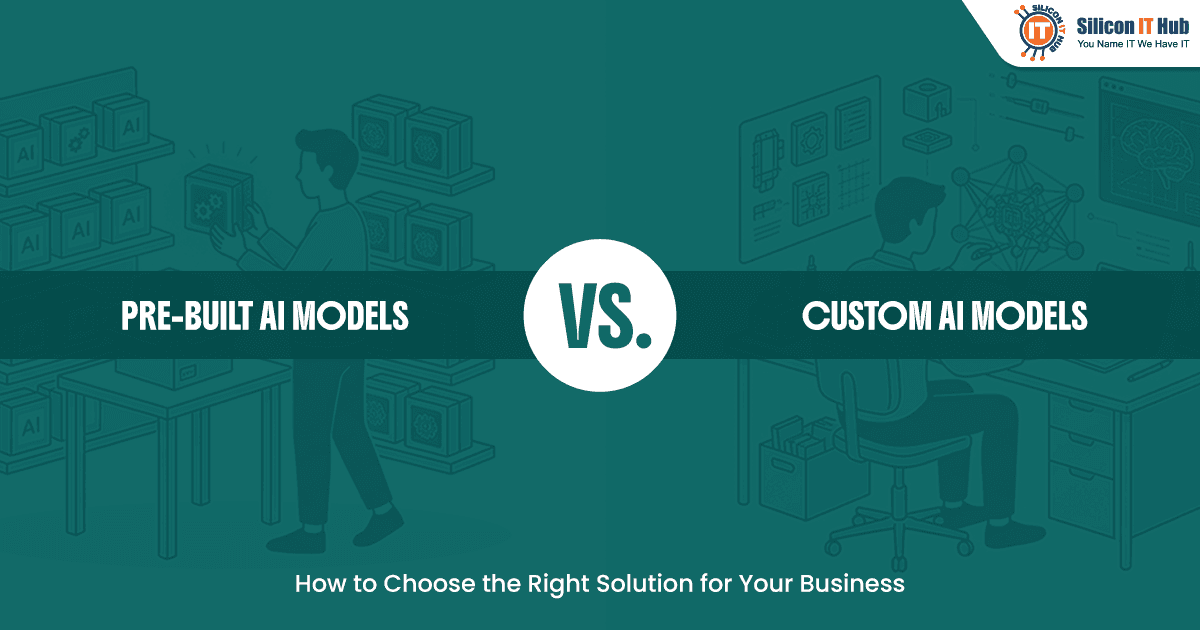
If your business needs AI quickly, pre-built models are usually the best place to start. Custom AI development services are worth investing in if the AI needs to handle company-specific data, follow complex business logic rules, or participate in a process which is not possible to achieve using ready-to-use solutions. The decision on choosing one of these models depends on your problem and level of control over it.
The knowledge of pre-built AI Models vs. custom AI models can help avoid common mistakes and save money. Those errors include paying for technology that you can buy, or use a general-purpose tool to solve a business problem it was not designed for.
Our recommendation: test an existing model first, and invest in Custom AI Model Development only when a specific limitation justifies it. Some projects end up needing both.
Pre-Built AI Models vs. Custom AI Models: Tabular Comparison
Pre-built models win on speed and upfront cost, while custom models win on fit and control.
| Decision Factor | Pre-Built AI Models: What to Expect | Custom AI Models: What to Expect |
| Initial cost | Usually lower, since the provider has already built and trained the model | Usually higher, since you pay to prepare data, build, test, and connect the model |
| Time to launch | Days to a few weeks for a straightforward use case | Several weeks to several months, depending on complexity and how ready your data is |
| Business fit | Suits common tasks and standard workflows | Suits specialized tasks and distinct business requirements |
| Data requirements | May work with prompts, connected documents, or limited configuration | May require carefully prepared, labeled, or domain-specific data |
| Customization | Usually limited by the features and available configuration | Greater control over model behavior, architecture, and task-specific training |
| Accuracy | Depends on the task, model, input quality, and configuration | Can perform better on a defined task when suitable data and testing support it |
| Integration | May offer ready-made connectors or APIs | May require additional engineering to connect with existing systems |
| Maintenance | Provider may manage model updates and infrastructure | Your team or service provider monitors the model, applies updates, and retrains it |
| Data control | Depends on policies, settings, and deployment options | Can offer more deployment control, but privacy still depends on implementation |
| Ongoing costs | May include subscriptions, usage fees, and additional integration costs | May include hosting, engineering, monitoring, support, and retraining costs |
| Best suited for | Prototyping, common business tasks, and faster deployment | Specialized prediction, classification, and workflows that need closer control |
The distinction is not simply between buying and building. You can customize an existing model without training a new one from scratch, and in practice that is usually the more sensible route than building a foundation model.
For example, if you sell home goods online and need descriptions for a few hundred products, an existing language model, such as GPT, Claude, or Vision API, may give you usable drafts on day one. If you manufacture packaged food and want to catch defects in images from your own production line, you will likely need a model trained or adapted on photos of your own products.
When Pre-Built AI Solutions Make More Sense
Pre-Built AI Solutions are a practical choice when your team needs quick results, or you are still testing whether AI can solve a particular problem.
1. You Need to Launch Quickly
Current models help you test an objective without building an ML pipeline. For example, a five-person marketing team can use an established language model to compose product descriptions, summarize campaign reports, and write different versions of ad copy. Connect it with your present workflow, review the output, and quantify if it saves enough time to keep paying for it. There is usually little reason to build a new model if the results are acceptable.
2. Your Use Case Is Relatively Standard
Meeting summaries, email drafting, translation, document extraction, and basic customer support tend to work well with existing models.
A 20-person accounting firm, for instance, could use an AI assistant to summarize client calls and draft first-pass status updates. You would still want access controls and a partner reviewing anything that goes to a client, but you almost certainly don't need to train a model from scratch.
3. Your Budget Is Limited
Pre-built models such as GPT, Claude, or Vision API reduce initial development costs. It is because these models already manage most of the research, training, and infrastructural work.
The purchase price is not the only cost, though. You also need to consider the costs incurred while using premium subscriptions, integration costs, and security assessment costs. Consider all of these running costs and not just the setup cost, especially when the usage is high.
4. You Have Not Validated the Business Case
If you're not sure AI will improve a process, run a small pilot. The usual practice is to test the pre-built model for real examples, document mistakes it makes, and compare the results with the existing workflow.
You get the evidence before you commit to a large-scale project. You can have a clear idea about the custom solution if the model experiment reports a limitation that further configuration will not be able to solve.
When Custom AI Model Development Is Worth the Investment
Custom AI Model Development becomes attractive when an existing model cannot meet your requirements consistently, or when a specialized task has enough business value to justify additional engineering.
1. Your Business Has Specialized Data
When you train your model for a particular task with relevant and representative examples, it can perform better. Consider a mid-sized snack manufacturer inspecting sealed bags on a fast production line. A general-purpose Vision API may recognize a bag but struggle to distinguish a slightly misaligned label or a tiny seal irregularity from normal product variation. Photos from your own inspection station could help developers build or adapt a model for those specific defects.
The result still needs testing across different lighting conditions, packaging types, production speeds, and defect categories. Specialized data creates an opportunity for better performance; it does not guarantee it.
2. Generic Tools Cannot Follow Your Business Rules
Some workflows depend on rules that are specific to your company. Suppose you run a regional freight carrier and need to predict delivery delays from route history, vehicle capacity, warehouse schedules, traffic, and service-level commitments. A generic tool can only summarize delays after they happen. When the predictive models are trained on structural data, they can flag shipments that are at risk before the trouble occurs. Business rules can now decide when to inform customers.
Custom AI solutions for business, in this case, can combine a model, current operational software, and clear decision rules rather than just relying on one AI component.
3. You Need Greater Control Over Data and Deployment
While working in a regulated or data-sensitive business, you need to manage where data is processed, who has access to it, how long they can hold it, and which systems can use the output.
AI model customization can provide more control over hosting, access permissions, logging, and integration. It is not just customization that can secure a solution. Security depends on the architecture, terms in the contract, and ongoing control.
Document the types of data and the controls your organization must meet before selecting a development approach.
4. The Workflow Is Central to Your Competitive Advantage
A custom-made solution can be worth considering if AI supports a process affecting product quality, customer experience, or an operating cost.
As a building material distributor, you want to forecast monthly demand for seasonal peaks. You might have considered seasonal purchasing, supplier lead time, regional demand, and inventory level. The development firm can design a custom forecasting model around the inputs and test it against your existing method.
The investment makes sense only if the improved decisions create measurable value that exceeds development and operating costs.
The Middle Path: Customize a Pre-Built Model
You do not always need to choose between an off-the-shelf AI tool and building a model from scratch. Customizing an existing model provides a practical middle ground. This allows you to adapt proven technology to your workflow without paying for new custom model development.
There are four common ways to customize your pre-built model:
- Prompting: Guide an existing model’s responses with clear instructions, examples, and context. This is beneficial for content generation, document summaries, and customer support queries.
- Retrieval-Augmented Generation(RAG): Connect a pre-trained model to your documents, policies, and knowledge bases so it can retrieve relevant information before generating answers. This helps when you want responses to reflect internal or frequently updated business information.
- Fine-tuning: Train an existing model using task-specific examples to improve its performance on specific or repetitive tasks.
- AI Agents: Build agents on existing models to perform multi-step tasks by interacting with business applications, databases, and APIs. For example, an agent can check an order status, review delivery policies, and prepare a customer response for approval.
The right approach depends on your business requirement. Prompting is enough for simple tasks, while RAG supports company-specific requirements and fine-tuning helps with specialized outputs. AI agents are convenient when your workflow involves multiple connected steps.
For your business, the middle-path approach can become a practical starting point. Customize an existing model, evaluate its results, and invest in custom AI model development only if its limitations justify the additional cost.
Pre-Built AI Models vs. Custom AI: Five Factors to Evaluate Before Choosing
A useful decision starts with the business problem rather than the technology.
1. Define the Result You Need
Write down what the AI system must accomplish. "Use AI to improve customer service" is too broad to guide a technical decision.
A better objective is to classify the incoming requests into the approved categories and direct them to the appropriate team. Check if an existing model can do the job efficiently. It is advisable to define the success criteria prior to evaluating classification accuracy, processing speed, error rate, or the amount of manual review needed.
2. Assess Your Data Readiness
Check that your records are accurate, available, legally usable, and labeled for the task. Low-quality data sinks custom builds more often than poor models do.
If your company has inaccurate data or limited examples of significant outcomes, it may take more time to prepare your data. It would be better for you to use pre-existing models or rule-based systems when improving your data.
3. Compare Total Cost of Ownership
A realistic budget covers more than the model itself. You will pay to integrate it, host it, call its API, prepare data, monitor it, secure it, support it, and train staff to use it.
Prebuilt tools can be affordable initially but become costly at high volume. Custom tools might need more money initially but decrease some per-task expenses.
Calculate how much each tool will cost for the same time period and under the same workload conditions. Also include the cost of wrong predictions and human evaluation.
4. Identify the Level of Control You Need
Check whether model behavior needs to change, use a certain deployment environment, protect sensitive data access, or investigate the reason for predictions.
You can choose the existing model if its configuration capabilities can cover your needs. Otherwise, you will have to customize the model differently.
5. Plan for Maintenance
Data, customer behavior, business rules, and model capacity can vary. That is why AI systems need ongoing evaluation. If the source is not maintained well, there are fair chances that the forecasting model can become less reliable and produce outdated answers.
Determine who will observe performance, scrutinize errors, approve updates, and roll back changes before the system goes live. Custom development is a poor fit when you cannot support the maintenance it requires.
Partner with a custom AI development company to build tailored AI solutions.
LET’S CONNECTConclusion: Choose the AI Model That Solves Your Actual Business Problem
The choice between pre-built and custom AI depends on performance, price, control, and business benefits. Pre-built solutions are an efficient way of starting work for common tasks and preliminary testing. The necessity for custom solutions arises when specialized data, business rules, or deployment requirements create a clear gap.
First, pick one process, define a measurable outcome, and try applying one of the available models. See what works and where problems arise. Measure the cost of these problems. Only if the gaps justify the investment should you approach a custom AI development company. Run a two-week pilot on one process and track error rate and review time before taking a decision.


 Have an Idea?Let’s Build It Together!