
How Claude Code Reshapes AI-Powered Software Development
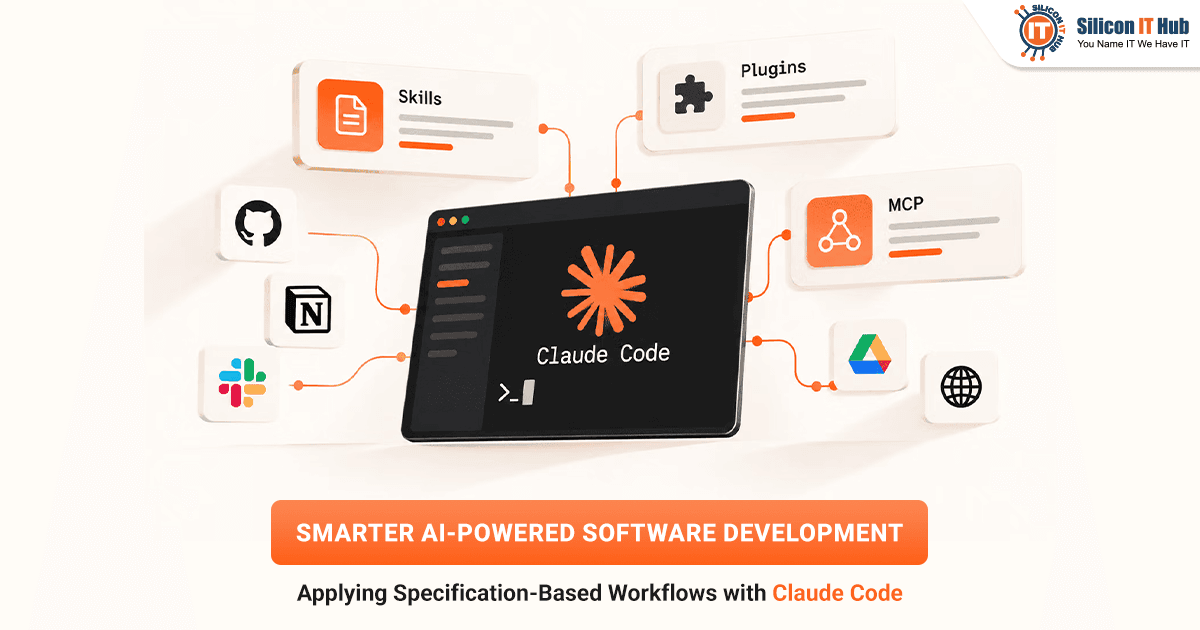
Introduction - Better Specifications Lead to Better AI-Generated Code
A one-page specification with acceptance criteria gets better code from Claude Code than a vague prompt. This is because the AI has less to guess. Ask for “a reset-password page,” and the AI must decide what happens when the email is unknown. It also decides how long a reset token lasts and whether it can be used twice. A specification settles all three before any code is written.
A specification-based development process could be used here as well. If a development team is using Claude Code with this approach, it will provide a better goal for an AI coding assistant. A reputable AI software development company uses this process to integrate automatic coding into usual methods.
An AI app development company can also use this approach to help teams handle complicated requirements and assess changes in accordance with pre-established acceptance criteria. It follows simple rules of defining desired functionality, assessing code, planning actions, making the smallest possible changes, and testing results.
What a Specification Contains and Why AI Tools Need One
A specification is a written description of expected behavior, constraints, and acceptance criteria. Developers provide enough information here to determine whether the result is correct. A useful specification includes-
Business objective
This includes the user problem and why solving it matters.
Functional requirements
It is a list of actions the application must perform, such as validating an email and issuing a reset token.
Technical constraints
These obstacles name the approved frameworks, APIs, data models, and architectural rules the code must follow.
Failure scenarios
These scenarios cover invalid inputs, unavailable services, and permission failures.
Testing requirements
These requirements specify which unit, integration, and end-to-end checks are necessary to pass.
Take password reset functionality on a B2B billing portal with 20000 customer accounts. A vague prompt might ask Claude Code to create a reset-password page. A stronger specification, instead, explains how the system validates the user’s email and generates a time-limited reset token. It prevents token reuse and responds to unknown email addresses.
Such a specification gives the developer and the AI tool a shared definition: a time-limited token, no token reuse, and a defined response for unknown email addresses. This does not mean that developers have to document every implementation detail before writing code. Define externally observable behavior first with important constraints. It enables developers to choose an appropriate implementation.
Necessity of Clear Specifications for AI-Powered Software Development
AI-powered development needs clear specifications because an AI assistant fills any gap in a request with its own assumptions. An AI coding assistant may interpret an incomplete request differently from the product owner.
It may also make assumptions about a database schema, reuse a pattern that no longer fits, or update one component. Here, specifications help teams address these risks before implementation begins.
Reduce ambiguity from the beginning
Vague requirements force the AI to guess, so write conditions you can measure. Think of a requirement such as “make the dashboard faster”. It does not identify the slow operation, the affected users, or the expected result. Developers need measurable conditions with an understanding of the current issues.
A more useful specification may require the dashboard to avoid repeated API requests. A performance target can be added after the team measures the existing application and agrees on a realistic threshold.
Claude Code can investigate the relevant components and propose a plan related to those requirements.
Keep generated changes within boundaries
An AI tool may produce a technically valid implementation that conflicts with the application’s predefined patterns. For example, it might introduce a new HTTP client when the project uses a shared client with authentication.
A specification can identify the approved libraries and existing service layers. Project instructions can address these requirements across development sessions. It becomes particularly helpful when the AI software development process is based on an existing codebase.
Convert acceptance criteria to verifiable tests
The value of specifications increases when there is a test or any other kind of verification for every critical requirement. For an online grocery store’s cart, the acceptance criteria might be: the total recalculates when a shopper changes a quantity, a quantity of zero or below is rejected, and items stay in the cart after the session refreshes.
These conditions can guide test creation and help reviewers identify missing behavior. Passing tests does not prove that software is completely correct. It provides developers with stronger evidence than accepting code because it looks plausible.
Improve collaboration between technical teams
Product managers understand the user’s problem, and designers define interaction expectations. Developers, on the other hand, understand the system constraints. A shared specification connects these perspectives before implementing costly assumptions.
An AI software development company can use this shared document to establish scope, discuss edge cases, and agree on acceptance criteria in advance. This can make review discussions more concrete because stakeholders can assess the delivered behavior against agreed necessities.
How Claude Code Supports Specification-Based Workflows
Claude Code for developers offers an agentic coding environment that can inspect project files and make code changes. Within the permissions and configuration set for it, it can run the test suite, the linter, and git commands. It helps developers perform tasks such as investigating unfamiliar code, running tests, and explaining a suggested change.
The value of Claude Code largely depends on how the development team directs and reviews that work.
Explore the codebase
Ask Claude Code to inspect the relevant files, identify dependencies, and summarize the current behavior before implementing a feature. It is possible to instruct it explicitly not to modify code during this investigation.
A three-person team maintaining an Express.js customer portal might ask it to locate the authentication routes, examine token validation, and report any security-sensitive dependencies. The output should be a grounded assessment of the codebase. It should not be a generic implementation plan based on assumptions.
Create a plan
Planning gives developers an opportunity to catch incorrect assumptions for changes involving several files or business rules. Claude Code supports a plan-oriented workflow through its permission and interaction approaches. Developers can review this approach and agree on specific components that need modification. It helps them clarify requirements before implementing the changes.
Anthropic’s published guidance describes an explore, plan, code, and commit approach. It fits this model. The development team should adapt the sequence to its architecture, testing practices, and risk levels.
Use project instructions
A CLAUDE.md file can provide persistent project context, such as coding conventions, directory structure, build commands, testing instructions, and architectural boundaries.
This platform also supports several customization mechanisms, including rules, skills, hooks, and subagents. All these mechanisms are suitable for different kinds of guidance or assigned tasks.
For example, a fintech team might document that new API endpoints need request validation, and that authentication tests must run before approving the change. These instructions improve consistency, but they do not replace code review or enforced checks. In summary, the written rule is not sufficient to ensure control until proven by the workflow.
Verify the implementation
Claude Code can run relevant commands, interpret test failures, and investigate defects once the code is generated. Developers can view the real changes and dependencies, ensuring that the tests actually cover the acceptance criteria stated.
Passing tests do not guarantee the feature matches the requirement, so a human reviewer should approve each merge, and owners and stakeholders should decide when to deploy.
Writing Specifications That Claude Code Can Follow
A specification Claude Code can follow is short and concrete: expected behavior, boundaries, and how to verify the result.
Automated software development involves selected implementation tasks according to specifications, tests, and reviews. The quality of the specifications matters, as a long prompt can be ambiguous, whereas a concise specification can be effective. It should define the expected behavior and boundaries.
A list of specifications for ensuring an effective AI agent development workflow is-
| Specification element | What to define |
| Business objective | The user problem and the reason the feature matters |
| Expected behavior | What the user can do and what the system returns |
| Acceptance criteria | Observable conditions that determine whether the feature is complete |
| System constraints | Approved frameworks, APIs, data models, and architectural rules |
| Edge cases | Invalid requests, unavailable dependencies, and permission failures |
| Verification | Tests, static analysis, security checks, and manual review |
| Out of scope | Related changes that should not be included in this task |
Consider a requirement for an internal expense-management application. For example, weak: “Add expense approvals.” Strong: “Expenses over $500 need manager approval, receipts must be PDF or JPG under 5 MB, and a rejected claim returns to the employee with a reason.” The specification should also define the permitted amount range, attachment rules, and expected behavior.
The development team can then map each condition to implementation tasks and tests. A prompt asks for a result; a specification defines how to verify that result.
Looking to Develop AI-Powered Software for Your Enterprise?
LET’S CONNECTMeasuring the Value of Specification-Based AI Software Engineering
To measure the value, compare lead time, rework rate, defect escape rate, review effort, and maintenance impact before and after adopting the workflow. AI-powered software development tools have different capabilities. Talking about Claude Code, it is useful when a team wants an AI coding assistant that can work across a repository.
An AI app development company can choose the right tool and measure the value of specification-based software engineering. The success of AI software engineering should be measured by the quality and the amount of code.
Teams can establish a baseline before introducing a new workflow. Useful measures include lead time for changes, rework rate, defect escape rate, review effort, and maintenance impact.
Interpret these measures together and avoid universal productivity targets without evidence from the team’s work. Companies can compare similar tasks, document the measurement period, and account for changes in scope.
Start With Well-Defined Development Workflow
One of the most useful applications of Claude Code is helping developers move from a clear requirement to an implementation that they can inspect and maintain. Specification-based software development creates that structure by defining expected behavior before coding.
Before your next feature, write a one-page specification with acceptance criteria for a single endpoint. Ask Claude Code to explore and plan first, and review the plan before it edits any file.


 Have an Idea?Let’s Build It Together!