

How to Improve Logistics Operations Using Artificial Intelligence
Introduction
Each logistics firm aims to deliver services faster, reduce costs, and increase visibility to gain an advantage over its rivals. Using manual processes and disconnected systems causes delays. Such compounded delays lead to congestion in the warehouses, a rise in the number of inquiries from customers, and increased costs. Artificial intelligence can change the game through logistics process optimization.
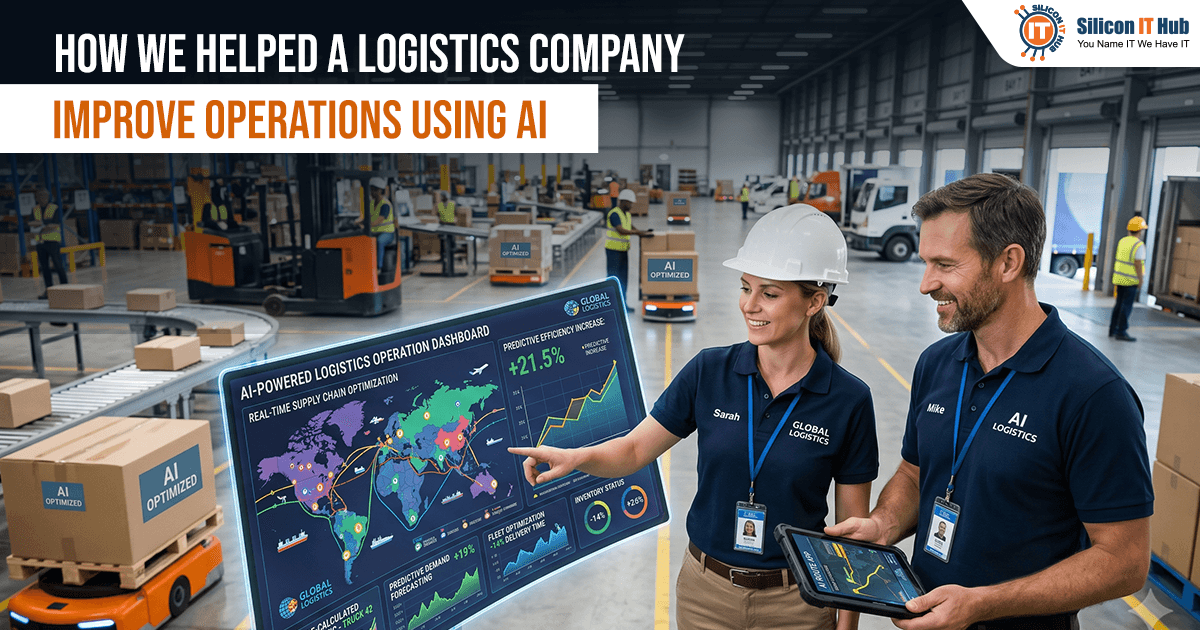
AI can identify operational patterns and predict disruptions in advance. It recommends actions to improve business outcomes instead of automating repetitive tasks. In other words, AI in logistics can help teams make better decisions with accurate, real-time information. In a recent engagement, our team worked with a mid-sized logistics company managing regional deliveries and hundreds of daily shipments.
This company was already using multiple digital tools, but the real issue was that all these tools operated independently. It resulted in preventing planners and managers from accessing a unified view. This blog will assist you in understanding the role of an AI software development company through a case study of this mid-sized logistics firm. It explains the challenges, the AI, and the lessons any logistics business can learn from this company’s digital transformation.
We will start with the reasons why traditional logistics operations are not sufficient.
Limitations of Traditional Logistics Operations
A logistics company may begin with a manageable fleet, some warehouses, and limited delivery routes. As business expands, shipments increase and supplier networks become larger, the overall operation becomes more difficult. Many organizations tend to add more personnel instead of improving their decision-making systems. Eventually, however, operations become increasingly dependent on manual methods.
Such traditional, manual logistics operations have some challenges, including-
- Delivery routes planned using historical assumptions
- Vehicle allocation based on dispatcher experience
- Warehouse inventory updated across multiple systems
- Shipment tracking requires manual intervention
- Customer support teams depend on multiple applications
- Delayed reporting that prevents proactive decisions
This is where AI in logistics delivers measurable business benefits. As per the official report, the market size of AI in the logistics industry is expected to reach USD 180.63 by the end of the year 2030. The following graph shows the gradual increase in the market share with a whopping 47 per cent CAGR.
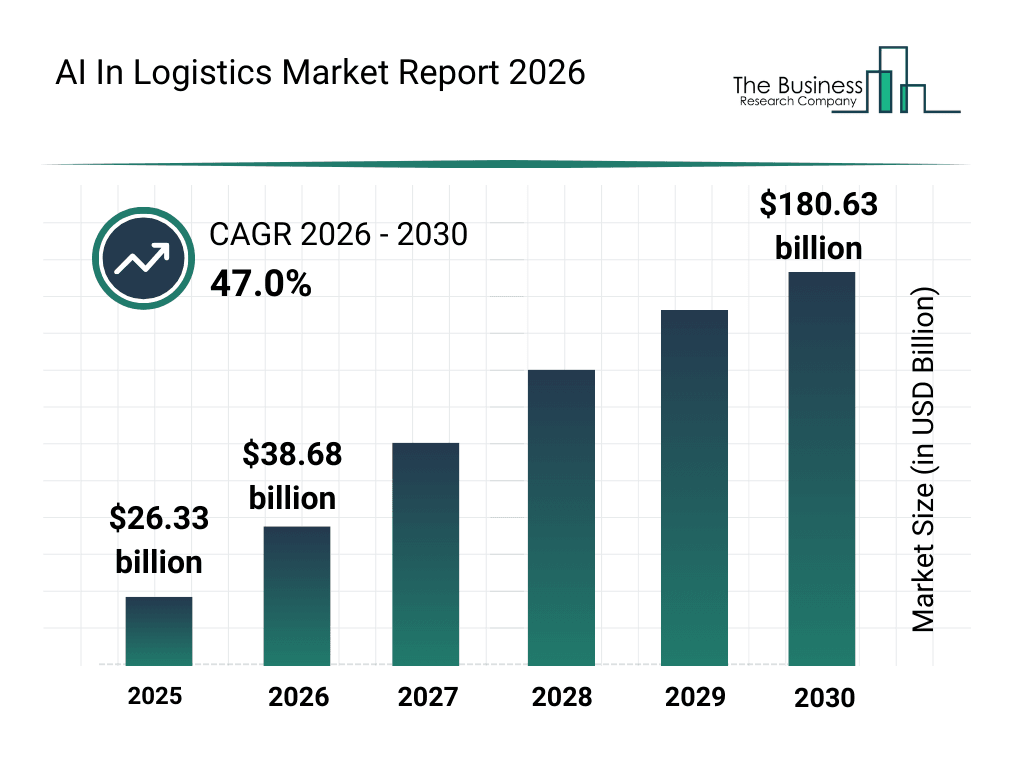
Source
AI is useful in connecting operational data across transportation, warehousing, and customer service. It supports decision-making throughout the organization. Here is a useful example of integrating AI in the logistics industry.
Logistics Automation Case Study
We recently worked with a logistics company on implementing AI in its operations. Here are the steps in a logistics automation case study.
Understanding Business Challenge
The client is a mid-sized logistics company that has experienced rapid growth over four years. The client engages in various operations like
- Regional transportation
- Warehouse management
- Multi-stop delivery routes
- Third-party carrier coordination
- Fleet scheduling
Every department had digital tools, but information remained fragmented. Dispatch teams planned routes manually, and manual supervisors updated shipment status separately. Other challenges included that management reports lacked current operational conditions, and customer service representatives relied on multiple applications to answer delivery questions.
The client needed technology that could continue learning as shipment volumes increased.
Diagnosing the Root Cause
We analyzed the client’s delivery planning, the usage of their fleet, the activity within their warehouses, and even how drivers were scheduled for work, to understand the underlying problem. We delved into things such as customer inquiries, shipment exceptions, and manual approval stages. Our investigation revealed that the problem was rooted far back, prior to any deliveries being made. Small planning inefficiencies accumulated, and they resulted in larger downstream issues.
We designed an integrated AI strategy instead of introducing isolated automation. We made a strategy capable of improving decision-making across multiple operational stages. We ensured that artificial intelligence improves those tasks by learning from operational outcomes.
Designing an AI Solution
We enhanced the client’s technology stack by integrating AI in logistics. Our in-house team of AI experts integrated AI capabilities with existing transportation systems, warehouse applications, and customer communication platforms through a robust logistics management software. This solution included several intelligent components working in sync.
Outcome
The client could optimize routes dynamically by recalculating delivery schedules based on live traffic conditions. The client could get inventory movement recommendations based on expected outbound orders instead of waiting for manual intervention. Automated exception detection identified delayed shipments in advance, and management dashboards provided operational insights using live business data.
Employees could adopt the new system quickly because these AI services operated within existing workflows. This could minimize the disruption and optimize the entire workflow.
An experienced AI software development company can build enterprise logistics environments with customized integrations and technologies.
Top AI-Powered Technologies that Deliver Operational Improvements
Logistics companies can get measurable improvements by using selected AI models. These models can solve specific operational problems effectively. Each capability of AI models can address a clearly defined business objective. As a result, the logistics company can achieve incremental improvements every day.
Some of the top AI-based technologies for the logistics industry include
Predictive Forecasting
Shipment volumes fluctuate because of changing seasonal demand, customer purchasing behavior, and weather conditions. The AI model, therefore, analyses multiple variables together to forecast transportation demand several days in advance.
Route Optimization
Traditional route planning is not sufficient for vehicles because once they are out, reality changes throughout the day. Traffic congestion, urgent shipments, vehicle breakdowns, and other factors need consideration. AI can improve operational efficiency for optimizing routes.
Shipment Exception Detection
Customer support teams typically learned about delayed shipments only after customers called. AI can address this challenge effectively. Machine learning models can monitor shipment progress continuously and identify delivery patterns that indicate a probability of delay.
Document Processing
Logistics activities produce thousands of documents in the form of invoices, bills of lading, proof of delivery records, and so forth. The use of AI in document processing will allow for data extraction, verification, and inconsistency detection.
The use of artificial intelligence in logistics can result in transformation by bringing the potential of operational enhancements. Artificial intelligence can be useful for scheduling deliveries quickly and efficiently and for ensuring effective fleet utilization. AI ensures logistics process optimization and increases overall efficiency by detecting any shipment risks faster.
Where AI May Not Be the Right Solution
Artificial intelligence is a highly powerful and revolutionary technology. This approach, however, may not be appropriate for every operational challenge. For example, if shipment records are missing certain information or there are significant differences in operational workflows, these will affect the AI model. Some highly specialized logistics operations that depend on regulatory decision-making or engineering may also need human oversight.
In such cases, it is best to approach an experienced AI development company.
Looking for Developing Advanced, AI-Powered Solutions for Your Logistics Business?
LET’S CONNECT!Why Businesses Choose Silicon IT Hub for AI-Enabled Solutions
Being an experienced AI software development company, Silicon IT Hub designs and develops solutions according to the existing environments. We assist logistics companies in minimizing disruption to their daily operations while implementing advanced, AI-driven solutions. The in-house team of expert AI developers enables companies in -
- Building intelligent enterprise-level applications
- Modernizing legacy logistics platforms
- Designing predictive analytics solutions
- Implementing AI in ERP and supply chain systems
- Automating document-intensive workflows
The expert AI developers at our firm understand business processes before developing and implementing advanced solutions.
Concluding Remarks
Artificial intelligence is reshaping logistics by combining predictive analytics, workflow automation, and connected data. A logistics company can reduce delays, improve its fleet utilization, strengthen customer service, and make decisions more quickly with AI. Whether you are planning to modernize transportation, warehouse management, or supply chain operations, it is better to partner with a leading AI software development company.


 Have an Idea?Let’s Build It Together!