


DevOps Best Practices for Faster and More Reliable Software Delivery

Introduction
In today’s competitive environment in the world of digitization, companies can no longer tolerate delays in software development services. They cannot afford constant production failures and long software development cycles. Consumers demand software that is fast, safe, reliable, and constantly evolving. At the same time, developers should provide new features to their clients without decreasing software quality.
DevOps unites development, operations, security, and QA teams within the framework of common practices, tools, and goals. Using collaboration, automation, feedback, and standardization, organizations can speed up the software release process while maintaining its stability and reliability.
What Is DevOps Software Delivery?
It is the practice of combining custom development services with IT operations. This is done to accelerate the collaboration and automation of the delivery process lifecycle.
In conventional approaches, the development and IT operations are two separate teams performing their roles in project development. The developers create the application, and the operations team handles deployment and infrastructure issues. This traditional approach can result in many problems, such as ineffective communication, delays in the deployment process, etc.
In the case of the DevOps approach, most of these barriers are gone as teams collaborate during all stages of software delivery.
These stages of software delivery usually include:
- Planning and coding
- Continuous integration
- Testing
- Continuous delivery/deployment
- Infrastructure provision
- Monitoring of the application
- Security assessment
- Continuous feedback
Software development services and DevOps are not all about fast releases. It is about releasing software reliably and safely.
Why Is It Important to Follow DevOps Best Practices in Custom Development Services?
Today, companies need to launch software regularly in order to meet their customers' requirements and adjust to new market circumstances. In turn, the quick launch of software products that lacks necessary processes leads to possible bugs, downtime, and security issues.
DevOps best practices in software development provide a good balance of speed and reliability.
With a proper implementation of DevOps, the company will be able to:
- Decrease software release cycles
- Automate routine development and operations work
- Spot bugs earlier
- Collaborate better between teams
- Have fewer deployment failures
- Make applications more reliable
- Increase the scalability of infrastructure
- Make applications more secure
- Quickly recover from incidents
- Make development and production environments more consistent.
For businesses that use the services of a software development company, such practices make projects more transparent and predictable.
DevOps Best Practices
We will discuss a list of 13 best practices for DevOps. They are as follows:
1. Build a Strong Continuous Integration Process
Continuous integration (CI) is one of the foundations of modern DevOps.
With continuous integration, developers regularly merge their code into a shared repository. Automated processes then build the application and run validation checks whenever changes are introduced.
Instead of waiting weeks or months to integrate large amounts of code, teams identify integration problems much earlier.
A strong CI process should include:
- Frequent code commits
- Automated builds
- Automated unit tests
- Code quality checks
- Dependency validation
- Fast feedback to developers
- Version-controlled source code
The earlier a defect is discovered, the easier and less expensive it usually is to fix.
Organizations should also keep CI pipelines fast. If developers have to wait a long time for feedback, they may avoid committing frequently, reducing one of the key benefits of continuous integration.
2. Apply Continuous Delivery and Continuous Deployment
Continuous integration is just one aspect of the delivery chain. The next thing to consider is developing an effective pathway from code that has been validated to deployment in production.
Continuous Delivery (CD) ensures that software remains in a releasable state at all times. Any successful change is potentially ready for deployment through a formalized process.
Continuous Deployment is another stage, along with automation, where the process is automated for the release of validated changes into production.
Well-planned CI/CD pipelines help automate activities such as:
- Compilation of code
- Running unit tests
- Static code analysis
- Integration testing
- Security testing
- Building artifacts
- Deploying environments
- Conducting acceptance testing
- Deployment to production
- Validation after production deployment
Which option between Continuous Integration and Continuous deployment an organization uses is based on its risk appetite, compliance needs, application architecture, and deployment strategy.
For teams interested in implementing DevOps practices for faster software deployment, delivery automation is the best option.
3. Automate your Tests
Test automation is crucial to ensure smooth software delivery, but relying on manual testing alone could be a serious constraint.
Automation in testing helps development teams perform repeatable tests within the CI/CD pipeline efficiently.
An extensive automation test strategy will consist of:
- Unit testing
- Integration testing
- API testing
- Regression testing
- Performance testing
- Security testing
- End-to-end testing
4. Use Infrastructure as Code
Manual management of infrastructure may lead to inconsistencies across different environments as well as to scaling problems.
A concept called Infrastructure as Code (IaC) is useful to define the infrastructure to overcome these problems.
There is no need to manually configure servers, networks, databases, and other types of infrastructure, as it can be done using code.
Advantages of IaC include:
- Consistency of environments
- Repeatable infrastructure creation
- Quicker environment creation
- Disaster recovery
- Adequate auditing
- Version control for infrastructure changes
- Configuration mistakes prevention
IaC is used in DevOps as infrastructure and can be provisioned within the CI/CD process.
5. Utilize DevOps Automation
DevOps cannot succeed without automation.
Yet the key to successful automation lies in automating repetitive, error-prone, and time-consuming tasks rather than everything that can be automated just because it can be.
The typical areas to consider for automation include:
- Code builds
- Tests
- Provisioning of the infrastructure
- Deployment of applications
- Database migration
- Security check
- Environment configuration
- Alerting
- Backups
- Rollbacks
The teams of developers and operations engineers will have more time to optimize the architecture through automation. This will improve the performance, add security features, and make users happy.
It makes sense to start automation with CI and tests, and gradually move towards automation of deployments, infrastructure, security, and other processes.
| DevOps Best Practice | How it Improves Software Delivery | Key Benefit |
| Continuous Integration & Delivery | Automates code integration, testing, and release workflows | Faster and safer releases |
| Automated Testing | Validates software throughout the CI/CD pipeline | Higher software quality |
| Infrastructure as Code | Automates infrastructure provisioning and configuration | Consistent environments |
| DevOps Automation | Reduces repetitive manual development and operations tasks | Greater productivity |
| DevSecOps | Integrates security checks into the software delivery cycle | Stronger security |
| DevOps Monitoring | Tracks application, infrastructure, and deployment performance | Faster issue detection |
| Automated Rollbacks | Restores stable versions when deployment failures occur | Faster recovery |
6. Embed Security Into Delivery Lifecycles
Security is something that should not be considered as an afterthought or a last step to take care of before going into production.
In software development services, DevSecOps automation is being increasingly used. Security is embedded into the development and delivery process.
Security automation may consist of the following:
- Static Application Security Testing
- Dependency vulnerability scan
- Container image scan
- Security testing of the infrastructure
- Secret detection
- Dynamic Application Security Testing
- Compliance validation
Finding security weaknesses early in the process helps fix them before they get to production.
DevSecOps also implies a collective effort. Development teams, operators, security personnel, and other stakeholders work together to incorporate security into their applications and infrastructure from day one.
7. Keep Microservices and Containers in Mind Where They Apply
There is no need for every application to use microservices, but they are applicable in some cases. In these cases, containers and deployable services allow the creation of a scalable DevOps process.
By using containers, you can package applications and their dependencies into reliable units. This can help in overcoming the common issue of software behaving differently in different environments it is deployed in.
Microservices might also allow for deployment of individual services without rebuilding/releasing the whole application.
8. Utilize DevOps Monitoring and Observability
If one cannot ascertain that the release is functioning properly, then fast deployment will be meaningless.
DevOps monitoring gives visibility into the performance of the application and infrastructure prior to and post-deployment.
One must keep track of performance data points like:
- Application response time
- Error rates
- CPU and memory usage
- Health of the infrastructure
- Performance of the database
- Request rate
- Availability
- Deployment performance
Unlike monitoring, observability goes further to allow one to see why something is wrong.
9. Make Small and Frequent Releases
A large number of changes always bring additional risks as they tend to be unpredictable in their interactions.
One of the most important DevOps principles is small and frequent releases whenever possible. This is done under the conditions imposed by the application architecture and business requirements.
Here is why small releases are beneficial:
- Easier debugging
- Less rollback
- Fast feedback from customers
- Lower deployment risks
- Easier code review
- Fast detection of bugs
10. Automate Rollbacks and Design for Failure
No software delivery system is foolproof.
Rather than relying on the fact that everything will always go well, an organization needs to be prepared for any eventuality.
Automation features like rollbacks will be able to switch back to the previous stable version of the application based on certain criteria.
Some of the deployment techniques include:
- Blue-green deployments
- Canary deployments
- Rolling deployments
- Feature flags
- Progressive delivery
11. Maintain Consistent Development Environments
Inconsistent environments are one of the typical reasons for software delivery failures.
The developers can develop an application in their local environment successfully. This application can run differently in tests or production due to discrepancies in dependencies, configurations, Operating Systems, or infrastructure.
Consistent environments are able to eliminate such issues.
Developers can use containerization, IAC, configuration management, and other approaches for automated environment provisioning. This helps in maintaining unvarying environments at different stages of software delivery.
The higher consistency between development, testing, staging, and production environments is achieved, the fewer surprises there will be for the teams.
12. Foster Collaboration and Shared Responsibility
DevOps is more than just a set of tools.
An organization may have an advanced CI/CD pipeline but fail in software delivery if there is no proper communication among the teams.
A successful DevOps process requires a culture wherein developers, operations personnel, security, testers, and business people collaborate to achieve success in delivery.
Teams must foster:
- Collaboration across functional boundaries
- Mutual performance objectives
- Transparency
- Knowledge sharing
- Blameless incident analysis
- Continual learning
- Documentation
- Improvement based on feedback
In case of a technical snag, the goal must be to figure out what made the system fail. This will improve the process rather than blaming someone.
13. Measure DevOps Effectiveness
An organization cannot get better at something it does not measure.
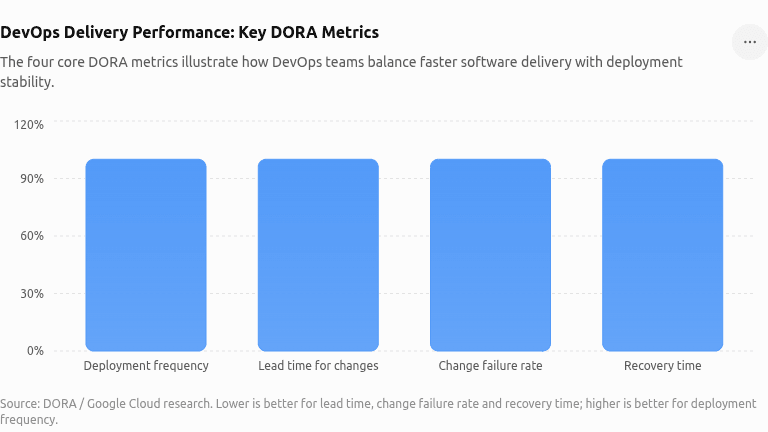
DevOps teams need to set metrics that will help them determine if they are getting faster and more stable in their process of delivery.
Some of the metrics used are:
- Number of deployments
- Time to deliver a change
- Failure rate of changes
- Mean time to recover
- Cycle time of release
- Build success rate
- Test failure rate
- Defect escape rate
Looking for Enterprise-Level Custom Software Development Services?
LET’S CONNECT!Software Development Services That Can Assist with Adopting DevOps Principles
Effective DevOps adoption might involve many aspects of application development, cloud infrastructure, automation, testing, security, and monitoring.
Companies not have resources in-house to cover all necessary skills can take the help of professional software development services. This will ensure the adoption of effective DevOps practices.
Professional Custom Development Services will help organizations to create customized solutions. This will be based on the needs of a particular company and will not offer a standardized solution.
A development partner will be able to assist in:
- Creating CI/CD pipeline
- Cloud Infrastructure Automation
- IAC (Infrastructure as Code)
- Automated Testing
- Application Modernization
- Containerization
- DevSecOps
- Monitoring and Observability
- Deployment Automation
- Performance Optimization
It is important that the partner not just implement DevOps tools but also create an appropriate process as well.
Final Thoughts
DevOps has emerged as one of critical methodologies for companies requiring fast software development services without compromising on quality and security.
The most efficient DevOps practices for custom development services involve technology, proper processes and culture. Continuous integration, continuous delivery, automated testing, infrastructure as code, DevOps automation, monitoring, and DevSecOps, can be combined. This will result in a predictable and scalable delivery process.
Be it in-house or with the help of external software development companies, DevOps can lead to the creation of an efficient software delivery process.


 Have an Idea?Let’s Build It Together!