

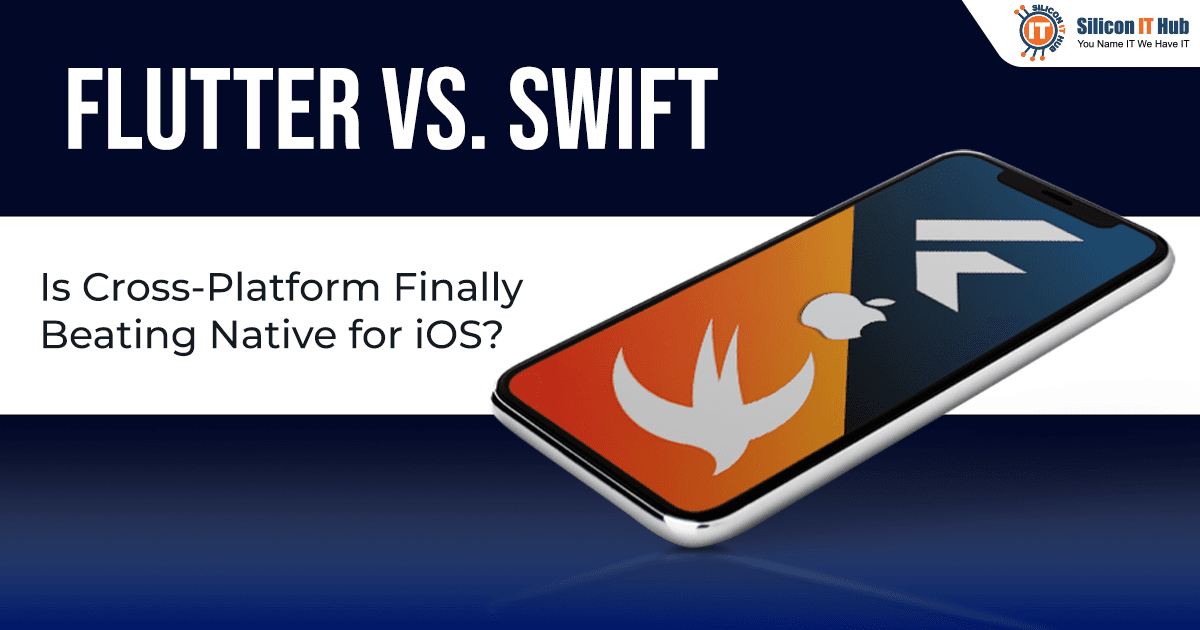
Flutter vs Swift: Which Is Better for iOS in 2026?
Introduction
As far as the creation of applications for iOS is concerned, the solution could only be one: native development via the Swift programming language. Times have changed, and Flutter can be seen as one of the most popular tools used for building iOS and Android applications with a single codebase.
Consequently, it became even more essential to address the question of comparison of Flutter vs Swift.
Flutter is famous for its rapid development, code reuse, consistency, and minimal development cost for both platforms. Swift is renowned for its ability to use the Apple ecosystem and provide native performance.
So, is Flutter finally beating native iOS development?
The short answer is: not universally, but it has become a powerful alternative.
The right choice depends on your product requirements, target platforms, budget, performance expectations, and long-term roadmap.
Let's compare Flutter and Swift in detail.
What is Flutter?
Flutter is a software development kit created by Google, which makes it possible to develop user interfaces using the Dart programming language. This makes it possible to create apps on different platforms with code that is quite similar.
The most important benefit of Flutter for enterprises is that it provides the possibility to develop apps both for Android and iOS at the same time.
Flutter can be used to build applications for:
- iOS
- Android
- Web
- Windows
- macOS
- Linux
Flutter also provides a rich collection of customizable widgets, making it possible to create highly branded and visually consistent interfaces.
Important Benefits of Flutter
The main advantages of Flutter are the following:
- Cross-platform development capabilities
- Unified code base
- Quick development cycles
- Hot reloading
- UI customization
- Good performance across application types
- A large community of packages and plugins
- Easy synchronization of updates for iOS and Android apps
For those who need to release their product on several platforms fast, Flutter will be extremely useful.
Why Businesses Choose Flutter
Assume that a company decides to develop an e-commerce application for iPhone and Android.
With the use of native development technologies, separate efforts would be needed for iOS and Android development.
With the help of Flutter, much of the code for the application could be shared by the developers.
This is the reason why a number of organizations are now considering the idea of collaborating with a Flutter app development company.
What Is Swift?
Swift is a modern programming language created by Apple for developing apps on their systems. When creating software for iOS, Swift can be used together with technologies such as SwiftUI and UIKit.
Unlike Flutter, Swift is mainly used for application development on native Apple systems.
Thus, developers have a great opportunity to use all API, frameworks, and tools provided by Apple’s system.
Advantages of Swift
Some key advantages of Swift when working on iOS include:
- Native iOS speed
- Ability to use Apple’s APIs
- High-quality integration with Apple’s system
- Support of iOS-specific features
- Availability of new technologies from Apple
- Development tools
- Mature native development ecosystem
In case an app requires iOS-specific features, Swift is very hard to replace.
Why Businesses Choose Swift
Native Swift development can provide greater control for iOS-only applications that rely on advanced camera functionality, Bluetooth, Apple services, system-level integrations, or specialized hardware capabilities.
A Native iOS app development company can also optimize the application specifically for Apple's hardware and software ecosystem.
Flutter vs Swift: One-On-One Comparison
We have now learned about both of these technologies separately; let's compare them according to the aspects that really matter to businesses.
Development Approach
The basic distinction between the two is very clear.
Flutter:
- Mainly cross-platform development
- Same source code
- Multiple platforms
- Dart programming language
- Flutter UI framework
Swift:
- Native Apple development
- Platform-dependent code
- Apple’s own frameworks
- Direct access to iOS APIs
In case you need an app for both iOS and Android, Flutter holds a significant edge.
In case you need an app specifically for iOS, Swift is definitely preferable.
Performance
Performance is among the topics that are discussed quite often when comparing Flutter to Swift.
Flutter apps will offer great performance if they are well-architected and optimized. If you are building business apps, e-commerce applications, social media platforms, content apps, or productivity tools, then Flutter will serve you well.
Swift is the choice if your app needs deep integration with the underlying hardware of the Apple ecosystem and OS.
Swift is the better choice for applications which:
- Have advanced graphics
- Advanced animations
- Need heavy processing
- Use specialized hardware
- Process advanced media
- Need deep system integration
Normal applications will find Flutter performance sufficient.
UI and UX
Flutter is very advantageous where custom interfaces are required.
Since Flutter uses its own widgets and rendering system, developers have substantial freedom in designing the interfaces.
This would enable companies to maintain consistency in design on different platforms.
One can create native modern interfaces using Swift, particularly SwiftUI, as per the design guidelines set by Apple.
Go for Flutter when:
- Cross-platform consistency is required.
- There is a need for customization in design.
- Consistency of the interface is needed for both iOS and Android.
Go for Swift when:
- Native experience on iOS is important.
- Design guidelines of Apple should be followed.
- Need for specialized iOS interface capabilities exists.
Development Speed
When more than one platform is being considered, Flutter usually wins in terms of development speed.
It allows developers to share code and test it easily through its hot reload feature.
This becomes particularly helpful when developing:
- MVPs
- UIs
- Features
- Fixing bugs
- Iterating products
Swift development can also be very productive if done by experienced iOS developers. If there needs to be an Android version as well, a whole new development effort is needed.
Code Reusability
It is one of the main strengths of Flutter.
Most parts of the application logic can be common between the two platforms.
Using the Swift language, the code written for iOS cannot be easily reused for Android applications.
Consequently:
Flutter → High code reusability across platforms
Swift → Native development for Apple platforms
For companies looking to develop across different platforms, it could make a lot of difference.
Cost
Development costs depend on the complexity of the project, its structure, and requirements.
Flutter may help a company save costs in case when it requires apps for several platforms.
Rather than developing completely different products, the business will have an opportunity to use a big part of its code and development process.
Possible cost benefits from using Flutter include:
- Less duplication of development efforts
- Less cross-platform teams
- Faster MVP development
- Simpler maintenance
- Common feature development
- Faster release for all platforms
Swift may be cheaper in the case of developing only an iOS application because it makes no sense to add a cross-platform layer.
Accessing Native API
Here, Swift gets an edge over Flutter.
Developers using Swift are able to use Apple’s frameworks and APIs.
Flutter provides support for native integration through plugins and platform-specific code, but in some cases where more advanced integration is required, developers might have to use Swift along with Flutter.
It is important for developers using Flutter to develop complex iOS apps to have knowledge of native iOS development as well.
Flutter vs Swift Developer Productivity
One of the most important aspects of the Flutter vs Swift developer productivity debate is how much work needs to be duplicated.
Suppose you need an application for iOS and Android.
A native approach typically involves separate platform development.
Flutter allows developers to share a significant amount of the implementation.
This will lead to productivity via:
- Business logic sharing
- UI components sharing
- Iteration speed
- Hot reloading
- Centralization of feature development
- Less duplicated implementations
- Uniformity of application behavior
But productivity does not always rely on code reuse.
A seasoned Swift developer can be significantly more productive in creating an iOS app than a Flutter developer who has to navigate around various platform-specific issues.
Hence, the experience of the development team plays as important a role as that of the framework.
When Should You Opt For Flutter?
Flutter should be your first option in case cross-platform development is a key requirement.
Use Flutter in cases where:
- You require iOS and Android apps.
- You are looking to release MVP ASAP.
- You have a limited budget for development.
- Consistency in UI is needed.
- Platform-specific features are not required by your application.
- You foresee regular updates for your product.
- You wish to avoid duplicated development efforts.
- You need a small development team.
Flutter may be especially appealing in cases where you are building:
- Startups
- E-commerce applications
- Fintech applications
- Social platforms
- Booking applications
- On-demand services
- Business applications
- Content platforms
- SaaS products
When Should You Use Swift?
You should still go for Swift if the native functionalities of iOS are important aspects of your product.
You should consider using Swift if:
- Your application is solely for iOS.
- Your application needs deep integration with the Apple ecosystem.
- Your application relies heavily on native APIs.
- Optimization is important.
- You need hardware-specific functionalities.
- You need access to the latest Apple technologies.
- You are developing complex iOS experiences.
Swift would be a good choice for apps where there is a need for the following:
- Camera capabilities
- Bluetooth capabilities
- AR capabilities
- Graphics
- Media capabilities
- Widgets
- Services within the Apple ecosystem
- System integrations
Whereas native development could simplify work around platform-specific needs.
Can Flutter and Swift Be Compatible?
Yes, and this is a key point which is often ignored in the debate between Flutter and Swift.
Using Flutter does not imply leaving native iOS app development entirely.
Flutter apps are able to connect with native iOS code when needed.
By way of illustration, a Flutter application can be utilized for:
- UI
- Business logic
- Routing
- Networking
- State management
- Cross-platform capabilities
On the other hand, Swift can deal with:
- Specialized iOS APIs
- Native hardware capabilities
- Specific Apple functionalities
- Platform-specific capabilities
This kind of approach can give the best of both worlds.
The company can enjoy the cross-platform productivity of Flutter and still use Swift in case of native iOS functionality.
Flutter vs Swift: Cost and Business Implications
Technology decisions shouldn’t be made solely from the point of view of programming languages.
There are other factors that businesses have to take into account when making such decisions.
Use Flutter If:
- You need support for multiple platforms.
- Time to market is critical.
- Speed is required.
- There aren’t many resources available for development.
- Consistent UI is crucial.
- Product evolution is fast-paced.
Swift Makes Sense If:
- The platform iOS is the major platform.
- Performance is the key focus.
- The app depends on the Apple ecosystem.
- The platform-specific feature is critical to the app.
The company already has a strong iOS development team.
The goal should be to minimize the total cost of building, launching, maintaining, and scaling the application, not simply the initial development cost.
| Requirement | Better Choice |
| iOS + Android application | Flutter |
| iOS-only application | Swift |
| Fast MVP | Flutter |
| Deep Apple Integration | Swift |
| Shared codebase | Flutter |
| Highly specialized iOS functionality | Swift |
| Consistent cross-platform UI | Flutter |
| Maximum native iOS control | Swift |
| Cross-platform + native integrations | Flutter + Swift |
How to Choose Between Flutter and Swift
A simple decision framework can help.
Use Flutter when:
Platform-agnostic and fast development are required together with code reuse.
Flutter is generally better suited when you require the same product to work on iOS and Android in an efficient manner.
Use Swift when:
Platform-specific and extensive Apple integration are needed, together with native controls.
Swift is generally more suited when the application is designed specifically to work within Apple's ecosystem.
Use Flutter + Swift when:
Cross-platform development and platform-specific native iOS development are required.
This combination could be particularly effective for larger applications with shared and platform-specific functionalities.
Want to Build an Intuitive Business App for Your Company?
LET’S CONNECTWhy to Outsource Flutter App Development?
Choosing Flutter is just one thing, but how you do it makes all the difference. For those who want to outsource Flutter app development, finding the developers who are knowledgeable in both Flutter and native mobile app development becomes crucial.
Hire Flutter developers who have experience in the following areas:
- Dart
- Flutter architecture
- State management
- REST and GraphQL APIs
- Firebase and cloud services
- Testing
- CI/CD
- App Store deployment
- Optimization
- Security
- Integration with native iOS
- Integration with native Android
An experienced Flutter development company knows when to apply Flutter and how to integrate the native code.
This is particularly important for a large project.
Flutter or Swift? The Future of iOS App Development
It is not likely that the future will consist exclusively of either one of them.
The mobile app development industry is shifting towards a more open approach where companies are free to pick up technologies depending on their individual product needs.
Flutter has shifted the paradigm.
Being cross-platform is not synonymous with being low in performance and delivering an inferior user experience. These days, Flutter apps are sleek, responsive, scalable, and production-ready.
Meanwhile, Swift leverages the power of the huge Apple ecosystem and naturally becomes the right choice for apps that require native functionality.
This is where true innovation comes in.
Final Verdict: Is Flutter Beating Native iOS?
So, is Flutter finally beating native for iOS?
For cross-platform applications, Flutter can absolutely be the better business and development choice.
It provides:
- Faster multi-platform development
- Reusability of code
- Consistency of the UI
- High developer productivity
- Possibility of saving costs
- Faster time to market
But Swift does not become obsolete.
Native Swift development is exceptionally strong for iOS-only apps, high-level Apple integration, specific hardware features, and performance-critical applications.
The answer will always depend on your product.
Thus, there is no definitive winner when comparing Flutter and Swift frameworks. If fast development, platform independence, and performance are very important, then Flutter should not be overlooked. If your application relies on the features provided by iOS, then you should consider Swift.
And for many modern products, the smartest strategy may be to combine both. Flutter for shared development and Swift for the parts where native iOS truly matters.
That is where cross-platform development has finally reached maturity, not by replacing native development, but by making the choice much more flexible.


 Have an Idea?Let’s Build It Together!