

Flutter AI App Development- Role of OpenAI in Personalized Experiences
Overview
Artificial Intelligence (AI) has brought transformational changes in user interactions for mobile apps. Modern applications, whether native or cross-platform, go beyond static experiences. These apps understand user behavior, predict preferences, and deliver personalized recommendations. More interestingly, apps can do this in real time. Core industry sectors can leverage the benefits of AI-powered applications to drive growth and increase ROI.
AI has introduced several tools for enhancing user experiences. A recommendation engine is one of these tools. Some core industry sectors, including eCommerce, entertainment, healthcare, and education, have adopted it as one of the most valuable features in their apps. Modern businesses can gain the advantage of a recommendation engine by investing in Flutter app development and OpenAI-powered intelligence.
This blog talks about the impact and benefits of AI recommendation systems using Flutter. It will dig deeper into the core components of this system and its implementation challenges. The first section is the expected growth of AI-powered mobile applications in the coming years.
Scope and Growth of AI-Powered Mobile Applications
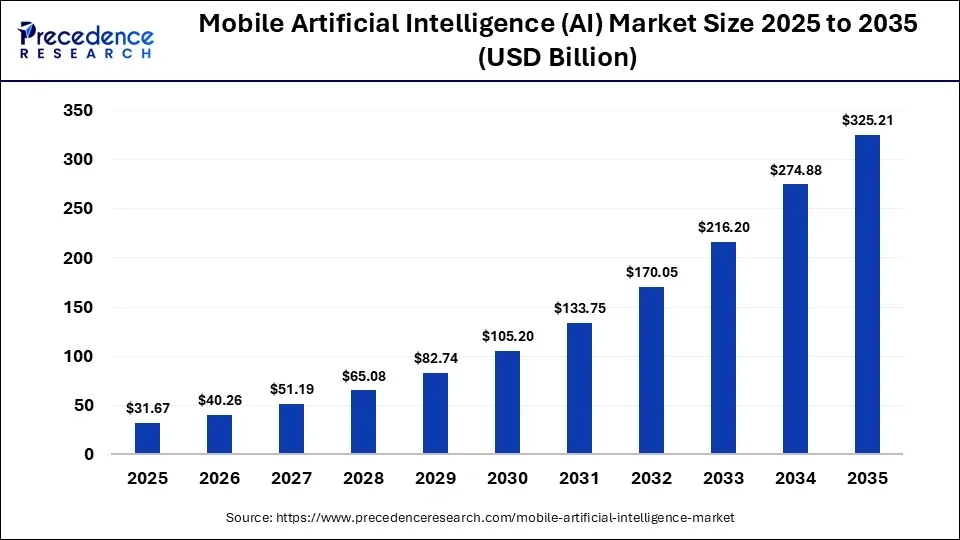
The adoption of AI-powered mobile apps has increased dramatically over recent years. This mobile AI trend will continue to rise as per the Precedence Research report. The report has predicted the market size of the mobile artificial intelligence from USD 40.26 billion in 2026 to USD 325.21 billion by 2035.
Source
This report reveals over 26 percent CAGR in the coming decade. Here, the rapid growth of AI in mobile platforms is largely because personalization is becoming a standard feature of modern apps. It is interesting to note that modern businesses can gain the benefits of AI-based recommendation systems for more engagement and personalization.
Business Impact of AI Recommendation Systems
Users expect mobile apps to understand their needs and expectations effectively. Generic or static user experiences are not sufficient for maintaining engagement, and therefore, AI recommendation systems are gaining popularity. The growing demand for personalization and customized experiences has accelerated the adoption of AI recommendation systems across different sectors.
Businesses can gain the advantage of AI recommendation systems in user engagement and conversion rates.
| Business Aspect | Traditional Apps | AI-Powered Apps |
| User Retention | 32% | 68% |
| Average Session Time | 4 Minutes | 11 Minutes |
| Conversion Rate | 2.1% | 7.4% |
| User Engagement | 38% | 81% |
Global businesses adopt recommendation systems rapidly to make their applications more intelligent, intuitive, and interactive. These systems consist of various technologies.
Top Technologies Used in AI Recommendation Systems
The core objective of an AI-powered recommendation engine is to analyze user behavior and predict the user’s preferences. AI recommendation systems use technologies, including
- Machine Learning
- Natural Language Processing
- Predictive Analytics
- User Behavior Tracking
- Conversational AI
Traditionally, recommendation systems relied on historical data. OpenAI has changed it by adding contextual intelligence and conversational understanding.
We will take an example of a shopping app to understand the role of an advanced recommendation system. A custom shopping app recommends products as per the user’s browsing history, previous purchases, seasonal preferences, and real-time conversations. This is useful for offering highly personalized experiences. A reputable Flutter app development company integrates OpenAI into the process. It is essential to make a recommendation engine.
How Flutter OpenAI Integration Works
Flutter is a popular cross-platform app development framework. Developers build seamless applications that run on multiple platforms using Flutter. Below is a flow of architecture for building AI recommendation engines.
User Activity
↓
Flutter Frontend
↓
API Layer
↓
OpenAI Recommendation Engine
↓
Personalized Suggestions
↓
Improved User Engagement
It enables apps to learn from user interactions and improve their performance.
Flutter AI app development companies can make an advanced recommendation system by integrating various core components.
Core Components of AI Recommendation Systems
AI recommendation systems use different components according to their scope and impact on business processes. We can classify their applications into four different categories.
User Data Collection
The AI recommendation system collects data related to the customer’s search behavior, session activities, click patterns, ratings, and purchase history. This can be a foundation of intelligent and interesting yet personalized recommendations.
Backend Processing
AI models and recommendation algorithms are useful for collecting data related to backend processes. Python, Node.js, TensorFlow, and OpenAI APIs are popular backend technologies for fetching this type of data.
OpenAI Layer
It is an intelligent layer that enhances AI capabilities by offering smart content suggestions, conversational recommendations, and context-aware responses. It can also give AI-generated summaries and personalized search experiences.
Frontend Experience
Flutter is a famous frontend platform that has dynamic UI elements for displaying recommendations on AI chat interfaces and personalized dashboards. This can result in increased user engagement for a business mobile application.
Flutter app development companies build recommendation engines with the help of these components. These engines bring massive changes in user-related processes and experiences for various sectors, including eCommerce, entertainment, healthcare, travel, and education. Following best practices for building these recommendation systems can help companies meet several challenges related to them.
Best Practices for Building AI Recommendation Systems Using Flutter
Some of the best practices for building Flutter-based AI recommendation systems include the following:
Focus on User Privacy
It is essential to secure storage and ensure data encryption and meet privacy compliance because recommendation systems rely heavily on user data.
Use Hybrid Models
The most effective recommendation systems combine collaborative filtering and context-aware AI suggestions. This can improve recommendation accuracy.
Optimize Overall Performance
This is one of the most important best practices. An AI-driven application can become resource-intensive, and therefore, Flutter developers should focus on lazy loading, optimized rendering, etc. This can optimize the performance of AI-based systems.
Train AI Models
Recommendation systems get improved with the help of continuous learning and feedback analysis. Regular optimization can help companies maintain accuracy and relevance for users.
These best practices can help businesses address several challenges.
Want to Build an Intuitive Cross-platform Business App for Your Company?
LET’S CONNECTKey Challenges in Flutter OpenAI Integration
Businesses can hire dedicated app developers to address the potential challenges of Flutter OpenAI integration.
API Cost Management
Large-scale AI requests can increase operational costs significantly, and therefore, it is necessary to manage API costs.
Real-Time Process Issue
The lack of an optimized backend architecture can make the management of real-time recommendations complicated.
Data Quality Dependency
AI models heavily rely on clean data, and therefore, poor-quality data can reduce the accuracy of recommendations over the period.
Over-Personalization Risk
This is another challenge. Excessive or over-personalization can lead to the user’s discomfort and disinterest. Businesses should balance both personalization and interaction in the application.
Addressing these challenges can help companies leverage the benefits of recommendation engines. It is better to consult a reliable Flutter app developer to learn more about emerging trends for building AI recommendation systems. Some of these trends are emotion-aware systems, AI copilot integration, real-time conversational interfaces, and voice-driven recommendations.
AI evolves continuously. This evolution will make recommendation engines more intelligent, human-like, and adaptive.
Final Thoughts
The Flutter and OpenAI combination reshapes the future of cross-platform app development. Businesses offer both personalization and interactivity through Flutter-based AI applications. Flutter OpenAI integration is useful for creating recommendation systems to improve engagement and deliver exceptional user experiences across any industry sector. We can expect that an intelligent recommendation system will become a core component of business applications in the future.
Silicon IT Hub is a leading Flutter AI app development company. We integrate the AI and ML advancements into cross-platform, Flutter-based business applications. Contact us to learn more about our AI app development services and the scope of AI-powered solutions for your company.


 Have an Idea?Let’s Build It Together!