

How IT Teams Improve EHR Connectivity in Healthcare Solutions
Overview
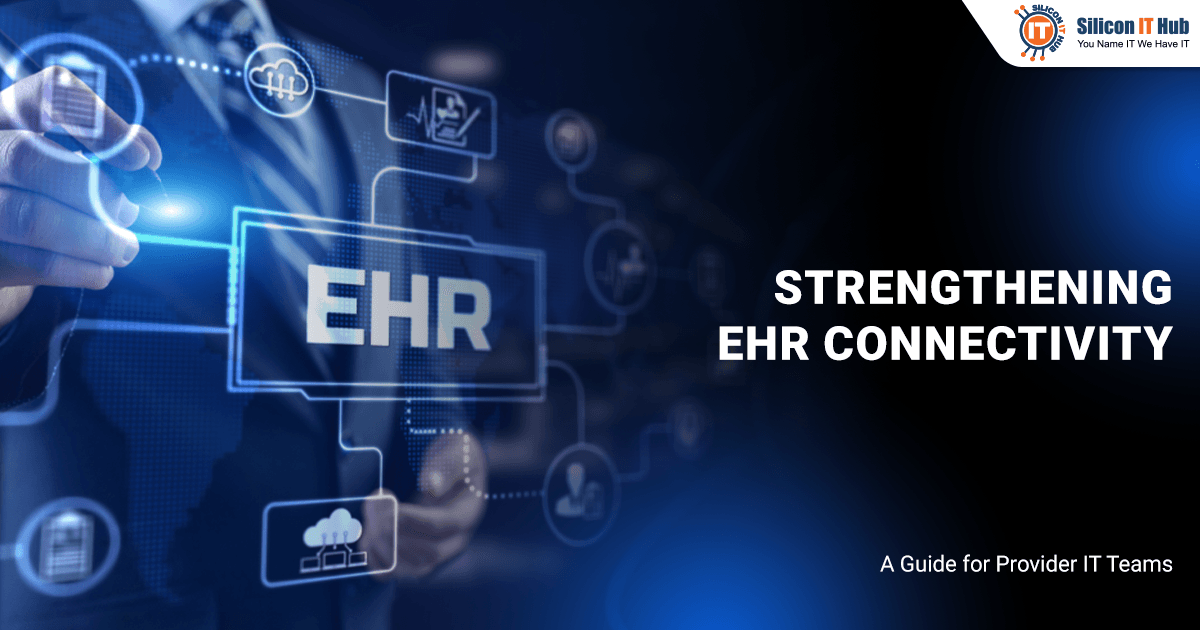
Healthcare organizations require multiple technologies to work together to manage various processes. Let’s take an example of an EHR (Electronic Health Record). In the clinical environment, EHR is at the center, but healthcare IT solutions involve different technologies to enable laboratories, pharmacies, patient applications, telehealth tools, and analytics systems to exchange information.
When these systems cannot communicate with one another effectively, clinical and administrative teams may face various issues. Some of these challenges include duplicate data entry, incomplete patient information, and disconnected experiences. This makes EHR connectivity a highly important operational capability.
Provider IT teams can create a robust ecosystem of authorized systems that exchange information in the right format in real time by strengthening connectivity. They can also maintain security, privacy, and regulatory requirements through EHR connectivity.
It is, however, necessary to understand the architecture, identify information flows, select proper standards, address data quality, and build a scalable integration strategy. This post gives tips for strengthening EHR connectivity for provider IT teams. Let’s start with its scope.
EHR Connectivity- Importance for Provider IT Teams
EHR Connectivity is the ability of an electronic health record system to exchange and access information with other authorized healthcare applications, organizations, and devices. A connected EHR environment may exchange information with-
- Laboratory information systems
- Radiology and imaging platforms
- Pharmacy systems
- Health information exchanges
- Patient portals
- Telehealth applications
- Medical devices
- Data warehouse
- Analytics applications
- Third-party healthcare applications
A more sustainable architecture based on EHR connectivity can establish controlled and standardized pathways. Companies can use EHR integration solutions for maintaining this connectivity.
The global healthcare IT market is booming and increasing at a steady pace to cross USD 1728 billion by 2032. The following graph shows the size of the global healthcare IT market, with contributions from healthcare provider and payer solutions.
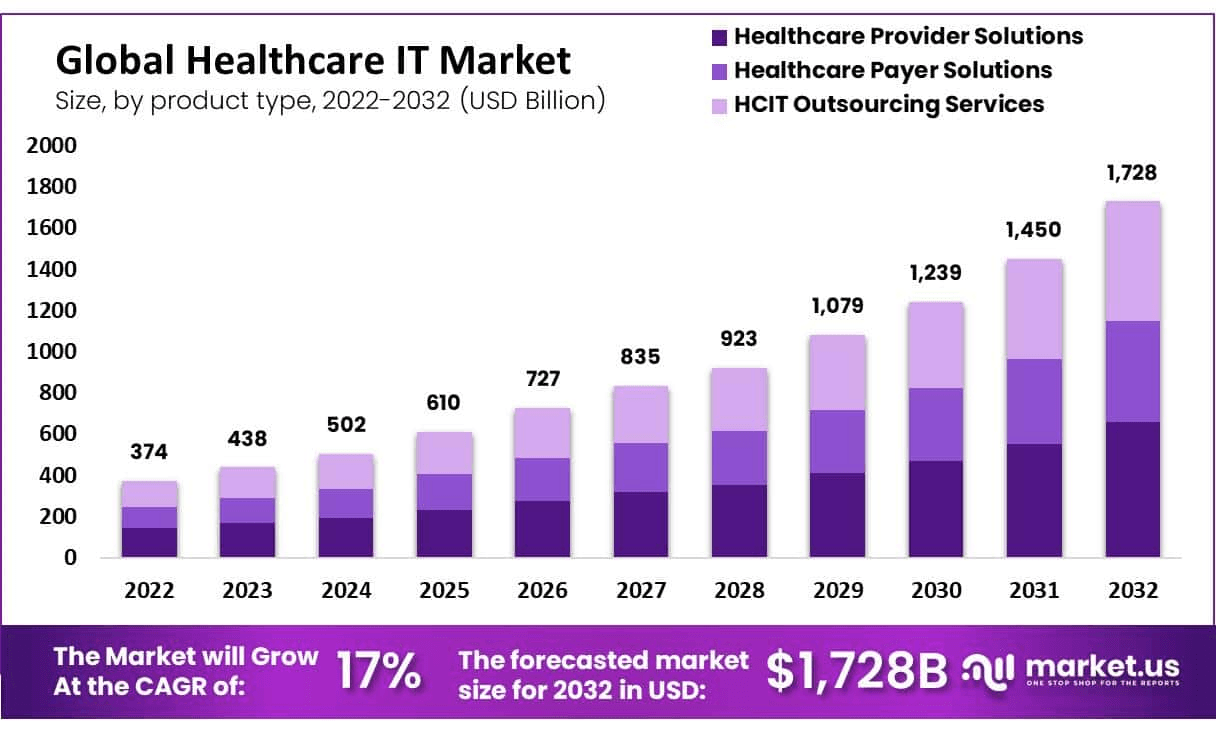
Source
The increasing healthcare IT market deals with enormous quantities of clinical and administrative details. For example, a patient’s demographic information, health updates, diagnoses, laboratory results, imaging reports, and references, etc., may exist across multiple systems. If these systems operate independently, healthcare professionals find it difficult to find them.
EHR connectivity remains useful here because it supports-
- More consistent access to patient information
- Reducing duplicate data entry
- More efficient clinical workflows
- Quicker information exchange
- Better coordination between systems
- More reliable downstream analytics
It is fair to say that connecting systems without addressing data quality, security, or workflow design can move problems from one application to another. Provider IT teams should consider integration as an architectural discipline instead of a collection of individual projects. When it comes to exchanging information, interoperability standards are essential.
Role of Healthcare Interoperability Standards
Interoperability in the healthcare industry depends on common ways of representing and exchanging information. Here, we mention several healthcare interoperability standards that provide frameworks for systems to communicate using agreed-upon structures and conventions.
HL7 Integration
This is widely used to exchange healthcare information between clinical and administrative systems. HL7 Version 2 messaging is associated with event-based messages, including admissions, discharges, orders, results, and patient updates. An integration engine can receive, transform, route, and monitor these messages.
This standard is important because many healthcare organization operate their mature systems based on HL7 interfaces. Provider IT teams have to manage existing HL7 interfaces while introducing newer integration approaches.
FHIR Integration
FHIR integration provides a more modern approach to healthcare data exchange. Fast Healthcare Interoperability Resources (FHIR) defines resources and APIs that support healthcare information exchange. FHIR is relevant to application-based interoperability.
It is because developers can use web technologies and APIs to request and exchange standardized healthcare resources. These resources can represent information related to patients, practitioners, observations, medications, conditions, encounters, procedures, etc.
FHIR does not solve interoperability automatically. For Provider IT teams, therefore, FHIR should be considered as a broader integration architecture rather than a standalone connectivity solution. Here is a quick table showing the differences between HL7 Version 2 and FHIR.
| Aspect | HL7 Version 2 | FHIR |
| Common use | System-to-system messaging | API-based data exchange |
| Architecture | Message-oriented | Resource/API-oriented |
| Common applications | Admissions, orders, results | Application integration and data access |
| Legacy system support | Strong | Depends on implementation |
| Web/API compatibility | Limited compared with modern APIs | Strong |
| Typical IT consideration | Interface management and message transformation | API management, profiles, authorization |
Many organizations prefer hybrid environments where HL7 interfaces continue to support established workflows, and FHIR APIs are used for newer applications. EHR APIs are also important for application-level interoperability. An API provides a controlled method for requesting or submitting information. This is better than having a separate application.
How to Build a Stronger EHR Connectivity Architecture
Improving connectivity begins with understanding the current environment. Here are two steps for building a stronger EHR connectivity architecture.
Map the Existing Landscape
An inventory consisting of EHR platforms, other ancillary systems, integration engines, APIs, interfaces, and other outside partners should be made before implementing a new interface. You can document all the details regarding the data, the frequency at which it is transmitted, and its form.
This creates a baseline for identifying duplicate interfaces and potential architectural weaknesses.
Identify High-Value Data Flows
Every integration has different priorities. It is, therefore, necessary to identify workflows where delays or duplication of information can create operational friction. Whether it is laboratory results reaching clinicians or patient demographic updates, diagnostic reports, or clinical documentation, it is essential to identify these processes.
A robust connectivity architecture needs a seamless integration of clinical data.
Clinical Data Integration and Exchange
Integration of clinical data goes beyond transferring information from one system to another. For example, two systems may represent a clinical condition differently even though they are describing the same concept. This is why data normalization, terminology mapping, code translation, validation, consistent metadata, etc., are important.
Focusing on clinical data integration can ensure effective healthcare data exchange. External partners possess different capabilities, standards, implementation guides, and data formats. IT teams need an architecture that handles differences without creating a separate solution.
These teams also should keep in mind some EHR integration challenges.
Common Technical Challenges in EHR Integration
Electronic health record integration becomes complicated when systems have different architectures and data models. Here are the common challenges of EHR integration:
Legacy Systems
Many healthcare organizations depend on existing systems that are not related to modern API-based integration. Replacing these systems can be impractical because they support critical workflows.
Data Mapping
The same concept applies to various systems in different ways. Data mapping can help teams understand source fields, target fields, data types, and business rules. Here, poor management can result in missing or misinterpreted information.
Patient Identity Matching
Information is only useful when it has proper association with the right patient. For example, differences in names, addresses, dates of birth, or demographic information can cause challenges related to matching.
Interface Failure
Healthcare workflows cannot tolerate silent integration failures. IT teams should monitor failed messages, invalid data, authentication failures, endpoint problems, and processing errors. Alerts and audit trails are also helpful for investigation.
Provider IT teams should also consider built-in security through authentication, authorization, encryption, audit logging, API security, and other measures. API-based connectivity introduces its own security considerations.
Want to Develop Advanced and Robust Software for Your Healthcare Organization?
LET’S CONNECTPractical EHR Connectivity Roadmap
The right architecture depends on the healthcare organization’s requirements. It is, however, important to consider the principle: avoid creating unnecessary dependencies that make future changes expensive. Provider IT teams should approach modernization of EHR connectivity in stages for this reason.
Phase 1. Assess
It starts with documenting current systems, interfaces, data flows, dependencies, and known pain points.
Phase 2. Prioritize
This stage includes the identification of high-value workflows and integrations that need improvement.
Phase 3. Standardize
It is necessary to determine where HL7, FHIR, APIs, or other appropriate technologies are useful.
Phase 4. Build
Appropriate integration services for routing, API management, monitoring, and transformation are essential.
Phase 5. Strengthen
The next stage is defining ownership, security policies, interface standards, and documentation requirements.
Phase 6. Monitor
This is the last phase for connecting electronic health records, and it includes monitoring of performance, errors, and results.
This iterative approach is manageable for your healthcare organization. You can choose the right option from EHR integration solutions to meet the diverse requirements of your healthcare organization.
Metrics for Provider IT Teams to Track
Connectivity should have measurable outcomes. Provider IT teams can monitor the following metrics-
- Interface availability
- Message success rate
- Failed transaction rate
- Average processing time
- API response time
- Data validation error rate
- Duplicate record rate
- Integration incident volume
- Number of manual data entry steps
These metrics can help IT leaders distinguish between an operational integration and the underlying workflow.
Future of EHR Connectivity in Healthcare
Healthcare connectivity is becoming more API-driven, standardized, and interoperable these days. FHIR-based APIs, integration engines, event-driven systems, and healthcare data platforms are creating new possibilities for moving information across different applications. At the same time, legacy infrastructure will remain part of many organizations.
Provider IT teams have to face the challenge of replacing legacy technology and creating an architecture where existing systems can coexist with modern applications. This is where well-designed healthcare IT solutions can be beneficial. Healthcare organizations can develop an integration strategy to connect current infrastructure with future applications.
Concluding Remarks
Robust EHR connectivity is essential for healthcare organizations that operate across highly complex technology environments. Successful integration needs more than connecting systems. It requires standardized data exchange, reliable APIs, security controls, and proper data governance.
The goal for provider IT teams should be to create a connected ecosystem that moves authorized information reliably. Effective clinical data integration, with the combination of HL7 integration and FHIR integration in healthcare IT solutions, can help healthcare organizations build an adaptable foundation.


 Have an Idea?Let’s Build It Together!