


Django vs Flask vs FastAPI- Python Frameworks Comparison for Techies
Overview
Technical considerations play a vital role in developing a business application. The choice of the right Python framework is such a consideration. It influences development duration, recruitment, cost of maintenance, and scalability, among other factors. A reputable Python development company can assist you in choosing the best framework among the three famous frameworks available: Django, Flask, and FastAPI.
These three frameworks can solve different problems. Django is a full-fledged web application framework with built-in functionality to solve standard problems that applications face. Flask is a minimalistic framework with an approach that allows for extensibility. It gives developers freedom to design architecture. FastAPI is a framework focusing heavily on modern APIs.
It is fair to say that there is no universally best Python framework available for every project. You need to consider the product type, development duration, team’s expertise, and integration requirements to choose the right framework. This blog highlights a comparison of Python frameworks to help technology leaders choose the best option.
Before comparing these frameworks, let’s understand them one after another.
Understanding Django, Flask, and FastAPI
The right programming language can help you build advanced and robust software. Python is a reliable language that remains among the top in the list of the most popular programming languages worldwide.
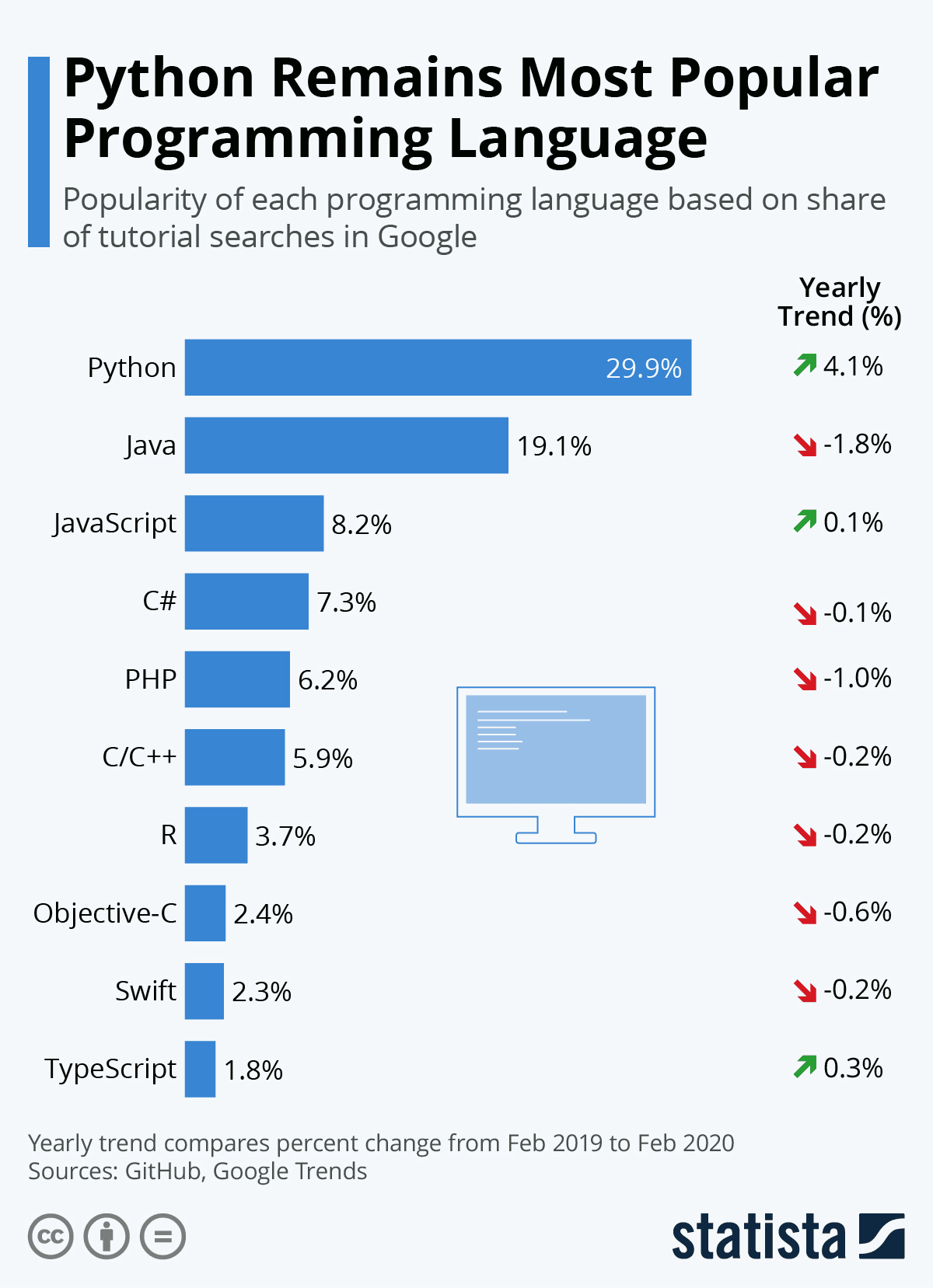
Its popularity is increasing steadily. The following Statista graph shows Python's popularity in terms of tutorial searches on Google. Its popularity percentage is over 29 percent, and the yearly trend has increased by over 4 percent. This shows its year-on-year rise in popularity.
Source
Before comparing Python frameworks, it is better to understand their fundamental philosophies.
Django- Complete Application Framework
As a high-level web framework, Django can handle many common web development requirements. Django has an ecosystem with capabilities for authentication, administration, security, URL routing, forms, and templating.
If your organization is seeking to develop a well-structured system, Django would be ideal.
Django is suitable for
- Enterprise web applications
- Content-heavy platforms
- Customer portals
- E-Commerce websites
- Data-driven applications
It offers outstanding security through protections and guidance for various threats such as cross-site request forgery.
Flask- Lightweight, Flexible Foundation
It is a lightweight WSGI web application framework designed to provide a simple core. It enables developers to add functionality through extensions and other Python libraries.
Flask does not attempt to dictate how your entire application should be structured. Instead, it allows developers to select the tools that fit their applications.
Flask can be a preferred choice for developing-
- Lightweight web applications
- Microservices
- Internal tools
- Prototypes
- Small-to-medium APIs
- Custom backend services
The documentation of Flask emphasizes scaling from quick applications to more complex systems, while offering many architectural choices.
FastAPI- Modern API Development
If you want to build high-performance APIs using modern Python type hints, FastAPI should be the choice for you. It uses the Starlette and Pydantic ecosystem. It also offers automatic interactive API documentation.
One of the major benefits of FastAPI is that type declarations can contribute to validation, serialization, and API documentation.
FastAPI is especially useful for developing-
- REST APIs
- Microservices
- Data-intensive services
- Mobile and web backends
- Real-time applications
- API-first products
Flask matters for technology leaders because it contributes to reducing friction between backend, frontend, mobile, and QA teams. It brings clarity in API documentation and contracts.
A reputable Python development company can choose the right framework by comparing these frameworks.
Python Frameworks Comparison- Django vs Flask vs FastAPI
It is better to compare these three frameworks against business requirements and technical priorities. Here is a quick table containing different aspects for comparing Django vs Flask vs FastAPI.
| Factor/Aspect | Django | Flask | FastAPI |
| Core Type | Full-stack | Minimal and extensible | Modern, API-first |
| Architecture | Opinionated | Flexible | Modern, API-oriented |
| Built-in Features | Extensive | Limited | Focused on APIs |
| Database Support | Built-in ORM | Usually extensions | External tools |
| API Development | Strong | Strong with extensions | Excellent |
| API Documentation | Requires additional setup | Requires additional setup | Built-in through OpenAPI |
| Async-first Approach | Supported capabilities | Not async-first | Strong async support |
| Flexibility | Moderate | Very high | High |
| Learning Curve | Moderate | Initially low | Moderate |
| Architectural Control | Framework-driven | Developer-driven | API-focused |
| Best Suited for | Full-featured web applications | Flexible, lightweight applications | Modern APIs and related services |
It is fair to say that this table gives a simple outlook of these highly popular frameworks. It is better to consult a Python development company to learn more about the differences between these frameworks.
Key Points of Comparison for Right Selection
When it comes to Python frameworks comparison, we should evaluate them from the perspectives of five major parameters. These parameters are: performance, scalability, development speed, security, and maintainability.
Performance
It is one of the most common points of comparison between frameworks.
FastAPI supports asynchronous programming patterns. Its official documentation positions it as a high-performance framework for building APIs. It also explains how underlying technologies contribute to its performance.
Flask can perform well for many traditional web applications. Its WSGI architecture remains a practical option for straightforward request-response processing in different applications. Flask is a lightweight framework.
Django can scale effectively for well-designed applications. This is a preferred framework for developing applications that need to grow. The official documentation of Django highlights scalability as one of its strengths.
Scalability
This characteristic should include more than the number of requests the application can handle.
FastAPI is useful when scalability involves APIs and distributed services. Its OpenAPI-based approach can help teams establish clear contracts between various services and consuming applications as well.
Flask offers architectural scalability through flexibility. This flexibility places more responsibility on the company’s engineering leadership. Development teams need to establish conventions early.
Django offers strong organizational scalability. This is because its conventions and built-in functionality create a consistent development structure.
Development Speed
Businesses focus more on development speed these days than technical benefits.
FastAPI can accelerate API development through type-based validation and automatic documentation. Developers can define request and response structures in Python. These definitions are then reflected in API documentation.
Flask can be extremely fast for developing smaller applications because it has minimal initial framework footprint. Developers can start with a small application and add components as per the client’s business requirements.
Django can accelerate development when your application needs functionality that this framework provides. Authentication, administration, database modeling, forms, and other capabilities can reduce the necessary development infrastructure.
Security
This should be evaluated at both levels- framework and organizational.
FastAPI has tools for API security, authentication workflows, validation, and documentation. This framework, however, does not eliminate the need for proper authorization architecture and dependency management.
Flask offers a minimalist philosophy, so teams have greater responsibility for selecting and configuring extensions as well as security components. This can be an advantage for experienced engineering organizations, but can create inconsistencies.
Django provides several security-related mechanisms. Its built-in capabilities can reduce the amount of security infrastructure. Developers should configure and use those capabilities correctly to leverage its advantage.
Maintainability
The maintenance cost of an application is one of the key deciding factors for a framework.
FastAPI occupies a useful middle ground for API-focused systems. Its type-oriented approach encourages explicit request and response definitions. On the other hand, OpenAPI generation offers a standardized description of API behavior.
Flask offers more freedom that can be beneficial early in your project’s lifecycle. Here, the challenge is to prevent every team or developer from making completely different architectural decisions.
Django has conventions to reduce architectural variation between developers. This is particularly useful when multiple teams, including development and operations, work on the same project.
It is better to evaluate maintainability before initiating the development process for business systems.
Wish to Build a Robust Python Application for Your Enterprise?
LET’S CONNECTWhen Should You Choose Django?
You should choose Django when the application needs a broad set of web application capabilities, and you want them within a cohesive framework.
Django is categorically useful for
- Database-heavy applications
- Administrative interface
- Multiple developers working on the same application
- Mature ecosystem
- Minimizing the number of foundational components
- Keeping authentication and user management at the core
Whether you want to build enterprise portals, SaaS platforms, marketplaces, or internal business applications, Django can be a beneficial option.
When Should You Choose Flask?
This framework is useful when flexibility is more important than a comprehensive built-in feature set in your application.
Flask is useful when you need to
- Build a relatively focused application
- The team possesses extensive expertise
- Build a lightweight service
- Integrate your application into the existing Python environment
- Start simple and add features gradually
The primary issue with Flask is the lack of governance. It provides engineering teams with freedom without architectural guidelines. This can lead to higher technical debt.
When Should You Choose FastAPI?
FastAPI will be the best option when you develop your customized product where APIs play an essential role.
It is especially suitable for developing-
- AI-powered applications
- Services for machine learning inference
- Backends for mobile apps
- Platforms with lots of integrations
- API-first platforms
- Microservices
With its automatic OpenAPI documentation, request validation, Python type handling, and asynchronous features, FastAPI is useful for developing modern backend architecture.
Tech leaders can hire dedicated Python developers who know much more than just frameworks. Developers should be knowledgeable about architecture, testing, API development, security, cloud deployment, and performance engineering.
When to Choose More Than One Framework
Not every organization needs to opt for any one Python framework. A larger engineering organization may reasonably use different frameworks to address specific workloads. For example, Django can power the core business platform, and FastAPI is useful for specialized APIs or AI services.
This approach can work for organizations that follow engineering standards around deployment, monitoring, testing, and security. Operational complexity is a major risk for this approach. This is because every additional framework introduces another ecosystem, deployment pattern, and maintenance consideration.
Final Verdict
The Django vs Flask vs FastAPI comparison is useful for choosing the right framework. Django is a preferred option when you need a comprehensive web application framework. Flask is a strong choice when simplicity, flexibility, and architectural control are priorities. FastAPI is highly suitable for developing modern APIs.
The best Python framework is, however, determined by business requirements rather than popularity. Technology leaders can leverage the advantage of Python by selecting the right framework. They need to consider development speed, talent availability, infrastructure, scalability, and security in the product roadmap.


 Have an Idea?Let’s Build It Together!
