

Which is better: Amazon Web Services vs Microsoft Azure vs Google Cloud?
Introduction
The short answer to the question "Which is the best cloud platform for modern businesses?" is that there is no universal winner. When we compare three giants- AWS vs. Azure vs. Google Cloud- the best platform is what helps your business achieve its goals. We will understand this through different examples. When you need a complex ecosystem with extensive third-party integrations, AWS support services are useful.
If your company depends heavily on Microsoft technologies like Windows Server, Microsoft 365, and Active Directory, Azure is a preferred option. When advanced analytics, AI capabilities, and container-native development are in focus, it is better to opt for Google Cloud managed services.
Companies consider several factors to choose the best cloud platform. This guide compares AWS, Azure, and Google Cloud to help you choose the right platform.
Understanding Giants- AWS, Microsoft Azure, and Google Cloud
AWS, Microsoft Azure, and Google Cloud are leaders among cloud service providers worldwide. The recent Statista survey revealed that Amazon Web Services has the highest market share at 30%, followed by Microsoft Azure (21%) and Google Cloud (12%). The following graph shows the position of the three giant cloud providers.
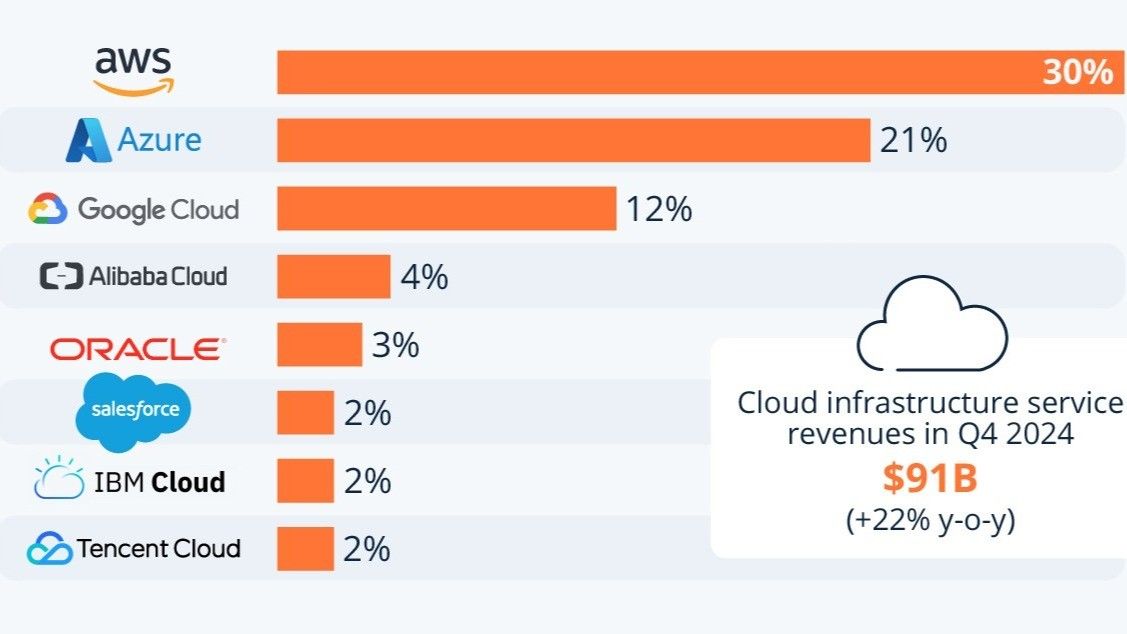
Source
These players have some noteworthy differences, and therefore, it is essential to understand them.
Amazon Web Services (AWS)
AWS remains the largest cloud platform from the perspective of market share and service breadth. It offers organizations access to hundreds of services covering computing, storage, databases, analytics, serverless computing, IoT, and security. One of the major reasons modern enterprises invest in AWS managed services is operational complexity. Though AWS offers significant flexibility, it may bring several management challenges.
AWS support services help companies optimize architectures and improve governance. These services aim to reduce unnecessary spending on the cloud. AWS is a preferred choice when you need extensive service options, and your business applications operate globally. When business software has a robust architecture that includes multiple environments and rapid scaling is visible, AWS is a preferred choice.
Microsoft Azure
When enterprises extensively use Microsoft-centric systems, Azure excels. Businesses that use Microsoft 365, Windows Server, SQL Server, or Active Directory find Azure integration easier than other platforms. Azure is useful for organizations that depend on-premises infrastructure with cloud workloads. Many enterprises adopt Azure managed services because of its capability of handling the high complexity of cloud governance.
As companies grow, cloud governance becomes more complicated. This is due to permissions, subscriptions, compliance management, and allocation of costs among various departments. When regulatory compliance plays a vital role and enterprise identity management is essential, then Azure from Microsoft is useful. It provides a hybrid infrastructure. But the company will need technical expertise for successful implementation.
Google Cloud Platform (GCP)
This cloud computing solution is different from others since it concentrates on engineering excellence, big data analytics, Kubernetes leadership, and machine learning. Organizations looking forward to using AI-based technology prefer GCP over any other solution. This is because of Vertex AI and BigQuery, in addition to Google’s powerful data processing capabilities.
The increasing demand for Google Cloud managed services among data-intensive businesses, SaaS providers, and AI-driven organizations. This shows the importance and capabilities of Google Cloud. GCP is also useful when data analytics drives business, and Kubernetes adoption is a priority. Developers use it for integrating AI and machine learning in their advanced applications with high productivity.
Every option has its pros and cons. It is better to go through a quick table to choose the best cloud platform for business.
AWS vs Azure vs Google Cloud- What Actually Works for Your Business
Here is a quick comparison showing the capabilities of each of these platforms according to the requirements of modern businesses.
| Business Requirement | AWS | Azure | Google Cloud |
| Global Reach | Extensive global footprint | Strong enterprise presence | Rapidly expanding network |
| Enterprise MS Integration | Moderate | Excellent | Limited |
| AI & ML | Strong | Strong | Exceptional |
| Kubernetes Support | Excellent | Very Good | Industry-Leading |
| Hybrid Cloud | Good | Excellent | Good |
| Service Size | Largest | Extensive | Focused |
| Startup Ecosystem | Strong | Growing | Strong |
| Analytics & Big Data | Excellent | Strong | Exceptional |
This comparison reveals the key capabilities and functionality of three popular cloud platforms. You can consult a reputable cloud-managed service provider to choose the right one for your business.
Cost Comparison between Three Platforms
Cloud pricing follows a complex structure. AWS, Azure, and Google Cloud have different pricing models. These models depend on resource consumption, networking, managed services, geographic regions, etc. Selecting the best cloud platform for business needs a focus on monthly infrastructure costs, along with other factors. The total cost of ownership includes the following factors:
- Staff expertise
- Security management
- Governance processes
- Compliance operations
- Monitoring tools
- Migration expenses
- Training requirements
A cloud platform that costs 10 percent less in compute charges can be costlier than other platforms if your team has no operational expertise.
This is where managed cloud services deliver measurable value. Effective governance with optimization can result in greater savings.
Security and Compliance Considerations
These are highly crucial considerations for selecting cloud platforms. Cloud service providers protect physical facilities, networks, and platforms. Organizations focus on application safety, data protection, access management, and cloud governance. All three platforms have enterprise-grade security measures.
In that sense, a company could ensure that the platform becomes successful by using the best cloud provider. Businesses without robust governance frameworks may struggle to thrive, regardless of the cloud provider. Companies might prefer Azure due to Microsoft's compliance and vice versa for others. Here, business requirements can drive the decision.
Want to Get a Consultation on Cloud Managed Services for Your Business?
LET’S CONNECT!Multi-Cloud Approach- When It Makes Sense
Modern organizations opt for multiple cloud providers based on the assumption that these providers reduce risk. Multi-cloud environments, however, increase operational complexity and skill requirements. It is better to opt for multi-cloud when companies face regulatory demands and different workloads benefit from various service providers. Most mid-sized businesses can leverage the benefits of cloud computing by implementing a well-controlled single-cloud strategy, instead of a fragmented multi-cloud approach.
How to Choose the Right Cloud Platform
AWS support service and other managed cloud service providers usually consider business objectives rather than technical preferences. For example, AWS is worth selecting when businesses require flexibility and scalability. Azure is useful for Microsoft-integrated products, and hybrid infrastructure matters most. Google Cloud is beneficial when businesses seek a competitive advantage using analytics, Kubernetes, and AI initiatives.
Workload assessment is essential when your requirements span multiple categories. Many successful organizations initiate the platform selection process by identifying their critical applications, performance expectations, and growth plans. Both these approaches are useful for producing better outcomes for companies.
Concluding Remarks
AWS, Azure, or Google Cloud- which one is better is an ongoing debate. It does not show a single winner. Each platform excels in different ways. AWS offers excellent breadth; Azure simplifies Microsoft-centric environments, and Google Cloud leads in AI-ML with analytics. Companies should take objectives, workloads, operational capabilities, and security requirements into account when choosing the best cloud platform.
AWS support services, Azure managed services, and Google Cloud managed services offer expert guidance to avoid costly decisions and accelerate your cloud journey. Your goal should be choosing the cloud platform that enables your business to operate efficiently today and tomorrow.
Silicon IT Hub is a leading provider of cloud-managed services. We assist companies in gaining the advantage of AWS, Azure, and Google Cloud platforms as per business objectives and workflows. Our expert business consultants can help your company select the most suitable platform, along with its successful implementation.


 Have an Idea?Let’s Build It Together!