


How to Choose the Right Ecommerce Technology for Business Growth
Overview
Using appropriate e-commerce technology enables you to select the platform that suits the needs of your business, fits your budget, and scales with your growing business. Some of the important factors that you need to take into account while selecting include flexibility, scalability, integrations, security, and cost of ownership.
Ecommerce store development is more than just product listing and payment processing. There should be reliable ways of managing inventory, ordering processes, and making the shopping process smooth and hassle-free.
Perfect ecommerce technology provides your business a space to grow and enhance productivity. For example, a small business may benefit from an all-in-one software technology that will allow them to release their products fast, but larger businesses require integration and management for increased traffic.
This is why choosing an ecommerce platform depends on your business needs and not on popularity only. You should evaluate your plans and find the best ecommerce platform that matches your goals to maintain a strong foundation and scalable growth.
The guide takes you through some of the most important platform selection criteria. We will also explain what makes a scalable ecommerce platform and talk about how an experienced ecommerce development company can help you select and implement the perfect solution.
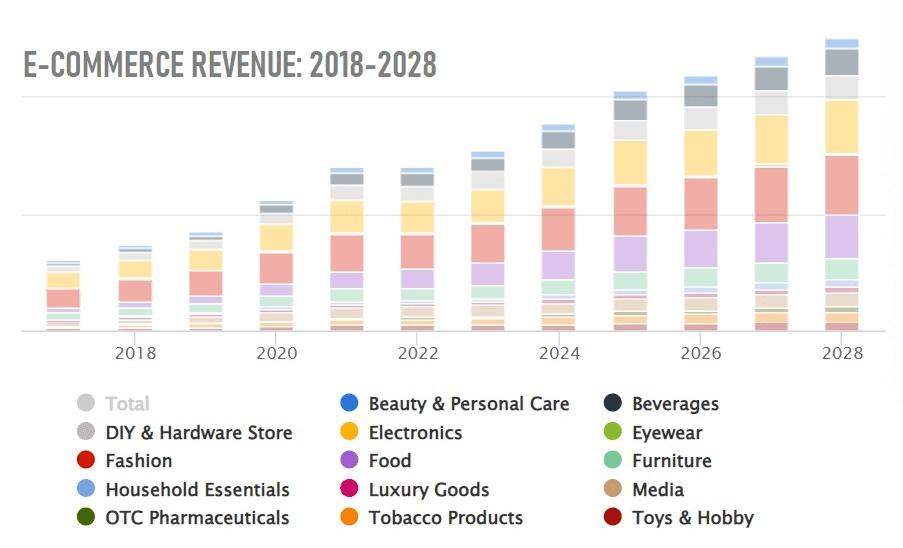
The graph here demonstrates shoppers’ secrets and predicts the future of eCommerce, with a significant spike in online shopping till 2028.
Why Ecommerce Technology Matters
Ecommerce technology solutions, when chosen correctly, can shape the customer shopping experience along with other elements. These factors include,
- Products
- Payments
- Orders
- Customer relationships
A well-designed software stack will be user-friendly as far as it enables people to shop around, compare choices, make purchases, and get updates on their orders. It will be useful for staff in inventory management, order processing, and sales tracking.
How the ecommerce website performs is yet another consideration for businesses. Slow page loading time, complex navigation, and an incomplete checkout process might annoy customers and reduce their chances of making purchases.
Organizations should be present on different platforms such as web, mobile apps, and social commerce platforms. In the long run, allocating funds for suitable ecommerce technology solutions would help businesses achieve a balance between user experience and operational efficiency.
Define Your Business Requirements Before Choosing a Platform
As a business, you should identify your needs and foresee the achievements for the online store before choosing a platform. Setting clear requirements helps organizations make it focused to select a process while reducing the risk of investing in unnecessary features.
Start with your product list, customers, the volume of orders, and sales strategy. An enterprise selling subscription products and personalized products requires very advanced features, while a company dealing with a limited number of products requires a basic digital store.
Defining your requirements will help you differentiate between essential features and those that can wait for a while. The process assists companies in prioritizing spending and avoiding opting for a complicated platform.
Recommended Selection Approach
| Business Stage | Suitable Technology Approach |
| Startup/Small Business | SaaS platform+mangaged hosting+Standard payment gateway |
| Growing Business | Modular architecture+cloud infrastructure+APIs+CDN |
| Large ecommerce Business | Headless commerce+scalable cloud+microservices where justified |
| Enterprise/Global Business | Distributed cloud architecture+advanced security+multi-region infra |
Look For a Scalable Ecommerce Platform
Imagine a small-scale business has 1300 customers and 1000 monthly orders. If sales spike, a platform can not force a rebuild immediately.
Scalable ecommerce platforms must support growth without needing a complete rebuild each time your business crosses a new benchmark. These platforms manage additional traffic, huge product catalogs, facilitate more transactions, and expand your business to reach new markets.
Consider the following criteria while evaluating a platform:
- Increasing website traffic during seasonal sales
- Expanding product portfolio and customer accounts
- Additional payment gateways and shipping providers
- New marketplaces and mobile applications
- Integration with enterprise resource planning systems
- Expansion into new regions and currencies
Companies should also consider easy ways of upgrading the platform or customizing it as their requirements change.
For example, according to Shopify’s 2026 e-commerce statistics report, global sales are forecast to reach $6.88 trillion this year. Mobile devices, on the other hand, account for an estimated 77% of e-commerce website visits in 2026. These trends focus on why businesses should select flexible technology that supports new sales channels and delivers a smooth mobile shopping experience while growing.
Businesses can temporarily exclude implementing advanced features. The trade-off is to adopt a practical way to add features when your company needs them the most.
Evaluate Flexibility and Customization Options
Business requirements may change after a quarter or a year post-launch, and new opportunities create different technology requirements. Your platform should accommodate these changes to avoid restricting your business expansion.
Flexibility should be an important part of your business platform evaluation. An adaptable e-commerce platform allows you to customize your product pages, simplify your checkout process, offer discounts, and integrate other features without unnecessary technical difficulties.
APIs, in this case, allow different software systems to communicate with each other. A quality API can help collaborate with payment services, inventory systems, marketing platforms, and other business apps.
It is important for companies to analyze the limitations of customizations available in their platform. Some basic customizations are quite simple to accomplish, while others become complicated. Other solutions offer greater control but need more development effort.
Headless commerce is another way through which companies can achieve highly customized customer-facing experiences. The goal here is to maintain a balance between flexibility and customization options.
Check Integration Capabilities
An ecommerce store hardly operates in an isolated environment. Modern ecommerce businesses depend on multiple digital systems that must communicate effectively.
Businesses may likely depend on the following tools to manage their operations effectively:
- Customer relationship management software
- Enterprise resource planning systems
- Accounting and invoicing tools
- Payment gateways
- Logistics platforms
- Marketing and automation tools
- Inventory management systems
The chosen ecommerce solutions should work smoothly with existing systems and future growth.
For example, you have received an order on the website. Information regarding the same should automatically reach relevant systems, inventory should be updated, and details required to process the order should go to the fulfillment team.
Without a proper system integration, the employees have to enter the same information in multiple systems. This is a time-consuming process and introduces intricacies.
Good integrations can reduce manual tasks. They can also improve data accuracy across business systems. Let’s help you set the foundation to experience sustainable business growth.
Prioritize Website Performance
Customers need their e-commerce websites to operate swiftly and effectively. When the website loading time slows down, the customers lose patience and leave without completing their purchases.
Website performance is even more essential for online businesses. Customers want quicker loading speeds, especially during promotions and product launches.
Low website performance creates a bad user experience and affects conversion rates. Businesses should perform tests on the performance of the platform with respect to page loading, image rendering, database management, and heavy traffic loads.
Periodic website performance evaluations help in detecting issues when the business expands its product range and number of customers. Always recommend that developers run website performance evaluation before launching the website.
Make Security a Priority
E-commerce websites manage important information, including customer data, order history, delivery information, and payment details. Businesses should not overlook securing customer trust and reducing business risks.
It is very important to evaluate the security abilities of the eCommerce platform from the perspective of platform providers and your own organization.
Some of the important considerations include:
- Secure HTTPS connections
- Support for proper payment security standards
- Role-based access controls for administrators
- Multi-factor authentication where available
- Regular software updates and security patches
- Data backup and recovery procedures
- Monitoring and incident response processes
The development partner should also understand how to use the platform according to the needs of privacy and security. It is a shared responsibility; however, even the most secure platforms cannot be safe when data security is compromised by insecure extensions used in the process. Data security is compromised when there are weak passwords and a lack of updates. Role-based access helps keep customer data secure.
Work With an Experienced Ecommerce Development Company
Technology selection in ecommerce development is merely a small portion of the entire process. The implementation of the chosen technology is equally important.
A professional eCommerce development company will assess your needs, weigh in the best available platforms, and create a technology strategy that suits your business objective.
An experienced ecommerce development firm will discuss the pros, cons, and repercussions rather than just offering an idea because it is trendy.
A development team may assist you with:
- E-commerce platform selection and implementation
- Custom storefront design and development
- Third-party system integrations
- Data migrations from existing stores
- Website performance optimizations
- Security improvements and ongoing maintenance
Effective communication ensures that the development partners get to know your customers, your business processes, and future plans before coming up with any solution.
During the hiring process, you should review partners’ relevant experience, communication skills, and post-launch support options. Ask questions about how the team will manage changing requirements, testing, documentation, and future enhancements.
The right ecommerce solution providers can help avoid implementation mistakes and create a storefront that is easy to manage as the business grows.
Consider the Total Cost
The initial cost of developing an e-commerce platform does not include overall operating costs. A few digital platforms might have reasonably low project initiation fees, but it increase as businesses plan to have additional functionality, or wish to add premium extensions. Other software solutions may ask for a big investment in the initial development phase and offer considerable customization.
Calculate the total cost of software ownership rather than comparing subscription prices only.
An inexpensive option can not always be affordable in the long run. Rather, software that complements your business can help reduce manual tasks, minimize technical issues, and make future implementations easy.
Test Before Making the Final Decision
Take time to test the platform before narrowing down to select one. Product demonstrations and feature lists can offer an insightful overview, but they do not always reveal how a platform can perform in real-life business scenarios.
Use a trial environment to explore the workflows that are important to your team. Test activities such as:
- Adding products and updating inventory
- Searching for products and filtering results
- Applying discounts and promotions
- Processing payments and refunds
- Managing shipping and order fulfillment
- Connecting external applications
- Reviewing sales reports
- Making routine administrative changes
Work with both technical and non-technical team members during the platform evaluation process. The developers here concentrate on integrations and customizations, whereas the other teams like sales, operations, and customer support teams encounter practical issues daily.
Identify limitations in the early phase and make financial decisions confidently.
Want to build an advanced ecommerce app for your business?
LET’S CONNECTConcluding Remarks
Choosing the right e-commerce technology is a vital investment in your business’ future. The influence of the selected platform is on how customers shop, how the team manages operations, and how efficiently the business responds to new opportunities. You should shortlist at least two platforms, run the checklist with operating teams, and compare the total cost for the next three years.
Let’s connect and set the foundation for you to experience sustainable business growth.


 Have an Idea?Let’s Build It Together!



