


Popular Backend Development Frameworks for Interactive Web Apps
Introduction
Backend development uses modern tools, libraries, frameworks, and other resources to build a website engine. The engine originates with different fundamental components intricately connected to the server, website root, database, and external & internal resources.
Backend frameworks are essential to products and developers both. They are libraries of server-side language that help build server configuration.
It is significant to leverage the most suitable technology to develop a website else there are high chances that the app you deliver does not satisfy users.
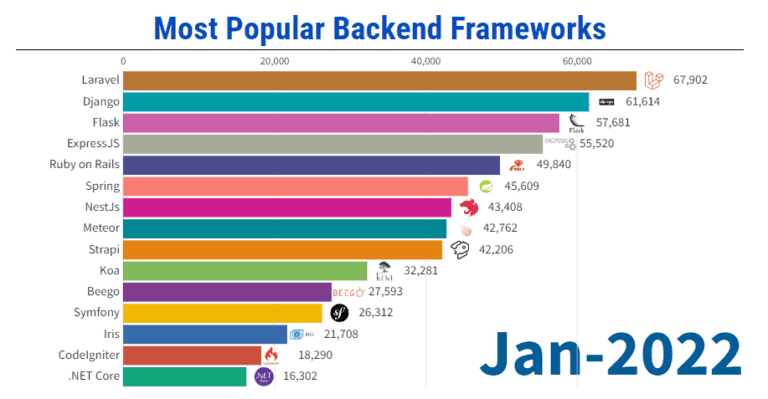
According to statistics and data, you can see the popular backend frameworks up to the first month of 2022.
What is The Backend Framework?
A backend framework, also called a server-side framework, is the collection of tools, resources, and modules that aids in the website architecture, design, and testing development.
It drastically affects the overall web app’s performance and can decide the project success ratio. Backend frameworks basically make app development tasks highly convenient and effortless for developers.
These frameworks usually emphasise scripting languages like JS, Ruby, and Node.js or compiled languages like Java and C#. With the best framework, developers can start better by mitigating the need to build and set up everything from the start.
Reason to Use Backend Framework
The goal of a backend framework is to streamline app development operations. The key reasons for using the backend framework for web development are:
Security
Integrations
Time-savvy
Scalability
Uniqueness
Additionally, most of the backend frameworks are free to use and open-source.
Here, we have listed the prominent backend frameworks currently accessible for web app development.
So, let’s start exploring.
Looking for expert Developers for a net Project?
Hire Dedicated DeveloperBest Backend Frameworks to Explore
1. Django
Django is a free, open-source Python-based web framework that enables a quick development process and realistic design. It is developed by expert developers and mitigates the challenges of web development.
Django aids programmes build apps from concept to conclusion as soon as possible. It also ensures high security and helps programmers to prevent various security blunders.
Many big brands and governments have used Django to build systems for content management, social networks, scientific computing platforms, and much more. It also helps with quick and custom scale to address the high traffic demands.
Many popular websites use Django, including Instagram, Pinterest, Mozilla, OpenStack, National Geographic, MacArthur Foundation, Knight Foundation, Open Knowledge Foundation, and Disqus.
2. Laravel
Laravel is a web app framework with expressive and elegant syntax that helps to build excellent functionality at the developer’s fingertips. Every feature is developed to offer a superior developer experience. Laravel mitigates the development pain point by simplifying repetitive tasks performed in most projects.
Developers can create robust apps in PHP with Laravel and Livewire frameworks. If developers are comfortable with JS, they can generate a great React/Vue-directed frontend pairing Laravel with Inertia. Laravel offers backend API for your Next.js app, mobile app, or other frontends.
Laravel provides the best testing experience with testing APIs, database seeding, and painless browser-based verification. It has a vast package library that helps developers to perform anything.
Several websites are built with Laravel, including MyRank, Neighbourhood Lender, Invicta Watch Group, Faith Properties, World Walking, Studio Stomp, Creative Spaces, and Startups.co.
3. Express.js
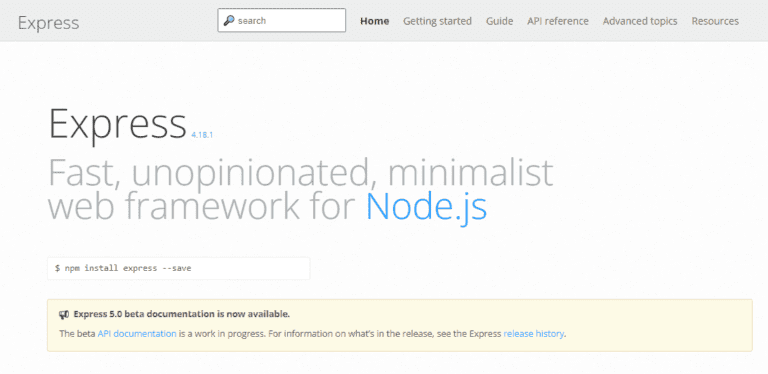
Express.js is a flexible Node.js-based web app framework that offers powerful features to develop comprehensive web and mobile apps. It is free and open-source software under the MIT licence.
With a variety of HTTP utility methodologies and middleware, it is easy for developers to build robust and scalable RESTful APIs quickly and easily with Node.js.
Express offers a thin layer of basic web app features without hiding Node.js features that developers already know and adore. Many frameworks are built based on Express like Feathers, KeystoneJS, ItemsAPI, Poet, Sails, Kraken, LoopBack, and more.
Express is one of the fast web frameworks, easy to set up and learn. It offers a routing API and a wide range of plugins.
Many well-known websites use Express, including PayPal, LinkedIn, Mozilla, Netflix, Uber, Groupon, GoDaddy, and eBay.
4. Flask
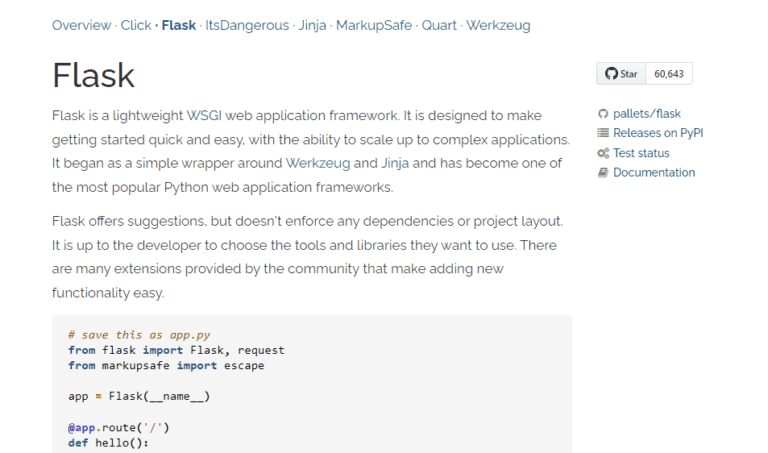
Flask is a Python-based web app framework to build robust and future-ready web applications. It is a WSGI framework that executes on the web server, not on the user’s browser. It features a Werkzeug toolkit to build WSGI- compatible web apps and Jinja2 to create templates.
Flask’s built-in development server offers an engaging debugger and lets developers write Python code in the browser on the occurrence of any mistake while requesting. It is a minimalistic framework that quickly configures web servers and bundles core elements by default.
Developers can use Flask to write less code and quickly deploy it as a microservice. It is a lightweight framework with fewer abstraction layers and rapidly builds an MVP. It manages HTTP and RESTful requests competently and eliminates HTTP boilerplate code.
Several notable websites use Flask, including Red Hat, Rackspace, PythonAnywhere, Lyft, Reddit, MIT, Hotjar, Mailgun, and Airbnb-Airflow.
5. Ruby on Rails
Ruby on Rails is a full-stack framework that supports all the necessary tools to develop stunning web applications on the front and back end.
Rendering HTML templates, sending/receiving emails, enqueuing jobs for asynchronous tasks, database updating, cloud storage, live page maintenance through WebSockets, and offering high security for common attacks, this framework covers it all and so much more.
Rails are improving with each passing year through the contribution of thousands of volunteers in small or big ways. Everyone helps to make this framework superior, whether they have been leveraging it since its initiation or just started yesterday.
Many popular websites use Ruby on Rails, including Basecamp, GitHub, Shopify, Dribbble, Zendesk, Airbnb, Square, Kickstarter, Coinbase, and SoundCloud.
6. Spring
Spring makes Java-based programming faster, simpler, and more secure for all. It focuses on speed, easiness, and productivity, which made it the widely adopted Java framework. Spring’s all-inclusive set of extensions and customisable third-party libraries is trusted by developers globally. It helps them to develop almost any app one can ever imagine.
Spring Boot changes how developers execute Java programming tasks and thoroughly simplifies the developer experience. Developers can leverage fast startups & shutdowns, and improve execution, by default. Moreover, Spring projects also endorse the reactive programming model for high efficiency.
Spring deals with security issues rapidly and responsibly. Additionally, the Spring community is massive, worldwide, varied, and includes contributors of all ages and skills, from complete newbies to seasoned experts.
Several major platforms use Spring, including Alibaba, Amazon, Google, Microsoft, Udemy, Trivago, Intuit, and iFood.
7. Asp.NET
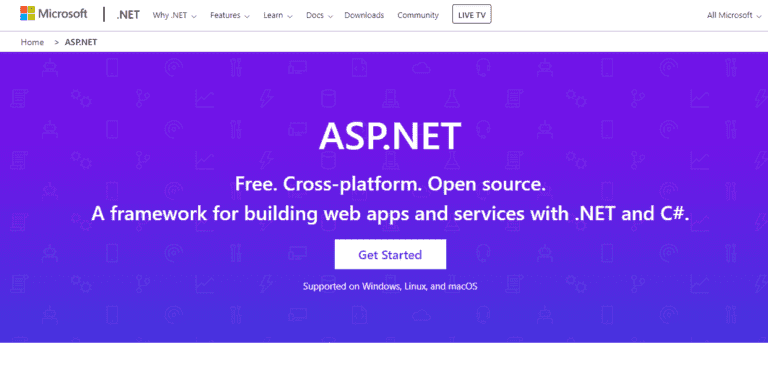
ASP.NET is an open-source, cross-platform framework that develops web apps with .NET and C#. It is free to use and supports Windows, Linux, and macOS.
Developers can create full-stack app UIs with C# instead of Java. The platform lets programmers build REST APIs for wide-ranging clients, including mobiles and browsers.
Additionally, it facilitates real-time two-way interaction between server and client. ASP.NET extends the .NET developer platform with tools, libraries, and programming languages to develop interactive web apps. It performs quicker than other frameworks in the independent TechEmpower Benchmarks.
The platform supports authentication protocols to protect apps against XSS and CSRF. It also provides a built-in user database with multi-factor and external authentication with Twitter, Google, and more. Programmers can get their queries solved with the help of an active community of developers. Moreover, anyone can get Asp.NET websites with Microsoft Azure for free.
Several well-known websites use ASP.NET, including Stack Overflow, Tencent, Siemens Healthineers, LightSail, VQ Communications, GoDaddy, and Raygun.
In a Nutshell
Most of these frameworks have code written using widely accepted programming languages like Java, Python, and JS.
If you are a newbie in framework usage, you can initiate with lightweight frameworks like Flask or beginner-friendly frameworks like Ruby on Rails.
If you want to learn the most popular frameworks, you can opt for Django, Spring, or Express.js.


 Have an Idea?Let’s Build It Together!

 B1-Ground Floor, Safal Profitaire, Corporate Road, Prahladnagar, Ahmedabad, Gujarat, India - 380015


 + 1 302 803 4919
 usa@siliconithub.com

