


How to Choose the Right Stack and Strategy for B2B Mobile Apps
Overview
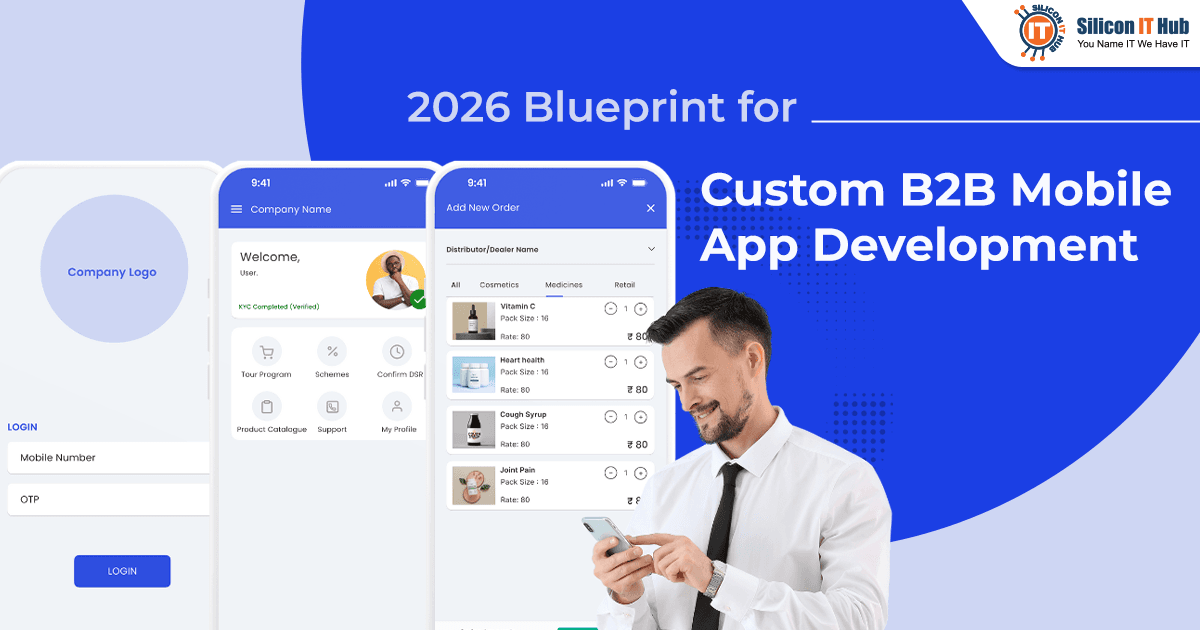
B2B mobile app development is a process to build secure and scalable apps in line with business workflows. Here, the right strategy, features, and B2B mobile app technology stack can determine long-term success with high ROI. Here, it is fair to say that B2B apps are more complex than B2C (Business to Customer) apps. Examples of B2B apps are Alibaba, Salesforce, and HubSpot, whereas Netflix and digital wallets are B2C apps.
Simply put, B2B mobile app development must support multi-user roles while meeting compliance requirements. B2B apps can offer offline access and support complex integrations. Moreover, feature-rich B2B apps connect to ERP systems, CRM platforms, and procurement tools to support operational processes and enterprise-level transactions. However, companies should opt for customized apps rather than off-the-shelf ones to meet business complexities.
This blog talks about the key features and implementation blueprint of B2B mobile app development. Let’s start with the difference between native and cross-platform B2B app development.
Native vs Cross-Platform - What B2B Mobile Platform Should You Choose
Native and cross-platform apps can take businesses to a new level. However, it is a crucial decision for entrepreneurs to select the right approach for developing their business apps. Here is a quick table of differences between native and cross-platform apps.
| Characteristic/Aspect | Native App Development | Cross-platform App Development |
| Platforms | iOS and Android OS | Single codebase |
| Performance | High | High (Near-native) |
| Development Cost | Higher | Lower |
| Maintenance | Separate updates | Unified Updates |
| Time to Market | Slower | Quicker |
| Ideal for | Performance-based apps | Enterprise apps with broad access |
In our experience, Flutter and React Native are ideal for developing B2B cross-platform mobile apps. These platforms can make business apps with a higher speed of deployment and cost-efficiency. Moreover, Flutter or React Native mobile app development offers faster updates and consistency in the user interface (UI). Here we mention the key features of modern B2B apps that companies should look for in the year 2026 and beyond.
Essential Features to Look for in B2B Applications
A B2B application should have the following features to leverage its business benefits. Let’s go through these features-
RBAC (Role-Based Access Control)
This feature enables different users to see data as per their roles and accessibility. It is useful for relevance and the security of data.
High Security
Enterprise-grade security features like end-to-end encryption and multi-factor authentication can make the app highly secure for users and enterprises.
Real-Time Notification
This is useful for the automated approval process. Push notifications can streamline and improve workflows effectively.
Integration Support
It is essential for your B2B application to connect to ERP, CRM, and other existing business applications, as well as payment gateways.
Offline Functionality
This feature is useful for remote teams and field executives. Offline sync ensures that all the team members can stay on the same page.
In our experience, integration capabilities and high data security are crucial features for any B2B application. However, it is essential to implement the B2B app properly to gain its advantages.
Implementation Roadmap for B2B Application
Implementing the app into your existing business system involves several steps. Some of these steps are-
Step 1. Define Business Objectives
It is necessary to avoid vague goals. Instead, you should define goals like bringing automation into core processes, improving customer experience, and enhancing supply chain management. In other words, you should focus on business outcomes rather than the app's features.
Step 2. Measure User Workflows
Before initiating development, it is important to define user roles, approval paths, and integration points. This can help teams avoid reworking the application. Moreover, defined workflows can help companies streamline processes and increase adoption.
Step 3. Choose Right Approach
When it comes to speed and cost, cross-platform B2B app development is preferable. On the other hand, when performance and appearance are priorities, it is better to opt for native app development. Simply put, companies should choose the right approach.
Step 4. Give Priority to Experience
Users expect a clear and minimal design with minimal clicks and quick loading. It is essential because outdated apps may face a lower adoption rate and performance issues. Therefore, it is better to give priority to user experience.
Step 5. Post-Launch Scaling
Let’s face it. Go-live is not the end of the process. Companies should measure adoption rates, crash reports, and user engagement metrics to understand the outcome. Continuous iteration for your B2B app can define its long-term ROI.
A renowned mobile app development company can make a feature-rich application for diverse industries. Let’s go through some real-life examples of the B2B application.
Real-Life Scenarios of B2B Applications
A B2B SaaS platform or a manufacturing company can leverage the benefits of custom B2B mobile applications. A cross-platform B2B application can offer a huge platform for a SaaS-based B2B company with unified updates. A custom B2B app with a strong backend and offline functionality is useful for the manufacturing company.
Core industry sectors prefer high-quality B2B app solutions. It is interesting to see the focused trends of B2B mobile app development in the year 2026 and beyond.
Mature B2B Mobile App Trends for 2026 (and Beyond)
Forward-looking companies opt for building apps that offer AI-powered insights and features related to predictive analytics. Furthermore, companies will focus on workflow automation and real-time monitoring through interactive dashboards. Development companies focus on API-first integration and other features that can simplify the complexities of modern business.
B2B mobile apps should have advanced features and seamless performance to achieve business objectives. The mobile app development company can utilize evolving technologies, including cloud, DevOps, AI/ML, and blockchain, to build robust solutions.
Want to Build a Robust and Reliable B2B Mobile Application for Your Company?
LET’S CONNECTConcluding Remarks
B2B mobile apps require the right technology stack and features to gain business benefits and high ROI. Companies should invest in custom B2B app development to meet diverse requirements and increasing complexities. Trends like predictive analytics, workflow automation, and real-time monitoring of the process can make the B2B app more efficient. Finally, companies should follow the best practices in implementing feature-rich B2B apps.
Silicon IT Hub is a renowned custom B2B mobile app development company. Our in-house team of experienced developers can build intuitive and native or cross-platform app solutions that drive business growth. Contact us to learn more about our enterprise mobile app development services.


 Have an Idea?Let’s Build It Together!



 B1-Ground Floor, Safal Profitaire, Corporate Road, Prahladnagar, Ahmedabad, Gujarat, India - 380015


 + 1 302 803 4919
 usa@siliconithub.com

