


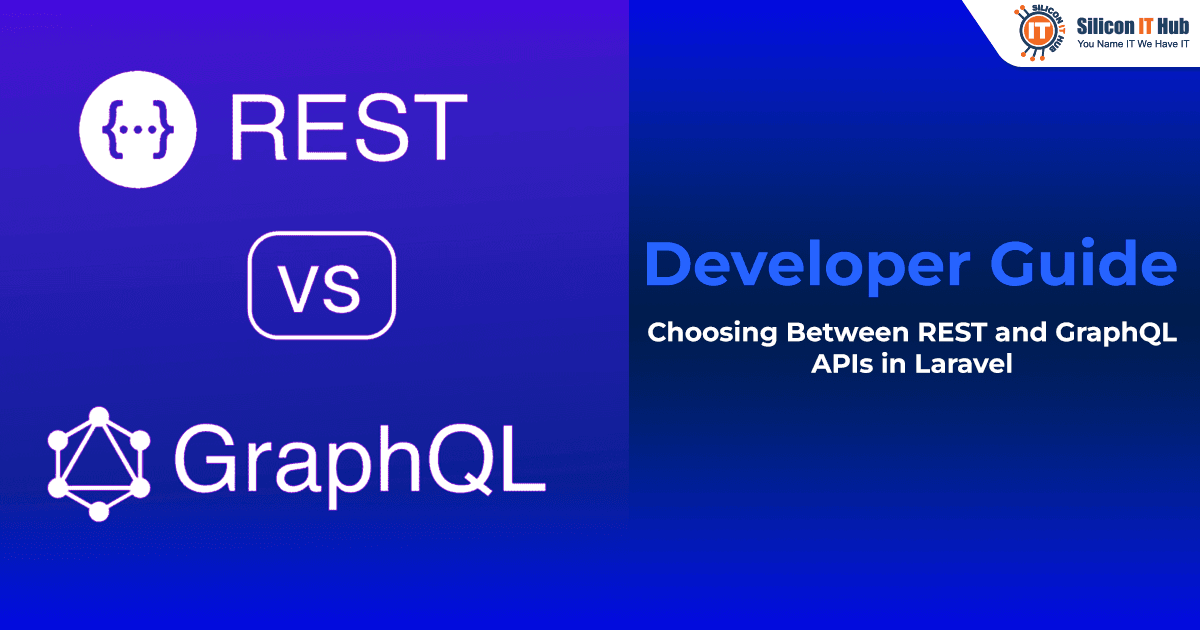
How to Choose Between REST and GraphQL in Laravel
Overview
Simplicity, standardization, and efficiency are some of the key characteristics necessary for web applications. RESTful APIs in Laravel can make it possible for modern business applications. However, if efficiency in data fetching and flexibility are all you need, GraphQL is the better choice. Simply put, the right choice for the API depends on the use case and data complexity, with frontend requirements.
This blog compares two Laravel APIs: REST and GraphQL. We will dig deeper into both these architectures and their real use cases. Before moving ahead, let’s find out the reason why this choice is necessary.
Why Choosing the Right API is Essential in Laravel
Let’s face it. If teams fail to choose the right architecture or build an API, they struggle to complete the project on time. As a Laravel web development company, we’ve seen delays in completing projects due to
- APIs returned too much or too little data
- Frontend teams kept requesting changes
- Performance issues appeared at scale
The right choice of API can help you get rid of these issues and complete the project on time without compromising on performance.
What are REST and GraphQL APIs?
Both RESTful and GraphQL APIs are the top APIs of Laravel. Let’s get their brief introduction before comparing them.
RESTful API
Representational State Transfer (REST) is a mature architectural style and one of the most popular approaches for APIs. It is a highly predictable and structured concept. According to an official report, nearly 82 percent of API consumers worldwide have adopted this approach since its introduction in 2000. It is a resource-based architecture and works like the following in Laravel API development:
/users → get users
/orders → get orders
/products/{id} → get specific product
This API is widely used in the Laravel development community.
GraphQL API
GraphQL is a query language where the client asks for exactly what it needs. Here is an example of this API-
{
user {
name
orders {
total
}
}
}
This API is useful for precise data fetching. Let’s go through the difference between them.
Real Difference between REST vs. GraphQL
Here is a quick table of comparison between REST vs. GraphQL.
| Factor | RESTful APIs | GraphQL APIs |
| Data Fetching | Foxed Responses | Flexible Queries |
| Endpoints | Multiple Endpoints | Single Endpoint |
| Performance | Can over-fetch | Optimized fetching |
| Learning Curve | Easy | Moderate |
| Caching | Strong (HTTP-based) | Complex |
| Best for | Simple CRUD apps | Complex, dynamic apps |
When it comes to customization, GraphQL is a preferred option. It is interesting to learn when to use REST and GraphQL.
When to Use REST and GraphQL
RESTful APIs in Laravel are useful for CRUD-heavy systems. They work best when data structures are stable, and changes in them are unlikely. Simply put, a straightforward application that follows predictable patterns can work well with RESTful APIs. It is beneficial for faster development, easier maintenance, and better performance of business applications. Applications like admin dashboards, CMS platforms, and ERP systems use REST for consistency.
On the other hand, GraphQL is useful when your business applications demand flexibility and efficiency in data fetching. GraphQL can assist companies in reducing unnecessary API calls. It is highly suitable for systems with complex data relationships and dynamic UX. SaaS platforms, marketplaces, and real-time dashboards work well with the support of GraphQL because this API offers more flexibility and adaptability.
How to Implement REST and GraphQL in Laravel
Implementing REST or GraphQL in Laravel starts with clarity and identification of business requirements. You can find whether you need fixed or flexible data, and the complexity of the data model. If simplicity and speed are your priorities, REST APIs can work wonders with Laravel controllers, API resources, and route-based endpoints. This approach ensures faster development, easier debugging, and a standardized structure
However, if the application needs flexibility, it is better to implement GraphQL using tools like the Lighthouse package. You can define schema, create resolvers, and connect your models. It is essential for enabling precise data fetching and reducing frontend dependency. Once your API is in place, it is better to focus on optimization.
You can use caching and pagination for developing RESTful APIs in Laravel. Techniques like query depth limiting and avoiding N+1 queries are necessary for implementing GraphQL. The final step is securing the API regardless of the approach. The Laravel web development company can do it by implementing authentication methods like JWT or OAuth, applying rate limiting, and validating inputs. This can ensure performance and protection at scale.
Real-Life Scenarios of REST and GraphQL
The selection of the most appropriate API depends on several factors, including product stage and complexity. If you own a startup and need speed, stability, etc., with quick deployment, then RESTful APIs in Laravel are the right choice.
If you scale into a SaaS platform with multiple touchpoints, like mobile apps and dashboards, or need to add evolving features, GraphQL is better. It has flexibility and efficiency in data fetching.
Apart from this, another noteworthy approach is a hybrid one. As per this approach, REST gives stable and predictable modules, whereas GraphQL gives dynamic, data-heavy components. This is a balanced strategy that many modern systems adopt to get the best of both worlds.
Looking to Build Robust Web Applications Using Laravel?
LET’S CONNECTCommon Mistakes to Avoid When Choosing REST and GraphQL
When it comes to implementing an API strategy, you should stay away from a few common mistakes. Many teams choose GraphQL because it is trending. They may not consider whether their application actually needs that level of flexibility. This leads to complexity. Similarly, some Laravel developers use this advanced architecture, which slows development.
Another critical mistake is ignoring caching strategies because it directly impacts both performance and scalability, especially in REST-based systems. Finally, it is necessary to align your API design with the frontend needs to avoid creating inefficiencies. Whether it is over-fetching data in REST or poorly structured queries in GraphQL, these inefficiencies can hamper performance. Therefore, it is essential to prioritize practicality over trends and design.
Concluding Remarks
REST and GraphQL are popular Laravel architectures. You need to select the best concept that aligns with the project’s needs and business objectives. REST works best when the application requires simplicity and speed. It is ideal for stable systems. GraphQL, on the other hand, is useful for flexible systems that can fetch dynamic data and offer high scalability. It is essential to choose the most suitable approach to gain its strategic advantage.
Silicon IT Hub is a renowned Laravel web development company. We build highly complex, user-friendly, and feature-rich web applications for modern businesses. Contact us to learn more about our Laravel development services.


 Have an Idea?Let’s Build It Together!

 B1-Ground Floor, Safal Profitaire, Corporate Road, Prahladnagar, Ahmedabad, Gujarat, India - 380015


 + 1 302 803 4919
 usa@siliconithub.com

