


How Low-Code and No-Code Platforms Transform Application Development
Introduction
Automation and digital transformation act as a backbone for the growth of modern businesses. However, traditional development cycles may bring hurdles in launching app solutions quickly due to their code-intensive nature. This challenge gives rise to low-code app development platforms and no-code development. Also known as LCNC, these concepts enable various teams to build functional apps quickly by using visual interfaces and prebuilt components.
These days, many companies integrate low-code app development platforms into their existing workflows to accelerate prototyping and achieve MVPs faster. In a highly competitive and fast-paced environment, both web and mobile app development domains can opt for no-code development or LCNC. This blog talks about the benefits and challenges of low-code/no-code development platforms. Let’s start with an overview of these platforms.
Overview- Low-Code and No-Code Development Platforms
Low-code app development platforms give a visual, drag-and-drop environment. It reduces the need for manual coding for faster application development. No-code development, on the other hand, empowers non-technical people, like business teams or project managers, to build functional apps without writing a single line of code. This makes app creation more accessible across different organizations.
Both low-code and no-code approaches accelerate delivery and are useful for various use cases, including workflow automation and internal tool development. However, the LCNC concept has some limitations in scalability and complex integrations. Businesses may prefer custom mobile app development to overcome these limitations.
Let’s dig deeper into some key reasons behind the increasing popularity of LCNC development platforms.
Why No-Code, Low-Code App Development Platforms Gain Popularity
As technology evolves, the low-code development platform market is expanding at a rapid pace. Businesses tend to embrace digital transformation through rapid application development processes, and the LCNC platform can make it possible by empowering non-technical users. This is a major reason the global low-code development platform market has been expanding continuously in recent years.
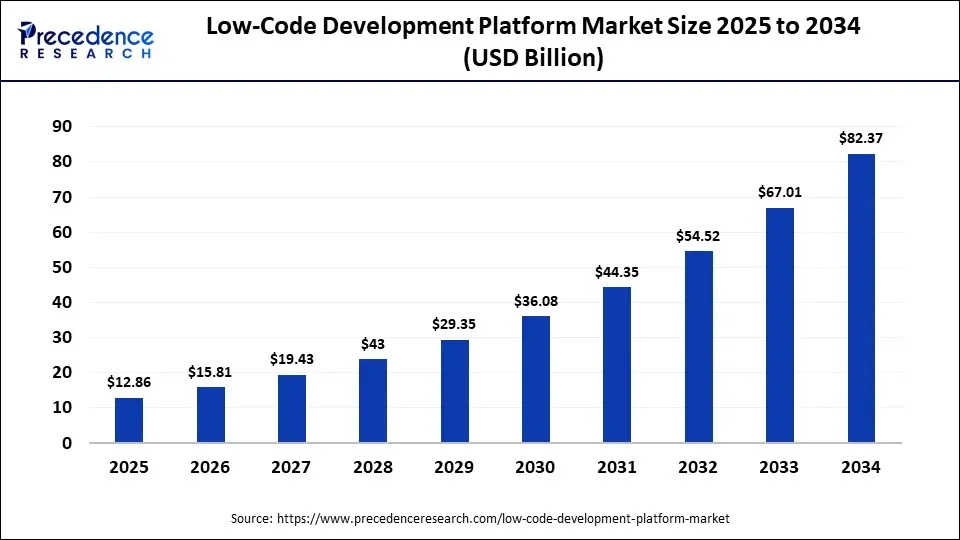
Precedence Research estimates that the low-code development platform market size will reach USD 82.37 billion by 2034. The following graph shows the steady growth of this platform’s market size with a CAGR of over 22 percent. Let’s go through all the possible reasons for the increasing popularity of no-code development and low-code platforms.
Source
LCNC platforms can reduce both the development time and cost significantly in modern mobile app development projects. They have user-friendly visual interfaces and reusable components that can keep up with web development trends as well. In other words, the LCNC platform offers speed, agility, and user-centered design in web and mobile applications alike.
Businesses can adopt these platforms to enable rapid prototyping and streamline automation in workflows. As these platforms empower teams to build app solutions in a relatively short time, they become a preferred choice for companies that look to innovate faster. Low-code and no-code development platforms offer the necessary efficiency and flexibility in making functional apps and MVPs for businesses.
Impact of LCNC on Traditional Web & Mobile App Development
Traditional web and mobile app development processes experience a significant impact from the rise of low-code and no-code platforms. A reputed mobile app development company builds solutions through visual interfaces, reusable components, and automated workflows by using LCNC tools. It enables development teams to allocate resources to handle more complex architectures, integrations, and optimization, ensuring quicker delivery.
Though these platforms can accelerate the development process, they cannot replace custom mobile app development completely. When it comes to building highly scalable systems, deep modification, and complete control over performance, it is better to opt for customization. LCNC tools can shift the development process from pure coding to a more strategic, solution-driven approach.
Simply put, LCNC facilitates developers, designers, and business teams to collaborate to build prototypes rapidly and deliver user-friendly apps without lengthy development cycles.
Benefits of LCNC for Businesses and Development Teams
As digital transformation takes place rapidly, businesses need tools that support innovation. Here, low-code and no-code platforms offer a practical way to traditional software development. As per this approach, teams can develop solutions faster and with far less technical complexity.
Faster Go-to-Market
The most significant advantage of low-code and no-code platforms is a faster go-to-market using low-code app development platforms. By using the drag-and-drop components and visual interfaces, teams can build applications quickly. Because of this accelerated development process, businesses can roll out new ideas, test prototypes, and launch solutions much faster than with traditional coding. It also helps them to adapt quickly to evolving market conditions.
Reduced Developer Dependency
Another important benefit is the decreased reliance on full-stack developers, who are often scarcely available and expensive to hire. With low-code, no-code tools, even non-technical users, such as business analysts or operations teams, can make functional apps without having to write complex code. This reduces developers' workload but also enables and broadens participation in the organization's digital transformation efforts.
Better Collaboration Between Teams
These platforms improve collaboration between business and IT teams. Since the app development process remains accessible, both technical and non-technical teams can understand the structure and logic. On one hand, the business team can communicate clearly about their requirements. On the other hand, the IT team can monitor the process to maintain compliance, performance, and security. This results in solutions that match business needs.
Alignment with Development Trends
Low-code and no-code solutions align with web development trends. The digital world leverages reusable components, automation, and faster release cycles, all of which LCNC platforms naturally support. These tools help organizations walk with modern development practices and maintain an agile digital strategy.
Although low-code and no-code platforms offer many advantages, they have their fair share of challenges. Let us check them out.
Challenges and Limitations of LCNC to Consider
Although LCNC platforms are useful, they do not always provide the perfect solution. Therefore, organizations must consider their limitations before awarding the project.
Security and Scalability Risks
Security and scalability concerns in no-code development are major concerns. Since these platforms depend on their built-in modules, businesses must ensure that their chosen supplier provides robust security standards and meets industry standards. They must also grow with the business, barring performance issues.
Vendor Lock-In and Customization Constraints
Unlike custom mobile app development, vendor lock-in with limited customization capabilities is present in LCNC platforms. After a business creates an app on a specific LCNC platform, it may be difficult to switch systems or add advanced custom features. This can limit flexibility as the business expands.
Not for Enterprise-Grade Applications
Finally, LCNC tools have limited capability for making complex enterprise-level apps. They work well for simple or mid-level applications, but large-scale or highly specialized projects often require traditional development for full control, performance, and customization options.
Though businesses can build apps faster with low-code and no-code platforms, they must also keep in mind their limitations. By balancing the benefits with the challenges, businesses can make smarter digital strategies.
Want to get a customized application with timely delivery and excellent performance?
LET’S CONNECTHow LCNC and Traditional App Development Co-Exist in Future
Low-code and no-code development platforms will continue to grow with evolving technologies. However, they will not replace traditional coding; instead, we can expect that both approaches will coexist. On the one hand, LCNC tools will speed up routine tasks, and on the other hand, traditional development will build highly customized systems. Developers will play a critical role in maintaining this balance.
Moreover, we will see the prevalence of hybrid models. There, mobile app development will get the speed of automation with the flexibility of custom code. Developers will use LCNC platforms for rapid UI creation and workflow automation while switching to code manually for integrating complex features. This will bring a robust blend of efficiency, scalability, security, and control. AI-assisted development processes and faster release cycles will make coding more strategic in the future.
Role of Silicon IT Hub in LCNC Application Development
Silicon IT Hub is one of the top custom software development service providers. It has in-house teams of experienced developers who can combine advances in emerging technologies with LCNC platforms to build highly customized and secure applications. Whether it is developing enterprise-level SaaS products or using an agile approach for a tailored app, we deliver solutions as quickly as possible.
A global corporate clientele gets the feature-rich app with elegant UI/UX design, timely delivery, and seamless performance in high-quality solutions.
Concluding Remarks
The rise of the low-code, no-code concept brings evolution in web and mobile app development. It results in faster delivery, stronger collaboration, and greater accessibility across different teams. Though LCNC platforms simplify and accelerate the process, they cannot replace the depth of custom mobile app development. We can expect the combination of LCNC and traditional app development in the future. These platforms will shape emerging mobile and web development trends in the digital-first world to keep businesses competitive in the digital era.


 Have an Idea?Let’s Build It Together!


 B1-Ground Floor, Safal Profitaire, Corporate Road, Prahladnagar, Ahmedabad, Gujarat, India - 380015


 + 1 302 803 4919
 usa@siliconithub.com

